

Read the first chapter
The whole of chapter one, free. About 12 min. Turn the pages with the arrows, your keyboard, or a swipe.
Chapter 1
The First Skipped Morning
The train doors on Platform 9 sigh shut like they’re bored of being opened, and for one clean breath Garnet City sounds ordinary - steel-on-steel, the dry whisper of fluorescent lights, the distant scrape of wheels settling into rhythm. Mara Voss steps onto the platform with her lunch still warm in her bag and the taste of yesterday’s coffee drying at the back of her throat. Her phone ticks toward 8:12. Her watch insists it’s 8:11. The discrepancy feels like nothing. The platform boards feel like wood pretending to be stone. Reality holds its shape just long enough for her to believe she’s late in the normal way.
Then the overhead speakers crackle, and the voice that follows isn’t delayed. It’s wrong - like it’s been spliced from another morning.
“ - Platform nine. Arriving now. Please stand clear.”
Mara’s stomach tightens. She looks at the digital board above the tracks. The letters flicker from 8:14 to 8:13 to 8:14 again, as if the display can’t remember which future it belongs to. A man in a work jacket laughs at something on his phone, but his laugh trails off mid-syllable and restarts a half-second later, perfectly synchronized to the movement of his mouth. The air temperature drops by a degree, then snaps back. Her skin prickles along her wrists, the way it does right before static shocks.
She tells herself it’s the station. Old wiring. Bad day. Her mind reaches for an explanation the way her hand reaches for the pole when the crowd sways. She plants her fingers on cold metal and feels a vibration under the platform - subsonic, like the station is chewing on a thought.
“Hey,” the woman beside her says, frowning at the board. “Did that just - ”
Mara doesn’t wait to hear the rest. Her commute has become a ritual she hates and trusts: catch the 7:48, transfer at Civic Loop, get to the lab before the day’s first meeting. She wants this morning to behave because if it doesn’t, she can’t fix what’s wrong. Her objective is simple and ugly: confirm what happened to her timeline on the train. If the skip comes again, she needs proof it isn’t just panic wearing her thoughts like a mask.
She checks her phone. The lock screen shows her - same jacket, same hair, same smear of mascara she wiped off last night. Except the notification timestamp reads 7:46. She’d left home at 7:52. She’d watched the news headline about the river flood while waiting for the bus. She’d wiped her thumb over the screen and felt the glass grit. She’d - she can’t reach the memory cleanly, like a finger pushing through water that resists.
The train arrives anyway, or the idea of a train does. A rush of air slaps her face, heavy with brake dust and hot rubber. The cars slide in with a smoothness that doesn’t match the stutter in the board. Mara squeezes through bodies that feel a fraction of a second out of sync - clothes brushing her arms, someone’s elbow nudging her rib. She boards because standing still feels like agreeing to be erased.
Inside, the overhead lights hum at a pitch that makes her teeth ache. The carriage is packed with commuters whose faces look familiar in the way strangers on a daily line become familiar: the same posture, the same tired eyes, the same scarf tucked too tightly at the throat. Mara grips the rail. Her bag strap digs into her shoulder. She inhales and catches detergent and old metal and the faint sweetness of someone’s mint gum.
The train lurches forward, then stops.
It doesn’t stop like it’s braking. It stops like the world has been paused and the motion is a setting that’s been toggled. The windows show a blur of platform tiles sliding past, then holding perfectly still, like a video frame stuck on a screenshot. A child’s sneaker hovers midair in the aisle. A woman’s lipstick-stained smile remains caught at the edge of her cheek.
Mara’s mouth goes dry. She can feel her own heartbeat in her wrists. The rail under her palm vibrates harder, and she realizes the vibration isn’t coming from the train. It’s coming from her - her bones, her blood, the way her body is trying to stay aligned with a reality that keeps skipping frames.
“Are you seeing this?” she hears herself say, but she doesn’t remember choosing the words. A man across the aisle stares at her. His eyes are wide, not with fear exactly, but with recognition that’s too fast.
“I thought it was just me,” he whispers.
Before Mara can ask what he means, the carriage jolts forward as if it’s been given back to the timeline. The stuck sneaker drops. The child laughs at the exact moment her mouth should have been laughing. The overhead lights flicker once - twice - and then steady.
Mara swallows. She turns her head toward the doors as if the platform can tell her what she missed.
The train doors open.
They open on Platform 9 again.
But the details are different. The poster above the timetable - some glossy ad for a luxury watch - has changed to a faded public service notice about fare evasion. The clock on the far wall reads 8:15 instead of 8:11, and the red second hand on the analog dial has no business moving so smoothly when everything else stutters. Mara feels it in her gut: she got what she came for, the confirmation she needed, and it’s worse than she feared. The timeline isn’t just off. It’s being rewritten in place, like someone keeps splicing new clips onto the same reel.
She pushes out into the station. The crowd pours around her, and for a second she loses the man she spoke to. The air is colder here, now. The platform smells like damp concrete after a leak, though she’s sure it was dry when she arrived.
“Excuse me.” Mara grabs the nearest station worker, a uniformed attendant with a radio clipped to his shoulder. His name tag reads LUCAS. His eyes track her hand, then her face. “Was there a delay? Did the 7:48 - did it - ”
Lucas’s expression pinches. “Ma’am, what time is it?”
“8:12,” Mara says automatically.
Lucas glances up at the board. The digits flicker, fail to settle, then land on 8:13. “It’s 8:13.”
“No,” Mara says, and the word comes out sharper than she intends. She forces her voice down. “I was on the train. I - there was a jump. I need to know what happened between stops.”
Lucas’s radio crackles. He freezes like he’s listening to something only he can hear. “You shouldn’t - ” he begins.
Mara leans in. “What?”
His gaze flicks to her wrist. Her sleeve rides up just enough to show the faintest shadow of ink there - something she hasn’t noticed until now, because it wasn’t there a minute ago. The skin looks normal, but the ink-dark line is like a bruise made of language.
Lucas’s mouth opens and closes. The radio spits static. He backs away half a step, and suddenly Mara can’t tell if he’s afraid of her or afraid on her behalf.
“Platform nine,” the overhead speaker says again, too loud now. “Arriving now. Please stand clear.”
Mara looks past Lucas to the tracks.
A train should be arriving. Instead, the tunnel mouth looks too deep, too dark, like it’s been hollowed out. The air coming from the tunnel smells metallic and faintly medicinal. It doesn’t belong to transit. It belongs to hospitals and old vents and places where time feels thick.
Her phone buzzes in her pocket. She pulls it out with hands that don’t feel quite attached to her body. A new notification slides onto the screen: a single line of text, no app icon, no sender.
TOMORROW.
Then, beneath it, an image loads: a close-up of her own wrist, taken from an angle she’s never stood in. The ink mark appears crisp in the photo. It’s smeared like it’s been dragged by a thumb. And it reads like a label.
09/17.
Mara’s breath catches. Tomorrow’s date. Her brain scrambles for the calendar and lands on it with sick certainty: 09/17 is the day she has a meeting she can’t miss. The day she has to present the prototype. The day her life is supposed to lock into place.
She looks at her wrist again.
The ink is there in real time now, darker than the shadow under her sleeve, as if it’s been waiting for her to notice it. A thin line of letters follows the date - something like a code, partially smudged, partially legible. Her skin tingles around it, the way it tingles when you’ve been holding a live wire too long.
“This isn’t possible,” she whispers.
Lucas’s voice cuts in, low. “Don’t look at it too long.”
Mara snaps her eyes up. “What do you mean?”
He swallows. “When it first starts, it’s like a tape that - ” He stops, jaw tightening. “It’s like a broken video. Frames skip. You think you’re staying with it, but it’s skipping you.”
The words hit Mara like cold water. Broken video. She’s heard that phrase before - some half-remembered conversation on the train, maybe. Or in a dream. Or in one of the versions of her morning that no longer has a clean edge.
The station announcement cuts off mid-sentence. For a heartbeat, the entire platform goes silent except for the hum of lights and the soft hiss of air vents. Then the speakers come back with a different voice, calm and clipped, like someone reading from a script they’ve rehearsed.
“Stand clear. Do not board. Repeat: do not board.”
Mara’s mouth goes dry again. Her feet are already turning toward the train doors, because her body believes in momentum. She forces herself to stop, heel grinding against tile. She looks at the tunnel. The darkness within it ripples as if it’s a screen trying to render depth.
Someone in the crowd bumps her shoulder. “What’s happening?” a woman asks, eyes darting between Mara and Lucas. “I thought the train - ”
The man from earlier pushes through the crowd toward Mara, breath ragged. “You said you saw it too,” he tells her, voice rising. “You said you were on the train - ”
“I am,” Mara says. “But it keeps changing. I need to confirm - ”
The man’s expression twists. “Confirm? Mara, you can’t - ”
He says her name like he’s known it longer than she has. Mara freezes. “How do you know my - ”
His eyes flick to her wrist. The ink mark seems to darken under his gaze. He flinches like her skin is hot.
“I heard it,” he blurts. “On the call. The voicemail. It rewound. It told me to find you. It told me - ” He sucks in air through his teeth. “It told me not to let you look away.”
Mara’s pulse stutters. “Voicemail?”
Lucas’s radio crackles again, and this time it doesn’t sound like static. It sounds like someone breathing into a microphone from the other side of a wall.
Mara turns her phone in her hand. There’s a new voicemail icon on her screen. No number displayed. The timestamp reads tomorrow at 8:12.
The message plays before she taps anything.
Her own voice fills the station.
“ - Mara,” her voice says, tight and urgent, layered with a faint echo like it’s been recorded and then played back through time. “If you’re hearing this, it means the skip landed wrong again. Don’t chase the minutes like they’re gone. Ch - ”
The audio distorts. The words buckle, then rewind a fraction of a second and speak again, but clearer, more deliberate, like a hand has corrected the tape.
“Don’t chase the minutes like they’re gone. Chase the place they’re being stitched from.”
Mara’s skin prickles. She can hear her own breathing in the recording, the same shallow rhythm she’s fighting right now. The message continues.
“On Platform nine there’s a corridor that shouldn’t exist. Door cycles you into the next version. You’ll need a physical clue that’s labeled with tomorrow’s date. If the ink is on your wrist, you’re already too close to the edit. Keep moving anyway.”
The voicemail ends with a click that sounds like a camera shutter.
Mara stares at her phone, mind trying to reject the impossible. She looks up at Lucas. “That voicemail - was it - ”
Lucas’s face is pale under the fluorescent lights. “We’ve been getting it,” he says. “Not from the future exactly. From… you. From the version that survived the skip.”
The man beside her shakes his head hard, as if he can shake the words loose. “I played it and it rewound. It changed what I heard. It changed me.”
Mara’s thoughts sprint toward the goal she came in with - confirm what happened to her timeline on the train. She got confirmation, but it came dressed as a threat. The cost is already on her skin. Tomorrow’s date. A label. A countdown she can’t see.
The overhead board flickers again, and for a moment the digits settle into a pattern that makes no sense until it does: 8:11. Then 8:12. Then 8:11 again, like a loop trying to trap her.
Mara’s wrist burns - just a line of sensation, localized, not pain exactly. She looks down and sees the ink’s edge ripple, the way wet paint ripples when someone breathes too close.
She makes a decision that feels like jumping off a moving stair. She shoves her phone into her pocket and grabs Lucas’s sleeve. His uniform fabric is rough, warm from his body. “Where’s the corridor?”
Lucas jerks back. “There isn’t - ”
“There is,” Mara snaps, and the certainty in her voice surprises her. She’s not guessing anymore. She’s following a path her future self already walked. “Door that cycles. Service corridor. I need it.”
Lucas’s eyes dart toward the far end of Platform 9 where a wall segment looks slightly cleaner than the rest, like it’s been repainted over old damage. There’s a narrow access hatch there, half-hidden behind an emergency map. Mara hasn’t noticed it until now because the station keeps rewriting what she’s supposed to see.
“Don’t touch the handle,” Lucas says quickly. “It’s - ”
Mara’s fingers already find the edge of the hidden door. Cold metal. No handle at first glance. Then, as her thumb presses the seam, the surface shifts, and a handle slides into place like it’s been waiting for contact.
The station speakers burst into static.
“ - Platform nine…” the voice starts, then breaks, then restitches itself into something else. “ - Corridor access - ”
Mara yanks her hand back. The ink on her wrist smears, leaving a darker drag across her skin. The date sharpens, the numbers becoming more legible as if the station is staining her with the future’s ink.
She inhales through her teeth, forces her grip to stay steady, and wraps her hand around the handle.
The metal is warmer than it should be, like it’s been held moments ago by someone with nervous sweat. Mara twists.
The door opens inward, not into a hallway, but into the same station - Platform 9 - except the posters are different, the crowd’s posture is different, and the air feels one degree warmer. The train’s windows reflect a different overhead light. It’s like stepping into a recording of her morning that’s been edited a little too hard.
Mara leans forward anyway.
As her foot crosses the threshold, the board behind her flickers one last time. 8:12. 8:11. 8:12 again.
Her wrist ink flares hot, then settles.
She’s late-for-work again, by the clock that won’t stop lying - but the date on her skin insists she’s also already tomorrow, caught between frames.
End of chapter one. 40 more chapters and about 112,622 words in the full book.
Swipe or use the arrows to turn the page


What's inside: 41 chapters
- 1. The First Skipped Morning
- 2. A Door That Opens Twice
- 3. The Voice Recording That Rewinds
- 4. Security Guards Who Don’t Remember
- 5. The Name That Doesn’t Match
- 6. Halley Lab’s Locked Basement
- 7. The Vent Camera Shows Her
- 8. A Stairwell That Changes Floors
- 9. Her Belongings From Other Days
- 10. The Cut That Splits Her Choice
- 11. Oren Halley’s Live Message
- 12. Riverline Museum’s Missing Wing
- 13. Lysa Noren Remembers the Wrong Mara
- 14. Restoration Lab Locks Behind Her
- 15. The Frame Map That Lies
- 16. A Journal Written in Her Hand
- 17. The Choice to Stop Reading
- 18. Lysa’s Bruise Opens a Door
- 19. Paused Screens Start Moving
- 20. The Museum Clock Skips Three
- 21. Mara Chooses to Lie
- 22. The Tunnel Floods With Frames
- 23. Searching for Lysa’s Last Frame
- 24. Tamsin Kade’s Exit That Isn’t
- 25. The Headlines That Name Her Killer
- 26. Oren Halley’s Trapdoor Announcement
- 27. The Control Room’s Broken Logic
- 28. The Viewer Chamber Behind Glass
- 29. Static Writes Over the Floor
- 30. No One Left to Watch
- 31. The Second Voicemail’s Hidden Key
- 32. The Museum Door Opens for Once
- 33. Mara Breaks the Viewer First
- 34. Oren’s Message Changes to Apology
- 35. The Final Cut That Holds
- 36. Lysa Steps Out of Static
- 37. The Museum Remembers Her Differently
- 38. Mara Refuses Another Cut
- 39. Oren Halley Leaves a Last Frame
- 40. Reality Skips Once, Then Stops
- 41. The Last Frame
About this book
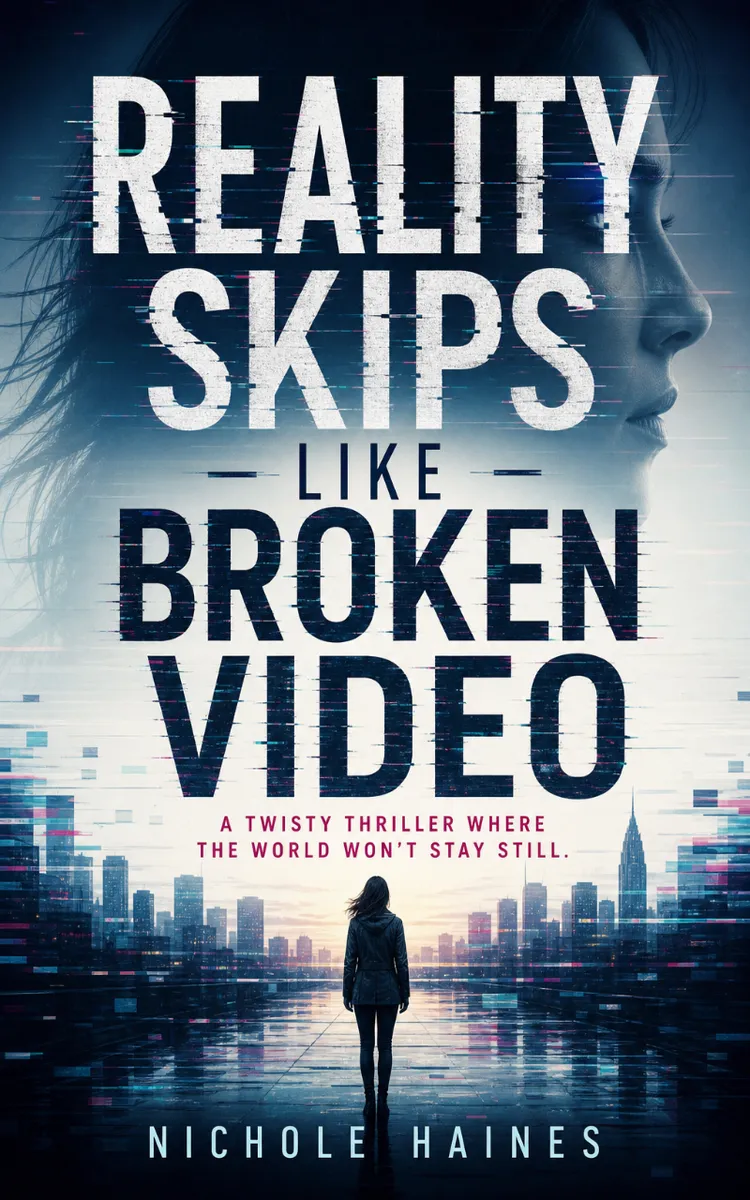
"Reality Skips Like Broken Video" is a fiction book by Nichole Haines with 41 chapters and approximately 112,622 words. A mind-bending story where reality glitches and rewrites itself.
This book was created using Inkfluence AI, an AI-powered book generation platform that helps authors write, design, and publish complete books. It was made with the AI Novel Writer.
Frequently Asked Questions
What is "Reality Skips Like Broken Video" about?
A mind-bending story where reality glitches and rewrites itself
How many chapters are in "Reality Skips Like Broken Video"?
The book contains 41 chapters and approximately 112,622 words. Topics covered include The First Skipped Morning, A Door That Opens Twice, The Voice Recording That Rewinds, Security Guards Who Don’t Remember, and more.
Who wrote "Reality Skips Like Broken Video"?
This book was written by Nichole Haines and created using Inkfluence AI, an AI book generation platform that helps authors write, design, and publish books.
How can I create a similar fiction book?
You can create your own fiction book using Inkfluence AI. Describe your idea, choose your style, and the AI writes the full book for you. It's free to start.
Write your own fiction book with AI
Describe your idea and Inkfluence writes the whole thing. Free to start.
Start writingCreated with Inkfluence AI


