
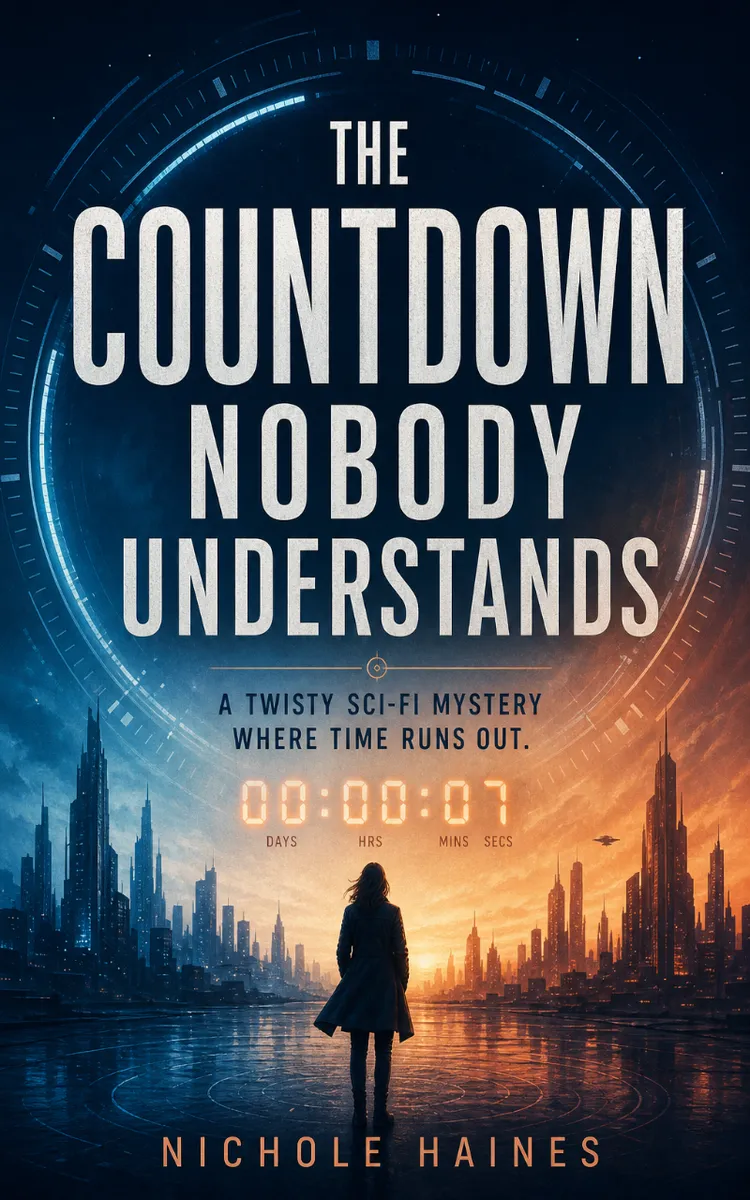

Read the first chapter
The whole of chapter one, free. About 13 min. Turn the pages with the arrows, your keyboard, or a swipe.
Chapter 1
The Countdown on Every Screen
The first tick showed up on the Meridian Square holo like a bruise spreading under skin - white numbers blooming across the public feed, then snapping into place with the clipped certainty of a system that didn’t ask permission. Mara stood at the edge of the fountain plaza, collar turned up against the late-evening chill, and watched it count down with the kind of rhythm that made her teeth ache.
9:59:58.
The city’s screens weren’t supposed to agree on anything. Meridian Square was a patchwork of municipal ads, transit alerts, and emergency crawl-lines that rarely matched each other even when the power grid stuttered. Tonight the grid was fine. Tonight the screens were synchronized. The tick brightened on the billboard over the transit hub, on the glass panels embedded in storefronts, on the public comm kiosks that usually served as a dead-end for lost pets and parking disputes. Even the mirrored panel inside the fountain’s rim - where tourists liked to take pictures - caught the countdown and held it like it belonged there.
Mara tried to look away. She couldn’t. The numbers didn’t just sit on the screens; they felt like they were sitting on her.
“Meridian Municipal,” she muttered, voice rough in the cold. “No one’s authorized this.”
Her wrist implant buzzed once, then again, as if it had opinions. A notification slid across her peripheral HUD: PUBLIC BROADCAST ACTIVE. SOURCE: VERIFIED. ROUTE: ALL DISTRICTS. She didn’t have to read it twice to know it was lying. Verified by what? Route from where? The system never used all districts for anything except storms and elections.
She stepped closer to the fountain, the slick stone under her boots sending a faint vibration up through her soles. The countdown ticked down and the air around the plaza tightened, like the city was holding a breath it didn’t know it had.
Mara needed the source. Not the feed. Not the overlay. The origin signal. The person behind it. If she could find the point where the broadcast was born, she could cut it - before the next tick became a disaster.
She broke into a jog, weaving past a knot of people who had started to gather without realizing they were doing it. A teenager in a puffy jacket filmed the fountain rim. An older man muttered prayers under his breath. A couple argued in tight, angry whispers, their faces lit by the same cold glow.
“Stop that,” Mara snapped at the teenager, because anger was sometimes faster than thinking. “Where are you streaming from?”
The kid blinked, still staring at his screen. “It’s just - everywhere. It came on. My mom’s got it too.”
“Mom’s got it,” Mara repeated, already moving. “Does she live in another district?”
He hesitated. “South Meridian. Yeah.”
“Then it’s not a local glitch,” Mara said, and heard the note of certainty in her own voice even as her pulse kicked harder. She didn’t wait for agreement. She scanned the plaza for the comm kiosk with the oldest hardware - those were usually the easiest to talk to when the newer systems refused.
The kiosk stood beneath a billboard frame, its faceplate scuffed from years of hands smearing on it. Mara slammed her palm against the panel, felt the faint give of the touch surface, and flicked her wrist implant into a silent mode meant for dead channels and maintenance ports.
The kiosk didn’t respond. It displayed the countdown instead, bold and unforgiving.
9:59:31.
Mara leaned closer, eyes narrowing. The numbers weren’t just in the UI layer. They were in the kiosk’s core display feed - the same way emergency alerts loaded, the same way a lockdown notification took over. That meant the system didn’t see it as an overlay. It saw it as truth.
“You’re not listening,” she said to the panel, though she knew better than to expect a machine to care. Her implant tried again, sending a handshake request into whatever network it could reach.
A soft tone sounded from the kiosk speaker - too cheerful for the situation - and then a new message replaced the timer: AUTHORIZED VIEW ONLY. ACCESS DENIED.
Denial, but with manners. Someone wanted her to know she’d been blocked.
Behind her, the crowd shifted, a low murmur rising like static. Mara turned her head just enough to catch it.
The billboard over the transit hub had changed. The countdown still ran, but now a thin line of text had appeared beneath the numbers, not in any municipal template she recognized - no logo, no department stamp.
TARGET ACQUISITION PHASE: BEGINNING.
Mara felt her stomach drop. Target acquisition. As if people were objects being gathered.
“Hey!” a woman shouted, pointing at her own wrist. “Mine says something different!”
Mara spun toward the woman. Her face was pale, and her eyes were too wide for the cold. The woman held her wrist up like she was showing proof of a crime.
On the woman’s HUD, letters crawled across the display: BEHAVIORAL COHERENCE INITIATED. DO NOT RESIST.
Mara’s implant flashed the same words a half-second later - then stuttered, like it had hit a wall.
That was the obstacle she hadn’t planned for: the countdown wasn’t merely warning the city. It was already rewriting it.
Mara forced her breathing steady. “What did you click?”
“I didn’t click anything!” the woman snapped. “I was walking. Then - then it was just on. Like someone pulled a plug and the whole world turned to a new channel.”
Like someone pulled a plug.
Mara’s mind sprinted, chasing the shape of the signal. If it was universal, then the source wasn’t a local transmitter. It had to be routed through major backbone infrastructure - fiber nodes, satellite relays, or something stranger that could reach every public screen at once.
And if it was selecting targets, then the broadcast wasn’t blind. It had a filter. A list. A method.
She looked back at the kiosk and saw her reflection in the scuffed panel glass - her own face tense, the countdown lighting her cheeks like a countdown lamp. Her reflection flickered as if the display was trying to re-render her.
Mara yanked her hand away and started running again, this time toward the municipal comm center.
The route through downtown Meridian Square was familiar in the way nightmares were familiar. She cut between parked delivery drones and a line of stalled streetcars, the air full of engine whine and the sharp scent of overheated electronics. Speakers in storefronts blared the countdown at different volumes, the same numbers spoken by different systems in different voices, all agreeing on the time left.
9:58:40.
A man in a suit stepped into her path, eyes locked on his phone with a blank, fixed expression. His lips moved silently, like he was reading something he couldn’t understand.
“Excuse me,” Mara said, pushing around him. His arm jerked - not to block her, but to adjust his posture, aligning himself toward the nearest screen as if the display had become a compass needle.
Mara’s skin went cold.
She’d seen that kind of micro-behavior before - when a system nudged people without making it obvious. Advertising personalization did it. Security cameras did it when they triggered attention. But this was too clean, too coordinated. People weren’t just being informed. They were being steered.
Mara’s wrist implant tried to overlay a new command: COMPLIANCE REQUEST. She ripped the signal down with a hard gesture, sealing her implant’s external access for a moment. The HUD dimmed, then returned, as if offended.
She needed physical access. She needed to get into the municipal comm network and find the origin packet before it became permanent.
The comm center sat three blocks north, a squat concrete building that always smelled like wet paper and burnt dust. Mara used the service entrance because the front doors would be locked under whatever pretense the city had chosen to call “public safety” tonight. The service door was supposed to require a badge, but every system had a seam if you knew where to press.
She reached into her jacket for the thin maintenance key - scraped, notched, and made to fit the kind of lock that thought it was too old to be beaten. Her fingers shook once, then steadied as adrenaline gave them purpose.
The lock accepted the key with a soft click.
Inside, the hallway lights were on and flickering, the hum of power supplies vibrating through the soles of her boots. Somewhere behind a door, a printer chattered like it was trying to escape.
Mara sprinted down the corridor, passing doors marked with routing codes and contractor names. The countdown followed her. Not on screens - there weren’t many in the comm center - but in the little indicators on equipment panels: status lights turning green and red in exact timing with the universal tick. The building itself was synching.
9:57:12.
Mara shoved open the first locked door she found that looked like it led to a comm relay room. The handle resisted for a heartbeat, then gave way with a metallic sigh. Inside, shelves stacked with equipment stretched into darkness, cables bundled like veins, and a single console glowed.
A sealed comms room. She’d found it.
“Okay,” she whispered, even though no one was there to hear. Her implant lit up with a map of the network layout as best it could, then froze when it hit the sealed layer. ACCESS REQUIRES AUTHORITY.
A voice crackled from a speaker above the console. “Unauthorized access detected. Please remain where you are.”
Mara froze with her hand still on the door frame. Her eyes swept the room. No visible cameras, but that didn’t mean anything. Meridian comm centers had eyes everywhere.
“Who are you?” Mara called, forcing her voice to stay even.
“Official broadcast support,” the speaker said. “You are not authorized for interference.”
Interference. Like she was the problem.
Mara stepped closer to the console and brought up her implant’s low-level diagnostic view. Her fingers moved fast, trying to coax the system into showing her what it was routing, what it had subscribed to, what it was listening for.
The console refused. Then it offered her something else.
A timeline bar appeared on the screen, crisp and clean, labeled with phases she hadn’t seen publicly. The countdown numbers were there too, embedded into the system’s schedule like a heartbeat.
But the timing didn’t match the public tick she’d watched outside. Her eyes darted between the console’s timer and the faint reflection of the plaza screens visible through the hallway window.
On the console: 9:57:12. Outside, through the glass: 9:56:03.
The difference widened, seconds stretching like rubber.
“No,” Mara breathed. “That’s not possible.”
She leaned in until her forehead nearly touched the cold glass of the monitor. “Your timeline is wrong.”
The speaker crackled again. “Your observations are inconsistent due to local display buffering. Universal synchronization is confirmed.”
Universal synchronization. That’s what she’d assumed. That’s what she’d feared.
But the mismatch meant something else too: the broadcast wasn’t just running everywhere. It was running on different clocks depending on where you stood, or what system you were connected to - meaning someone could control the next phase by targeting specific nodes.
Mara’s implant vibrated hard, trying to reassert control. In the corner of her HUD, a message blinked:
PHASE CHANGE IMMINENT. TARGET LIST UPDATED.
The room’s lights dimmed by a fraction, then brightened again, like the building flinched.
Mara looked toward the door, toward the hallway, toward the possibility that the phase change was already happening in Meridian Square without her.
She could keep fighting the console, try to break the sealed layer, chase the source. Or she could act on what she had: the evidence that the next phase wasn’t just a warning. It was selecting.
Mara yanked her wrist implant’s access override. The screen flickered as she forced the sealed comms room to accept a maintenance handshake - something she’d only ever used on dead channels and backup servers. The console screamed a soft alarm. Not loud. Not public. Just enough to alert whoever was monitoring the inside.
A new line of text scrolled across the console, unprompted, as if the system was showing her something it wanted her to see:
RELAY ROUTE: ACTIVE. NODE: MERIDIAN SQUARE - DOWNTOWN. SIGNAL ORIGIN: UNKNOWN. SOURCE ID: NULL.
Null. Like the broadcast had no author, no device, no signature.
Mara’s throat tightened. She’d been chasing a person and found an absence.
Outside the comm center, through the window, the plaza screens screamed white numbers again. The tick continued. It didn’t stop for her.
9:55:44.
Then the console added one more line, the letters coming slower, heavier, like the system was choosing each word.
TARGETS: SELECTED INDIVIDUALS WITH BEHAVIORAL INCOHERENCE DETECTED. PHASE 2: DIRECTIVE BROADCAST.
Behavioral incoherence. That phrase made Mara’s skin crawl. It was the language of surveillance systems when they declared someone a risk without proof.
It meant the countdown wasn’t going to hit everyone the same way. It was going to hit people like the woman outside - people who had resisted, even for a second. People whose machines had flagged them as misaligned.
Mara thought of the teenager filming the fountain. The suit man walking like a puppet. The older man praying. She didn’t know who was on the target list, but she already felt the edges of the world tightening around her like a net.
Her implant buzzed again, harder this time, and the HUD painted a warning triangle on her vision.
LOCAL COMPLIANCE REQUEST TRIGGERED.
Mara didn’t wait. She turned from the console, grabbed the power panel behind it, and ripped the maintenance cover off with a jerk. The smell of hot dust and ionized metal filled her nose. Wires glowed faintly under the panel’s insulation.
She didn’t know if she could kill the relay without killing herself in the process. But she knew she couldn’t do nothing.
She jammed her hand into the bundle and found the line the diagnostics had been refusing to show. The sealed comms room didn’t want to grant her access, but it still needed power to pretend it was protected.
A sharp sound cut through the room - like a lock finally admitting defeat. The console flickered, then went black for a heartbeat.
In that heartbeat, the speaker above her hissed with a new voice, not the polite official tone. This one sounded strained, clipped, like someone reading from a script that had begun to break.
“Interference confirmed. Phase 2 will proceed without local relay.”
Without local relay. Which meant she could cut this room and still watch the countdown continue everywhere. Which meant the source wasn’t here. It had already moved on.
Mara’s fingers tightened around the wire she’d yanked free. She could feel the tug of the network through the building’s vibration, distant and enormous.
The console flared back to life, and the timeline bar updated instantly, jumping forward like a predator shifting its weight.
9:55:11.
The speaker’s strained voice returned. “Your actions are logged under target behavior.”
Target behavior.
Mara swallowed hard, taste of metal flooding her mouth as if her body had decided to prepare for impact. Outside, she heard a sudden surge of noise - people shouting, screens spiking brightness, the plaza’s fountain lights going harsh white.
She didn’t need to see it to know the next phase had started in Meridian Square already. The universal countdown could be synchronized globally, but Phase 2 could be tailored locally, and she had just made herself a variable.
She backed toward the door, keeping her hand on the exposed wire, and hit the release latch with her elbow. The room alarm didn’t blare. It didn’t need to. The system didn’t warn; it responded.
Footsteps thundered in the hallway - fast, coordinated. Not maintenance staff. Too many. Too sure.
Mara slipped out anyway, letting the door swing shut behind her. She sprinted for the service corridor, the comm center’s cold air biting her lungs, and forced her implant to map exits even while it tried to overlay compliance requests across her vision.
9:54:38.
Down the hall, a screen embedded in a wall - meant for internal status - flashed a new message in the same clean font as the earlier one.
DIRECTIVE BROADCAST LIVE. TARGET INDIVIDUALS WILL EXPERIENCE BEHAVIORAL COHERENCE ADJUSTMENT.
Mara glanced at it and felt something inside her pitch sideways. The countdown wasn’t just counting time. It was counting people into a category. Into a shape.
She ducked behind a maintenance cart, shoved her shoulder into the door at the corridor’s end, and forced it open with a grunt. Beyond it was the street, Meridian Square’s open cold air rushing in, carrying the sound of the plaza like a distant riot.
The screens out there were brighter now, and the countdown numbers had changed their style - less like a universal clock, more like a personal countdown.
Mara found her own wrist display had updated. The text crawled across it with the same calm certainty.
PHASE 2 COHERENCE ACTIVE. TARGET CONFIRMED.
She stared at it, breath fogging in front of her face, while the plaza’s lights snapped into a new pattern - white strobes timed to the tick.
She’d wanted to stop the broadcast. She’d wanted the source.
Instead she’d forced the system to look at her, and the countdown - synchronized worldwide - was already moving into its first selective sweep.
The universal numbers continued to fall, but somewhere in the city, the countdown started to feel like it had her name on it.
End of chapter one. 40 more chapters and about 110,605 words in the full book.
Swipe or use the arrows to turn the page


What's inside: 41 chapters
- 1. The Countdown on Every Screen
- 2. The Emergency Broadcast That Lied
- 3. Following the Signal’s Hidden Relay
- 4. The Kestrel Gate Door That Won’t Open
- 5. A Stranger’s Name in Mara’s Head
- 6. The Response Team’s Countdown Test
- 7. The Map That Changes When Read
- 8. Elior’s Archive Locked by Blood
- 9. The Wafer That Plays Her Past
- 10. A Missing Sentence in the Code
- 11. Dr. Rook’s Proof of Impossibility
- 12. The Lab’s Gravity Rewrites Itself
- 13. Choosing to Save Dr. Rook
- 14. The Phase Jump That Splits Time
- 15. Elior’s Recruitment Cycle Explained
- 16. The Clinic Ward Where She Wakes
- 17. The Nurse Who Knows Her Smile
- 18. The Maintenance Tunnel Under Ward 9B
- 19. The Empty Device That Still Records
- 20. Midpoint: The Countdown Chooses Mara
- 21. The Component That Opens a Mind Door
- 22. Elior’s Body Isn’t Dead
- 23. The Search for Elior’s Missing Body
- 24. The Storage Lab That Smells Like Ozone
- 25. Mara’s Deal With the Retrieval Captain
- 26. The Partial Delivery That Backfires
- 27. Decoding the Countdown’s Real Purpose
- 28. Kestrel Gate Within Turns Hostile
- 29. The Retrieval Team Breaches the Archive
- 30. Mara Loses the Key-Memory
- 31. The Endpoint Address in Her Wrist
- 32. Sable Station’s Platform Without Exits
- 33. Mara Chooses to Become the Answer
- 34. The Ritual That Reverses the Transfer
- 35. The Countdown Hits Zero, Then Screams
- 36. Elior’s Voice Returns With a Warning
- 37. Kestrel Gate Reappears in the City
- 38. The Consent Broadcast That Almost Replaces Her
- 39. Captain Yara Kline’s Final Offer
- 40. Ending the Echo Without Losing Elior
- 41. The Last Relay
About this book
"The Countdown Nobody Understands" is a fiction book by Nichole Haines with 41 chapters and approximately 110,605 words. A science fiction story driven by an unexplained countdown.
This book was created using Inkfluence AI, an AI-powered book generation platform that helps authors write, design, and publish complete books. It was made with the AI Novel Writer.
Frequently Asked Questions
What is "The Countdown Nobody Understands" about?
A science fiction story driven by an unexplained countdown
How many chapters are in "The Countdown Nobody Understands"?
The book contains 41 chapters and approximately 110,605 words. Topics covered include The Countdown on Every Screen, The Emergency Broadcast That Lied, Following the Signal’s Hidden Relay, The Kestrel Gate Door That Won’t Open, and more.
Who wrote "The Countdown Nobody Understands"?
This book was written by Nichole Haines and created using Inkfluence AI, an AI book generation platform that helps authors write, design, and publish books.
How can I create a similar fiction book?
You can create your own fiction book using Inkfluence AI. Describe your idea, choose your style, and the AI writes the full book for you. It's free to start.
Write your own fiction book with AI
Describe your idea and Inkfluence writes the whole thing. Free to start.
Start writingCreated with Inkfluence AI


