
Read the first chapter
The whole of chapter one, free. About 11 min. Turn the pages with the arrows, your keyboard, or a swipe.
Chapter 1
A Name Hidden in Plain Sight
A Name Hidden in Plain Sight: The Survival-Trace Map of Amaruca Ta Mari
A museum drawer can hold a whole life, and still tell you almost nothing. The paradox is that the quieter the evidence - one fragment of paint, one carved edge, one misread sign - the more power it has to reshape a history once you notice what it’s not saying. Amaruca Ta Mari sits inside that paradox: a name that survives, but only by surviving wrong turns, worn surfaces, and the gaps between what people thought they saw and what was actually there.
I’m not chasing a grand revelation carved in stone. Instead, I’m tracing how a name stays alive when the rest of its story goes missing. This chapter follows what I call the Survival-Trace Map - the pattern of where Amaruca Ta Mari can be found again and again across fragments, copies, and records, even when the original context has vanished.
You don’t have to be an Egyptologist to feel the pull here. Many of the best discoveries begin the way most of our daily knowledge does: with something incomplete. A label that doesn’t match the object. A note written in a hurry. A sign that looks like one thing until you learn the alphabet of its mistakes.
So what does it mean when a name doesn’t just survive - when it survives in the cracks?
Mapping Where a Name Survives When Everything Else Disappears
Hassan is 34, and he works as a museum registrar - the person who makes sure objects are where they’re supposed to be, that their paperwork matches the physical world, and that the meaning people attach to them isn’t drifting away from the facts. His day-to-day life is mostly careful routine: checking incoming crates, logging conditions, confirming accession numbers, and reconciling old records with new photographs. In a museum, the past rarely arrives intact. It arrives as a set of things that must be aligned - object to label, label to catalog, catalog to history.
That’s why Hassan’s mind keeps snagging on a specific kind of problem: the mismatch between what’s written and what’s visible. A registrar learns quickly that “documented” doesn’t always mean “correct.” Old catalog descriptions can be based on partial views, different lighting, or a sign that looked obvious in one hand and confusing in another. Sometimes the physical object is stable; the interpretation is what has been moving all along.
Now put that museum reality into the Valley of the Kings, where the evidence is famously stubborn and famously damaged. In that landscape, names survive through a chain of conditions: carving quality, erosion, reuse of blocks, the survival of one wall face but not the other, and the human habit of copying what could be seen. A name can be knocked out of its original sentence and still remain readable in a different place - like a word you recognize even after the rest of the sentence has fallen apart.
The Survival-Trace Map is built for that exact kind of evidence. It doesn’t ask, “Do we have the full inscription?” It asks, “Where does the name reappear, and in what form?” The map is less about certainty and more about continuity - tracking whether Amaruca Ta Mari shows up as the same set of signs, a close variant, a partial sequence, or a name that’s been reshaped by later hands. You can’t treat those appearances as equal. The point is to see the path the name takes through human attention.
This is where fragmentary evidence becomes more than a limitation. In Egypt’s funerary world, names are supposed to be durable, because they’re part of remembrance. But durability is not the same thing as preservation. A name can be intended to last for eternity and still end up as a few stubborn strokes on a block that later gets moved, reused, or buried. When that happens, the survival of a name becomes a record of survival itself - of which surfaces endured, which contexts were lost, and which people happened to notice the right marks at the right time.
Hassan would call it chain-of-custody thinking. The registrar’s instinct matters because the Survival-Trace Map is, in a way, a chain-of-meaning. It looks at how Amaruca Ta Mari travels from one record to the next: carved trace, later copy, catalog note, photograph, and then the interpretive decision that turns a damaged sign into a readable name. The name’s survival isn’t just physical. It’s bureaucratic, visual, and interpretive - layered like sediment.
The Fragile Logic of “What the Sign Looks Like”
In the Valley of the Kings, the smallest differences can matter. Egyptian writing isn’t just letters; it’s a system of sign shapes that can be worn down, re-chiseled, or misread when only a fragment survives. One reason a name like Amaruca Ta Mari can persist is that some combinations of signs have enough structure to remain recognizable even when the surrounding text is gone. Another reason is that later researchers often work from earlier drawings and photographs, which means the evidence can become self-reinforcing: if a name was recorded once as readable, later people may look for the same readability.
This is where the deep dive gets unexpectedly technical without becoming a textbook. When you’re trying to follow a name through fragmented evidence, you have to understand how people actually reconstruct texts. Egyptologists commonly rely on hand-drawn copies, squeezes (historically used to capture relief), and photography, and each method has its own distortions. A drawing can smooth out uncertainty. A photograph can flatten three-dimensional carving into two-dimensional shadow. Even lighting temperature - how a surface is lit - changes whether a worn edge reads as a stroke or a crack.
The Valley adds another layer: blocks and inscriptions aren’t always found in their original positions. In many sites, stone has been moved, reused, or broken. That means a name can survive on a block while its original placement - what it was attached to, what scene it belonged to - vanishes. The name stays, but the sentence evaporates. You end up with a situation where the name is true as a name and uncertain as a context.
A single example of how this can happen is the way sign reading can shift with better imaging. Modern imaging techniques - like high-resolution digital photography and reflectance approaches - can reveal carving edges that earlier observers missed. Even without naming specific machines, the principle is familiar: new visibility can create new confidence, or it can undo an older assumption. That’s not a failure of scholarship; it’s how evidence works when it’s made of stone and time.
So why does the name Amaruca Ta Mari survive through these conditions? Part of it is the stubbornness of carved form: even when everything else is gone, the strokes that compose a name may remain. Part of it is the human behavior of record-keeping: once someone writes “Amaruca Ta Mari” into a catalog or a drawing, that written form becomes a reference point. Later scholars often start from reference points, because the alternative is to treat every fragment as brand new and unknowable.
The Survival-Trace Map formalizes that behavior without pretending it’s perfect. It marks the difference between a direct reappearance of the name and an indirect echo. A direct reappearance is when the same sequence is visible again on another surviving fragment. An indirect echo is when a name appears in secondary records - catalogs, notes, lists - without the physical fragment being present in the same way. Both are “traces,” but they carry different weights.
That’s the logic that changes the story: you stop treating the name as a single fact and start treating it as a sequence of survivals. Every survival tells you something about what the Valley held onto and what humans chose to notice. The name becomes a navigational tool through uncertainty.
The Counterintuitive Twist: Survival Can Rewrite Meaning
Here’s the surprise: sometimes the survival of a name doesn’t just preserve history - it changes the history people think they have. When a name like Amaruca Ta Mari persists through fragmentary traces, it can cause later researchers to build connections that were never possible from the original, lost context. In other words, the name’s endurance can become a scaffold for interpretation.
That matters because it flips the usual assumption. We often treat fragmentary evidence as “less information,” full stop. But in practice, fragments don’t merely reduce certainty; they can increase plausible storylines. A name that survives in more than one place can make researchers suspect a relationship - family, role, ritual function - even when the missing context would have prevented that suspicion. The name’s survival becomes a new kind of evidence, one that points toward patterns of presence rather than patterns of reading.
This is why Survival-Trace Map thinking is so different from simply asking, “Is the name authentic?” The question becomes, “What does the pattern of survival encourage people to believe?” That’s not cynical. It’s honest. Human interpretation is always part of the evidence chain, and a durable name can lure interpretation in specific directions.
If you don’t track how Amaruca Ta Mari appears - whether as a clearly carved sequence on multiple pieces, or as a repeated transcription from earlier records - you risk treating the interpretive scaffold as if it were carved directly into stone. The counterintuitive part is that the name’s survival can create the appearance of a coherent story even when the underlying context is fragmentary. The Valley doesn’t just preserve; it selects.
This is also why a museum registrar like Hassan matters to the investigation. In a museum, the difference between “the object says X” and “the paperwork says X” can be the difference between a correct history and a beautiful mistake. The same principle applies to the Valley, except the paperwork is drawings, photographs, and catalog entries made across generations. Amaruca Ta Mari survives not only because stone endured, but because records did - and because those records guided later eyes.
So the survival of the name is not only a window into the past. It’s also a mirror held up to the present: a reminder that evidence is never just found. It’s assembled.
Hassan’s Archive and the Valley’s Missing Context
Hassan tells a story that sounds small until you realize how it echoes the Valley. Years ago, a collection he helped register included an object whose catalog description had been copied from an older inventory. The object itself was there - same dimensions, same material - but a detail in the description didn’t match the physical surface under the museum’s lights. It turned out the older description had been based on a partial view, and the later copy had treated that partial view as gospel.
The fix wasn’t dramatic. Hassan didn’t “discover” a new truth out of nowhere. He compared the record against the object, checked the old photographs, and traced where the mistake entered the chain. The history didn’t change because the object became different. The history changed because the interpretation pipeline had been corrected.
That’s the mindset that helps when the Valley offers only fragments of Amaruca Ta Mari. If the name appears through multiple traces, Hassan’s approach suggests a way to treat those traces: ask where the name is directly visible, where it’s being repeated from earlier records, and where the interpretation may have been smoothed over by time. When context is missing, the chain matters.
On paper, the Valley’s evidence can look like a set of neat references. In reality, it’s a patchwork of surviving surfaces and human documentation. A registrar’s habit of checking accession records maps cleanly onto the Survival-Trace Map: trace the name through each stage where meaning could shift. That includes the moment a sign is read, the moment a drawing is made, and the moment a catalog decides how to write what was seen.
Even the physical setting shapes the survival. In the Valley, a fragment that survives long enough to be recorded may have been exposed to different conditions than the rest of its original structure. That means Amaruca Ta Mari might persist in places where other parts of the inscription didn’t. The name’s survival then becomes a kind of geography - not just where the name was carved, but where it was vulnerable, where it was protected, and where later researchers happened to capture it.
Hassan doesn’t talk like an Egyptologist; he talks like someone who has learned the cost of trusting a secondhand description. And that’s exactly what this investigation needs. When Amaruca Ta Mari survives through fragmentary evidence, the investigation isn’t only about ancient stone. It’s about the modern handling of that stone in drawings, catalogs, storage, and attention.
The human story is that names live twice: once in the ancient world that carved them, and once in the modern world that keeps re-encountering them. Each time the name is recorded, it has to survive a new filter - lighting, handwriting, catalog conventions, and the reader’s expectation.
That’s why the Valley’s missing context doesn’t stay missing. It reappears as a question, and the name is the thread that keeps tugging.
What Amaruca Ta Mari’s Survival Says About How History Gets Built
There’s a quiet lesson buried in this kind of evidence: history isn’t only what happened. It’s also what endured long enough to be noticed, then noticed correctly, then written down in a form that can be found again. A name like Amaruca Ta Mari surviving through fragments doesn’t just preserve identity - it reveals the pathways of human attention across time.
When evidence is incomplete, societies don’t sit in uncertainty. They create meaning from what they can reach. Sometimes that meaning is faithful. Sometimes it’s a guess that becomes tradition because the guess was recorded. The Survival-Trace Map forces you to see that difference - not by demanding certainty where it can’t exist, but by showing how certainty is manufactured from survival.
And maybe that’s the most unsettling part: the same thing that keeps a name alive can also steer the story it’s used to tell. The Valley of the Kings preserves fragments, yes - but it also preserves the human habit of building coherence out of whatever still shows up.
If a name survives in the cracks, are we reading the past - or the way we keep learning how to read it?
End of chapter one. 7 more chapters in the full book.
Swipe or use the arrows to turn the page


What's inside: 8 chapters
- 1. A Name Hidden in Plain Sight
- 2. The Valley’s Unwritten Power Routes
- 3. Why Titles Lie: Reading Royal Labels
- 4. Toolmarks as a Fingerprint of Presence
- 5. The Missing Years Problem
- 6. Women’s Roles in the Valley’s Machinery
- 7. The Name-Variant Maze
- 8. What “Hidden History” Really Means
About this book
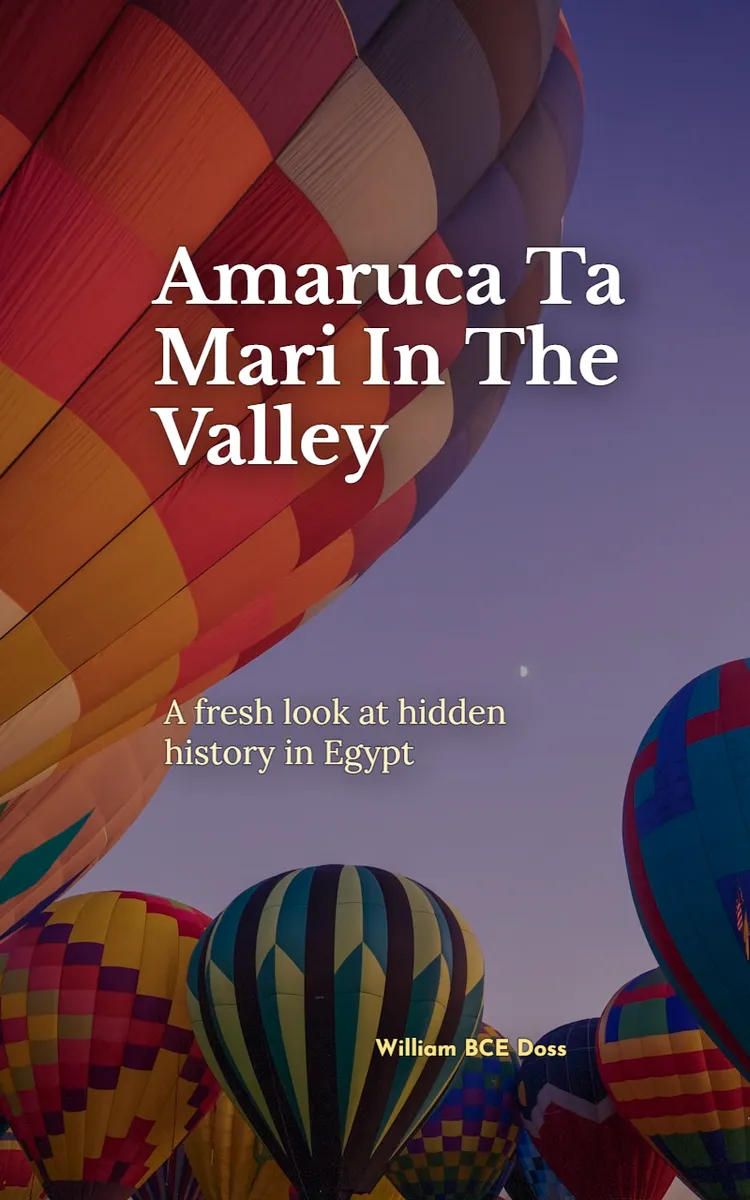
"Amaruca Ta Mari In The Valley" is a curiosity book by William BCE Doss with 8 chapters and approximately 15,472 words. Investigating a lesser-known figure in Egypt’s Valley of the Kings.
This book was created using Inkfluence AI, an AI-powered book generation platform that helps authors write, design, and publish complete books.
Frequently Asked Questions
What is "Amaruca Ta Mari In The Valley" about?
Investigating a lesser-known figure in Egypt’s Valley of the Kings
How many chapters are in "Amaruca Ta Mari In The Valley"?
The book contains 8 chapters and approximately 15,472 words. Topics covered include A Name Hidden in Plain Sight, The Valley’s Unwritten Power Routes, Why Titles Lie: Reading Royal Labels, Toolmarks as a Fingerprint of Presence, and more.
Who wrote "Amaruca Ta Mari In The Valley"?
This book was written by William BCE Doss and created using Inkfluence AI, an AI book generation platform that helps authors write, design, and publish books.
Write your own curiosity book with AI
Describe your idea and Inkfluence writes the whole thing. Free to start.
Start writingCreated with Inkfluence AI


