
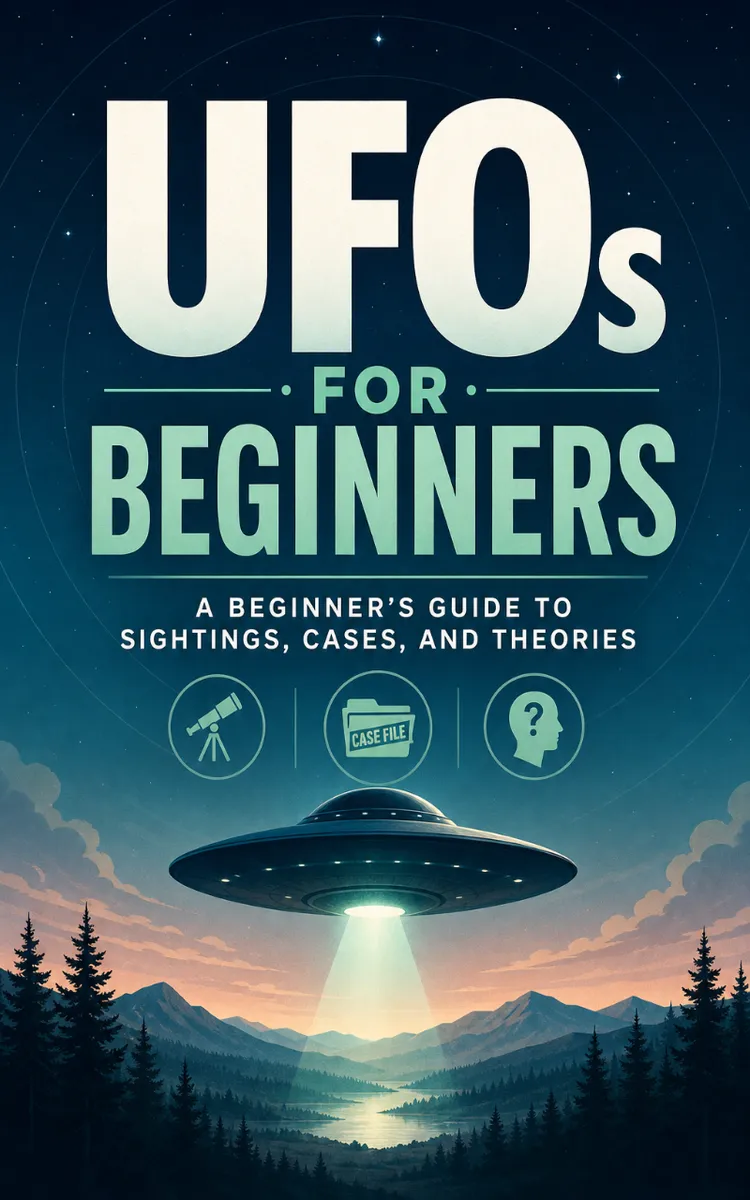
UFOs For Beginners
Created with Inkfluence AI
Beginner overview of UFO/UAP history, types, cases, and theories
Table of Contents
- 1. Why UFOs Feel Personal
- 2. Roswell’s 1947 Shockwave
- 3. Four Alien Archetypes People Name
- 4. The Same Names, Different Species
- 5. Saucers, Triangles, Cigar, Spheres
- 6. The Cases Everyone Brings Up
- 7. The Researchers Who Refused to Drop It
- 8. Bible Stories as UFO Footnotes
- 9. Vatican Whispers and Colorado’s Fast Track
- 10. Abductions, Hybrids, and the Implant Question
- 11. Congress, Declassification, and Lazar’s Tale
- 12. What Disclosure Would Break-and Fix
- 13. UFO Watching Without the Noise
Preview: Why UFOs Feel Personal
A short excerpt from “Why UFOs Feel Personal”. The full book contains 13 chapters and 26,143 words.
The Beginner’s Lens Filter
At least one thing about UFOs and UAPs is genuinely paradoxical: the more personal the report feels, the harder it becomes to treat it like a simple “mystery object.” People don’t just say, “I saw something strange.” They say it felt close, meaningful, even disturbing - like the sky noticed them back.
So why does that happen? This chapter gives you a way to look at UFO and UAP stories without surrendering your skepticism. We’ll define the terms in plain English, then dig into why people report them in the first place - how culture, technology, and human perception can all steer the same experience in different directions. Along the way, we’ll use one concrete anchor: Nina, 19, a community college student, who finds herself trying to make sense of a late-night claim from a friend - and realizes that “what happened” is only half the puzzle.
What if the most reliable part of a UFO story is not the object at all, but the way the witness’s brain tries to place it?
The Opening
The words UFO and UAP are often used like they mean the same thing, but they don’t. UFO stands for “Unidentified Flying Object,” a phrase that grew popular in the mid-20th century and sticks in everyday speech. UAP, “Unidentified Anomalous Phenomena,” is the newer term used by the U.S. government to describe sightings of things that can’t be easily explained with the information available. The shift isn’t just cosmetic - it nudges attention away from “flying objects” as an automatic assumption and toward “anomalous phenomena,” which could include objects, motion, sensor effects, or other behaviors that don’t fit ordinary explanations.
That sounds tidy, but real reports are messy. A person might describe a solid craft with windows, another might say it was a cluster of lights, and a third might insist it was silent and soundless in a way they couldn’t explain. Some accounts come with photographs or radar data; many don’t. Even when the description sounds vivid, the question remains: what exactly made the witness label it “unidentified” in the first place?
Nina’s problem begins with a familiar kind of story. A classmate tells her that a few months ago, while walking home, they saw a bright object move against the stars in a way that didn’t match any plane schedule or weather pattern they knew. The classmate insists it wasn’t a drone. They talk about the colors, the speed, the sudden change in direction - details that sound specific enough to be true, and emotional enough to be hard to dismiss. Nina listens the way many newcomers do: she’s curious, but she’s also aware that “curious” can slip into “convinced” faster than she expects.
That’s where the Beginner’s Lens Filter comes in - not as a gimmick, but as a mental habit. When you hear a UFO or UAP story, you’re not just asking, “Was it a spacecraft?” You’re also asking, “What information did the witness have at the time, what parts of the scene were missing, and what kind of explanation would fit the facts they actually observed?” The goal isn’t to mock the witness. It’s to separate the experience from the conclusion as carefully as you can.
One reason this matters is that the sky is full of things that can fool you. Bright planets, satellites, aircraft with particular lighting angles, distant searchlights, balloons, and even certain weather conditions can all produce “impossible-feeling” motion or color. When people add stress, darkness, time distortion, and a brain trying to make sense quickly, the result can be a confident story that still points to something ordinary.
The beginner trap is treating confidence as evidence. The Beginner’s Lens Filter treats confidence as a starting point - like the first clue at the edge of a bigger investigation.
The Deep Dive
To understand why UFO and UAP reports feel personal, you have to look at how human perception works in low-information situations. Nighttime is one of them. Low light reduces detail, especially depth cues. Your brain leans on pattern-matching: it tries to interpret motion, brightness, and distance using what it has learned from daytime life. If something moves in a way that doesn’t match your expectations - stopping too suddenly, changing direction too sharply, or appearing to “hover” while you can’t judge distance - your mind may fill the gap with something dramatic.
Then there’s the modern layer: technology. People now carry phones with high-resolution cameras, but those cameras don’t behave like human eyes. They can struggle with exposure settings, motion blur, and automatic focus. A bright light can bloom into a blob. A moving object can turn into streaks that look “structured” even when the original scene wasn’t. Meanwhile, people also have access to a constant stream of images - movies, documentaries, social media clips, and urban legends - that supply ready-made templates for what a “real” UFO looks like.
...
About this book
"UFOs For Beginners" is a curiosity book by Anonymous with 13 chapters and approximately 26,143 words. Beginner overview of UFO/UAP history, types, cases, and theories.
This book was created using Inkfluence AI, an AI-powered book generation platform that helps authors write, design, and publish complete books.
Frequently Asked Questions
What is "UFOs For Beginners" about?
Beginner overview of UFO/UAP history, types, cases, and theories
How many chapters are in "UFOs For Beginners"?
The book contains 13 chapters and approximately 26,143 words. Topics covered include Why UFOs Feel Personal, Roswell’s 1947 Shockwave, Four Alien Archetypes People Name, The Same Names, Different Species, and more.
Who wrote "UFOs For Beginners"?
This book was written by Anonymous and created using Inkfluence AI, an AI book generation platform that helps authors write, design, and publish books.
Write your own curiosity book with AI
Describe your idea and Inkfluence writes the whole thing. Free to start.
Start writingCreated with Inkfluence AI


