
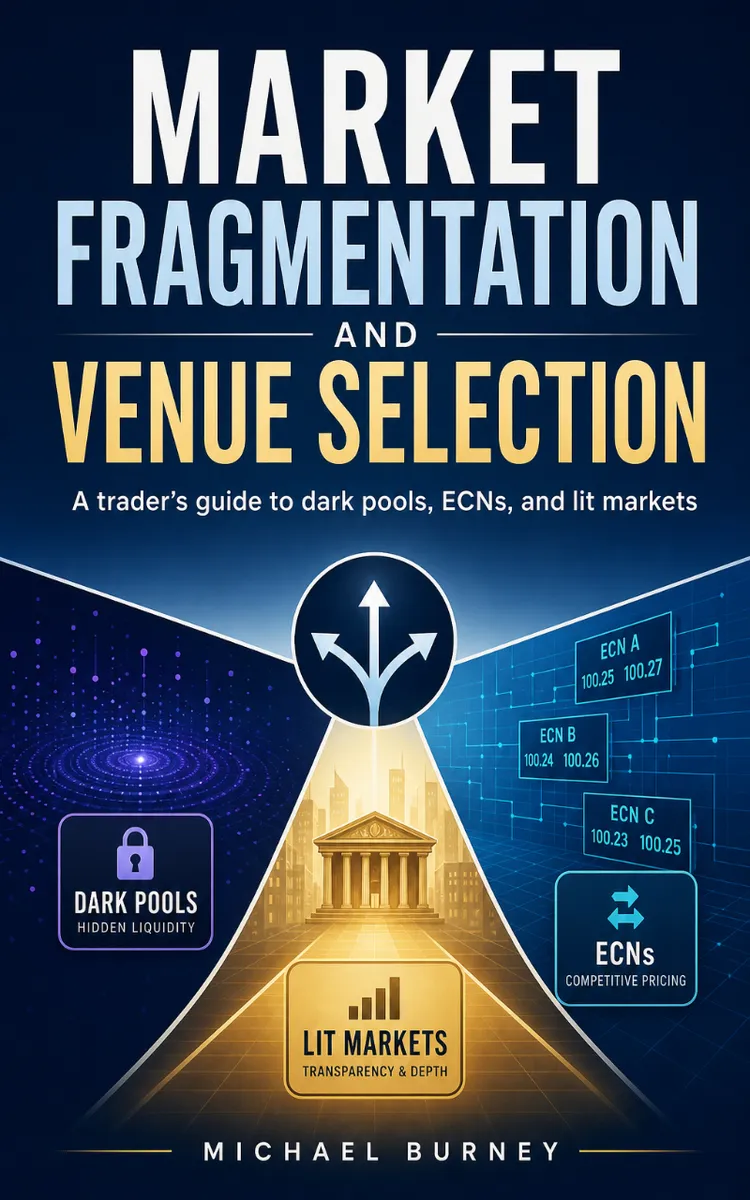
Market Fragmentation And Venue Selection
Created with Inkfluence AI
Trading venue selection across dark pools, ECNs, and lit markets
Table of Contents
- 1. Market Microstructure and Fragmentation
- 2. Reading Order Book Signals by Venue
- 3. Dark Pool Selection for Block Orders
- 4. ECN Routing and Maker-Taker Optimization
- 5. Lit Market Execution for Price Discovery
- 6. Smart Order Routing with Execution Constraints
- 7. Measuring Venue Performance with TCA
- 8. Adapting to Regime Shifts and Microstructure Traps
Preview: Market Microstructure and Fragmentation
A short excerpt from “Market Microstructure and Fragmentation”. The full book contains 8 chapters and 17,179 words.
The order book can look “full” and still betray you. You’ve probably seen it: you place a limit order that should cross with room to spare, and it sits while the market runs away. Or you hit the bid for a clean fill and later realize the fill came from a thin patch that collapses when more size arrives. Fragmented liquidity across dark pools, ECNs (Electronic Communication Networks), and lit venues creates exactly this kind of mismatch between what you see and what you actually trade.
This chapter gives you a working mental model for how fragmentation changes three things that matter on every ticket: your spread (the difference between the best bid and best ask), your fill quality (how close your executed price lands to the decision price), and your execution risk (the chance you miss the trade, get worse prices than expected, or move the market while you trade). After you read it, you’ll be able to map a ticker’s venue-by-venue behavior into a simple execution plan, rather than guessing based on the “best bid and offer” you see on your screen.
You’ll also learn to measure whether the venue you picked actually delivered, using the same inputs you used to place the order: quoted prices, trade prints, and your order’s own timestamps. That turns venue selection from a belief into a feedback loop.
Why This Matters: how fragmentation hits spreads, fills, and execution risk
Fragmentation means liquidity sits in multiple places, each with its own rules for disclosure, matching, and queue behavior. Lit venues show the book and trade prints openly. Dark pools hide some or all of their resting interest until a trade happens. ECNs sit in between: they publish quotes and trades, but their internal routing and matching rules can still shape your realized price.
The practical result shows up in your execution math. Your “spread” is not one number; it’s a collection of micro-spreads across venues. The best displayed bid might belong to a thin lit queue, while deeper size sits elsewhere - often in a dark pool where you don’t see it until you either post a midpoint order or you get matched by another party’s order. When you route only to the lit top of book, you can pay for that invisibility through worse fill quality during volatility spikes.
Fills suffer because fragmentation creates timing risk. Even if the displayed best offer looks stable, other venues can pull liquidity or reprioritize it when volatility rises. A marketable order that would have crossed cleanly in a consolidated book can now face pockets of thin liquidity at the moment it arrives. That’s not a “news” problem; it’s a venue interaction problem.
Execution risk also changes in a way that’s easy to underestimate: your trade doesn’t just interact with the visible book. It interacts with hidden queues, midpoint mechanics, and routing rules that determine which venue takes your order when multiple venues show “available” liquidity. If you don’t account for that, you can end up paying spread to enter the trade and then suffering additional slippage to finish it.
A simple way to see this: when you buy, you care about where the next shares come from after your first fill. In a fragmented world, those next shares might come from a different venue than your first fill, with different queue depth and different resiliency. That’s the difference between “I got filled” and “I got the price I modeled.”
How It Works: the Venue-Impact Map for spreads, fills, and execution risk
You need a tool that forces you to connect venue behavior to execution outcomes. Use the Venue-Impact Map: a one-page way to classify what each venue contributes to your specific order type and urgency, then choose routing and order style based on that map. You’ll build it from observed behavior (quotes and prints) and then stress-test it with a small “what if” using your own order size.
To make it concrete, Elena, 34, a buy-side portfolio manager, trades a basket of mid-cap names during the first and last hour when liquidity fragments and volatility jumps. She runs her execution with a simple rule: she never assumes the lit top of book represents the whole market. Instead, she builds a Venue-Impact Map for each ticker and updates it when regime changes.
Use these steps to build and apply the map:
1. Pick your execution target and decision price
- Decide what “good” means for your order. For most buys, you’ll anchor to the midpoint of the best bid and best ask at decision time (when you send the order) or to the best ask if you must cross immediately. Record that decision price and the time you sent the order.
2. Segment the venues you actually can route to
- List the venue set your broker can access for that ticker: lit exchanges (displayed), dark pools (hidden), and ECN-style venues (displayed but with their own matching). You do not need every venue in the universe; you need the ones you can route to today.
3....
About this book
"Market Fragmentation And Venue Selection" is a finance book by Michael Burney with 8 chapters and approximately 17,179 words. Trading venue selection across dark pools, ECNs, and lit markets.
This book was created using Inkfluence AI, an AI-powered book generation platform that helps authors write, design, and publish complete books. It was made with the AI Ebook Generator.
Frequently Asked Questions
What is "Market Fragmentation And Venue Selection" about?
Trading venue selection across dark pools, ECNs, and lit markets
How many chapters are in "Market Fragmentation And Venue Selection"?
The book contains 8 chapters and approximately 17,179 words. Topics covered include Market Microstructure and Fragmentation, Reading Order Book Signals by Venue, Dark Pool Selection for Block Orders, ECN Routing and Maker-Taker Optimization, and more.
Who wrote "Market Fragmentation And Venue Selection"?
This book was written by Michael Burney and created using Inkfluence AI, an AI book generation platform that helps authors write, design, and publish books.
How can I create a similar finance book?
You can create your own finance book using Inkfluence AI. Describe your idea, choose your style, and the AI writes the full book for you. It's free to start.
Write your own finance book with AI
Describe your idea and Inkfluence writes the whole thing. Free to start.
Start writingCreated with Inkfluence AI


