
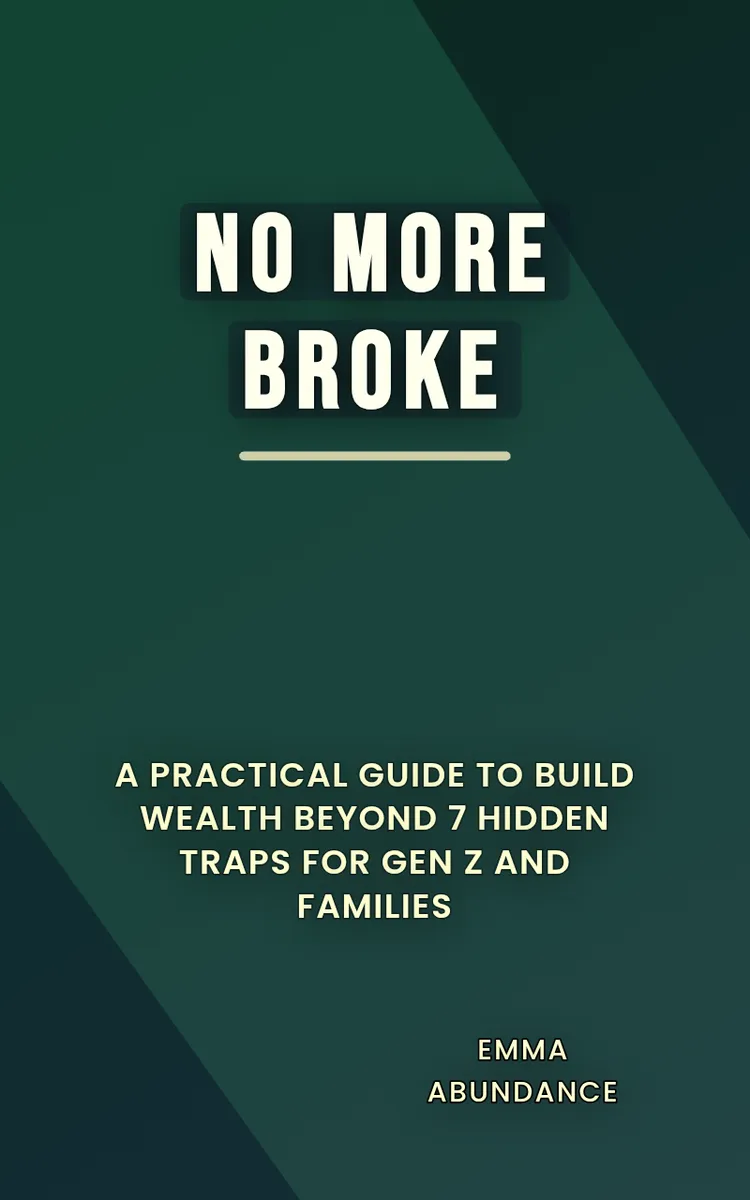
No More Broke
Created with Inkfluence AI
Wealth-building strategies for Gen Z and families
Table of Contents
- 1. The 7 Hidden Traps Checklist
- 2. Build a Budget That Survives Reality
- 3. Debt Payoff With the Avalanche Plan
- 4. Emergency Fund in 3 Levels
- 5. Automate Investing for Consistent Growth
- 6. Build Credit Without Paying for It
- 7. Wealth Beyond 9-to-5 With Side Income
Preview: The 7 Hidden Traps Checklist
A short excerpt from “The 7 Hidden Traps Checklist”. The full book contains 7 chapters and 12,019 words.
Why “broke patterns” quietly steal your yearsWhat if the reason you feel broke is not your income, but the way your money moves every week? Most people don’t wake up one day and decide to live paycheck to paycheck. They build routines that slowly force them into the same trap: spending more than they plan, borrowing to cover gaps, and earning money in ways that don’t stabilize their life.
This chapter gives you a way to spot seven common “broke” patterns before they harden. You will learn to scan your spending, debt, income, and habits like a mechanic checks a car before it breaks down. You will also leave with a checklist you can run in under an hour so you can name the trap you’re in and decide what to fix first.
The goal is simple: stop guessing. When you can point to the pattern, you can change it. And when you change it, you stop repeating the same month-ending panic. The Seven-Trap Radar helps you do that.
The Seven-Trap Radar checklist: find the 7 traps fast and act on themRun this like a diagnostic. You do not need fancy spreadsheets to start, but you do need to look at real numbers from the last 30 to 60 days. The “radar” works because each trap leaves a recognizable footprint in your bank activity, your bills, and your choices.
Use these seven traps as your filter. For each one, you will check for a specific sign, then decide what “good” looks like for the next 14 days.
Trap 1: Permission spending (you buy first, plan later).
What it looks like: You use your card or apps when you feel stressed, bored, or “it’s fine.” Then you notice the damage after payday.
How to spot it: Pick your top 10 purchases from the last month and highlight anything you bought without a planned list.
Rule to apply: If you can’t explain why you bought it in one sentence, it counts as permission spending.
Trap 2: Minimum-payment debt (you pay the floor, not the damage).
What it looks like: You pay only the minimum due and keep the card balance moving.
How to spot it: Check your credit card statement or banking app and find the payment that stays “almost the same” each month while the balance barely drops.
Rule to apply: When you see minimum-payment behavior, you must increase the payment or reduce the balance. Otherwise the debt keeps “reloading” your paycheck.
Trap 3: Bill stacking (bills hit at the same time, then you scramble).
What it looks like: Rent, subscriptions, phone, insurance, and payment apps all land near the same week. You feel fine until the stack hits.
How to spot it: List every fixed bill with its due date. Circle clusters where 3+ things hit within a 7-day window.
Rule to apply: If you can’t spread the due dates, you must build a buffer for that week.
Trap 4: Income whiplash (your pay changes, your spending doesn’t).
What it looks like: Your hours, tips, commissions, or side income swings month to month, but your bills stay rigid.
How to spot it: Compare your total deposits from the last 3 months. If one month is noticeably lower, check what stayed the same.
Rule to apply: Base your spending on your lowest-pay month, not your best month.
Trap 5: “Small fees” addiction (the $5 and $10 drains that never stop).
What it looks like: Late fees, overdraft charges, delivery fees, convenience charges, and “trial” renewals.
How to spot it: Search your bank for “fee,” “charge,” “overdraft,” or the names of the apps you use.
Rule to apply: If a fee shows up twice, you need a system change, not a reminder.
Trap 6: No-money-buffer habit (you keep zero breathing room).
What it looks like: Your checking account hits near zero within days of payday.
How to spot it: Look at your minimum daily balance over the last month. If it regularly hugs zero, you live on the edge.
Rule to apply: Start with a buffer target you can hit fast, like $300, then move up.
Trap 7: Debt and spending loop (you use borrowing to cover lifestyle).
What it looks like: You borrow not because of a one-time emergency, but because your monthly spending outruns your cash flow.
How to spot it: Compare your “new debt” month to month (new charges, new balances, new loans) to your spending categories. If the loop repeats, you have a structural problem.
Rule to apply: Stop the loop at the source by cutting one category enough to create cash flow, then attack the debt.
Don’t overthink which trap “counts.” Use your evidence. If you see minimum payments plus balance that barely drops, you don’t need a motivational speech - you need a payment plan. If you see bill stacking, you don’t need another budgeting app - you need due-date control or a buffer for that week.
Keisha, 22, just got her first full-time job after college. She makes decent money on paper, but her bank balance hits zero fast and she relies on her credit card when payday slips by even a few days....
About this book
"No More Broke" is a finance book by EMMA ABUNDANCE with 7 chapters and approximately 12,019 words. Wealth-building strategies for Gen Z and families.
This book was created using Inkfluence AI, an AI-powered book generation platform that helps authors write, design, and publish complete books. It was made with the AI Ebook Generator.
Frequently Asked Questions
What is "No More Broke" about?
Wealth-building strategies for Gen Z and families
How many chapters are in "No More Broke"?
The book contains 7 chapters and approximately 12,019 words. Topics covered include The 7 Hidden Traps Checklist, Build a Budget That Survives Reality, Debt Payoff With the Avalanche Plan, Emergency Fund in 3 Levels, and more.
Who wrote "No More Broke"?
This book was written by EMMA ABUNDANCE and created using Inkfluence AI, an AI book generation platform that helps authors write, design, and publish books.
How can I create a similar finance book?
You can create your own finance book using Inkfluence AI. Describe your idea, choose your style, and the AI writes the full book for you. It's free to start.
Write your own finance book with AI
Describe your idea and Inkfluence writes the whole thing. Free to start.
Start writingCreated with Inkfluence AI


