

Read the first chapter
The whole of chapter one, free. About 9 min. Turn the pages with the arrows, your keyboard, or a swipe.
Chapter 1
The Symbol That Chooses You
One afternoon, Nadia, a bookstore clerk in her early thirties, had to keep moving one particular book. Not because customers asked for it - because her hands wouldn’t stop reaching for it. The spine kept catching her attention: a faded image, a small mark repeated on the cover, the same shape she’d seen earlier on a scarf in the subway and, weeks before that, on a church bulletin she’d picked up by accident.
That’s the paradox at the heart of recurring symbols: they appear to “call” to us before we can explain why. We like to think meaning comes first, but attention often behaves like a reflex. A sign can act like an invitation - quiet, directional, and strangely personal - long before you’ve learned its language.
In this chapter, we’ll follow that invitation. We’ll look at how symbols return across time and cultures, how the mind treats patterns as information, and why mysticism so often begins with noticing. The goal isn’t to decode everything at once; it’s to understand how attention gets shaped, the moment a symbol becomes more than decoration.
What if the first step in understanding a mystical symbol isn’t interpretation at all - but the way it finds you?
How Repeated Marks Become Invitations
Nadia’s bookstore is the kind of place where shelves do most of the talking. New arrivals sit face-out beside older titles, and customers drift in and out with that loose, browsing attention. Nadia has worked there long enough to notice the difference between “interesting” and “sticky” - the items that linger in her field of view even when she’s distracted by other things. The recurring symbol wasn’t the book’s subject matter. It was the repeated mark: a simple geometric form, the same arrangement of lines appearing across unrelated covers and printed matter.
A useful way to think about this is that the mind doesn’t wait for full meaning. It responds to pattern. Cognitive psychologists have long described perception as active prediction: the brain constantly generates expectations and then checks what the senses deliver. When a shape repeats, it reduces uncertainty. Even if you don’t know what the symbol “means,” your brain recognizes it as familiar, and familiarity carries its own pull. That pull can feel like intuition. It can also feel like fate - especially when the symbol shows up in places you didn’t plan to visit.
There’s also a social layer. Symbols don’t live in isolation; they travel through printing, clothing, architecture, and family stories. A single emblem can move from one community to another the way a melody migrates - kept, altered, remixed. When Nadia encounters the same mark on a cover and later on a flyer, she’s seeing the residue of that migration. The symbol is not choosing her in a supernatural sense; it’s moving through the world in ways that keep intersecting with her attention. Yet the experience of intersection can still feel like being addressed.
History shows how often this happens. In early modern Europe, printed images circulated widely - woodcuts, engravings, and devotional prints. People carried these images into homes, and they became part of everyday visual life. A mark that first appeared in a religious context could later appear on a trade card, a decorative border, or a personal keepsake. The same symbol could become meaningful to different people for different reasons, simply because it kept returning in their lives.
Nadia noticed her symbol because she worked where symbols were already stacked together. Bookstores are dense with repeated visual cues: series branding, recurring fonts, author logos, and cover motifs. That environment doesn’t invent mysticism, but it does make pattern-detection more obvious. Her attention didn’t start with doctrine. It started with repetition - then repetition started to feel like direction.
The Mind’s Shortcut: Pattern, Expectation, and “Meaning Later”
Nadia’s experience isn’t unique, and it isn’t just a personal quirk. There’s a well-known psychological effect called confirmation bias - the tendency to notice information that fits what you already believe and to downplay what doesn’t. But the twist here is that the belief often arrives after the noticing. You first track the recurrence, then you begin to interpret it, and only later do you decide what it “says.”
Another relevant concept is selective attention. Your brain can’t process every detail in a room equally, so it prioritizes. Once a symbol gains priority, it becomes easier to spot in new contexts. That’s how a feedback loop can form: noticing increases exposure, exposure increases familiarity, familiarity increases salience. Mysticism often describes this as a sign. Psychology might describe it as a learning system tightening its focus.
To ground this in something measurable, consider how researchers study priming - when exposure to a stimulus changes how you respond to a later stimulus. If you’re repeatedly exposed to a shape, you tend to recognize it faster later, even when you don’t consciously “decide” to. The recognition itself can feel like insight, because it arrives before your explanation. A mystic might say the symbol is “speaking.” A scientist might say the brain is updating what it expects to see.
Here’s the counterintuitive part: recurring symbols can be persuasive even when you don’t understand them. The persuasion doesn’t require translation. It requires only attention. This matters because mysticism is often treated as if it begins with knowledge - reading, studying, memorizing. But for many people, the first spark is closer to the moment Nadia realized her hands kept returning to a particular cover. Her brain flagged the symbol as significant, and only afterward did she start seeking interpretations. The meaning didn’t precede the attention. The attention preceded the meaning.
That reverses a common assumption. If you expect understanding first, you’ll be disappointed when a symbol feels powerful but opaque. If you expect attention first, you can treat opacity as part of the process rather than a flaw. Mysticism, in other words, may begin not with clarity but with a kind of structured curiosity - an invitation that feels urgent even before it becomes legible.
Why Mystical Traditions Keep Returning to Symbols
Mysticism isn’t the only tradition that relies on symbols, but it tends to treat them as living channels rather than mere decorations. Across different spiritual histories - Jewish Kabbalah, Christian iconography, Islamic geometric design, Hindu and Buddhist ritual marks - symbols often serve as bridges between ordinary perception and a deeper reality. The bridge doesn’t operate by magic words alone. It operates by repeated forms that train attention.
Look at the way ritual uses repetition. When a community repeats a gesture, a chant, or a visual sign, it creates an internal rhythm. Over time, that rhythm becomes a cue for a particular mental state. The symbol is less a “message” delivered once and more a door repeatedly approached. Even outside formal mysticism, you can see this in secular life: team logos, national flags, graduation regalia - people learn what these symbols “do” to their feelings long before they analyze them.
Religious history also shows how symbols preserve continuity while allowing reinterpretation. A symbol can outlast the literal story it originally carried. The mark remains, and the meaning can shift with new contexts. That’s one reason mystics often talk about the same sign appearing in different places. From a historical perspective, that can happen because symbols travel. From a lived perspective, it can feel like an ongoing conversation.
Nadia’s bookstore clerk job becomes relevant again here. She’s surrounded by symbols that don’t share a single doctrine, yet they share visual logic: repetition, symmetry, emphasis through contrast. When she sees the same mark on unrelated items, her mind does something natural - it searches for connection. The symbol becomes a thread she can follow through the clutter of everyday life.
One real-world detail that helps explain why symbols feel “alive” is the way printing and design make repetition unavoidable. A logo isn’t just a picture; it’s a repeated decision. Publishers reuse emblems and recurring motifs because repetition builds recognition. Recognition builds comfort. Comfort can become emotional. Mysticism borrows this mechanism and redirects it toward the sacred.
So when Nadia experiences the symbol as an invitation, she’s also experiencing the world’s design language. Symbols are sticky because human perception is built to learn patterns quickly. Mystical traditions are sticky because they harness that learning, giving a repeated mark a place to land in the mind.
The Human Story: Nadia and the Shelf That Wouldn’t Let Go
Nadia’s recurring symbol started as background. Then it became foreground. After she first noticed it, she began seeing it in small ways: on the corner of a bookmark, in the outline on a greeting card, in the slight variation of the same arrangement of lines. The timing mattered. It wasn’t months of casual drift; it was a tight cluster of sightings, which made the repetition feel deliberate.
What’s striking is how her attention behaved before she had a theory. She didn’t begin with a label for the symbol. She began with a compulsion to look - an almost physical pull. That’s the part that often gets lost when people talk about mysticism as if it’s always an intellectual pursuit. For Nadia, it wasn’t first a question of what the symbol “means.” It was first a question of why it kept showing up.
The bookstore itself likely amplified the effect. Books are curated; symbols are concentrated. Nadia’s work means she handles covers every day, sees customers scan spines, and learns which motifs the public recognizes instantly. That environment can train her to notice visual cues quickly. When the same mark returned across different books, she didn’t just recognize it. She felt an urge to keep tracking it, the way you might track a familiar face in a crowd.
Eventually, she started asking different kinds of questions. Not “What is the correct interpretation?” but “Where else does this appear?” “How old is the design?” “Is it tied to a particular community, or is it a decorative motif that keeps getting reused?” Even without claiming authority, she moved from personal noticing to historical curiosity. That shift - attention turning into inquiry - is a hallmark of how recurring symbols often work in real life. They become invitations not only to feel, but to investigate.
And that’s where the central theme tightens. Nadia’s symbol wasn’t a lightning bolt. It was a repeated pattern that shaped her attention, which then shaped her questions. The symbol acted first as a filter, narrowing what her mind treated as relevant. Only later did her understanding catch up.
What This Tells Us About Attention and Meaning
The most counterintuitive finding here is that the power of a symbol can precede comprehension. A recurring mark can steer attention long before you can name its tradition, history, or doctrine. That means the “mystical” quality people report may begin as a perceptual event - something closer to recognition and prediction than to decoding.
This reframing matters because it changes what you think mysticism is doing. It’s not only transmitting ideas; it’s shaping experience. When attention tightens around a recurring symbol, it becomes easier to live inside the question it raises. The symbol doesn’t just represent something. It organizes how your mind moves through the world.
At the same time, this doesn’t reduce mysticism to illusion. It suggests a partnership between human perception and human culture: our brains are built to learn patterns, and our traditions are built to reuse meaningful patterns. When those two meet - when a symbol keeps returning - it can feel like an invitation because attention is the mechanism that turns “out there” into “addressed to me.”
There’s a quiet lesson in Nadia’s shelf-stubborn symbol: meaning may not arrive first, but it can still arrive reliably - through the route of noticing. The world is full of marks, and we don’t see all of them with equal weight. The mystery isn’t only what symbols mean; it’s why some of them seem to find the exact part of us that’s ready to ask.
End of chapter one. 7 more chapters in the full book.
Swipe or use the arrows to turn the page

The World In Chaos 6x9 Interior

When Everyone Else Has Moved On 8 5x11 196p REVISED v3

The Blind Spot of Reality EDITED Garamond 6x9
What's inside: 8 chapters
- 1. The Symbol That Chooses You
- 2. Rituals That Train Your Attention
- 3. The Hidden Grammar of Prayer
- 4. Meditation Without the Mystique
- 5. The Dream as a Sacred Messenger
- 6. Mantras: Sound That Repeats Meaning
- 7. The Ethics of Seeking Signs
- 8. Your Mystic Book, Written Forward
About this book
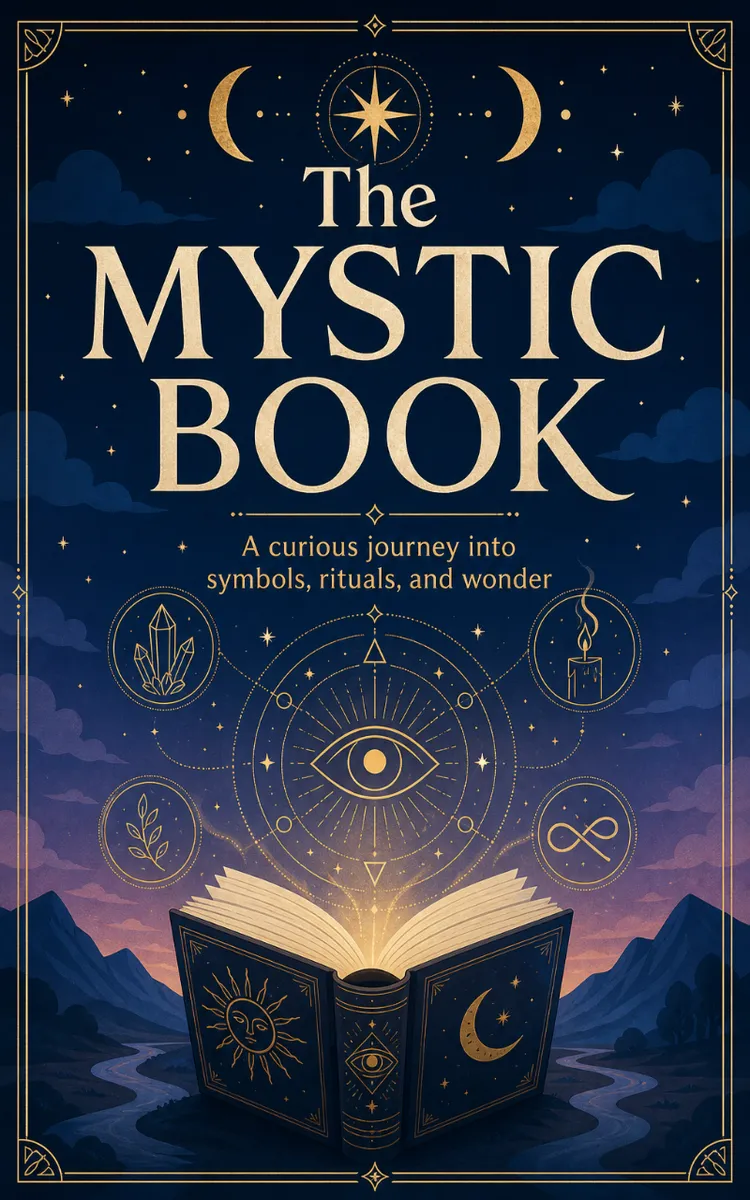
"The Mystic Book" is a curiosity book by Lilly Marrs with 8 chapters and approximately 14,499 words. Mysticism overview exploring symbols, rituals, and spiritual traditions.
This book was created using Inkfluence AI, an AI-powered book generation platform that helps authors write, design, and publish complete books.
Frequently Asked Questions
What is "The Mystic Book" about?
Mysticism overview exploring symbols, rituals, and spiritual traditions
How many chapters are in "The Mystic Book"?
The book contains 8 chapters and approximately 14,499 words. Topics covered include The Symbol That Chooses You, Rituals That Train Your Attention, The Hidden Grammar of Prayer, Meditation Without the Mystique, and more.
Who wrote "The Mystic Book"?
This book was written by Lilly Marrs and created using Inkfluence AI, an AI book generation platform that helps authors write, design, and publish books.
Write your own curiosity book with AI
Describe your idea and Inkfluence writes the whole thing. Free to start.
Start writingCreated with Inkfluence AI


