
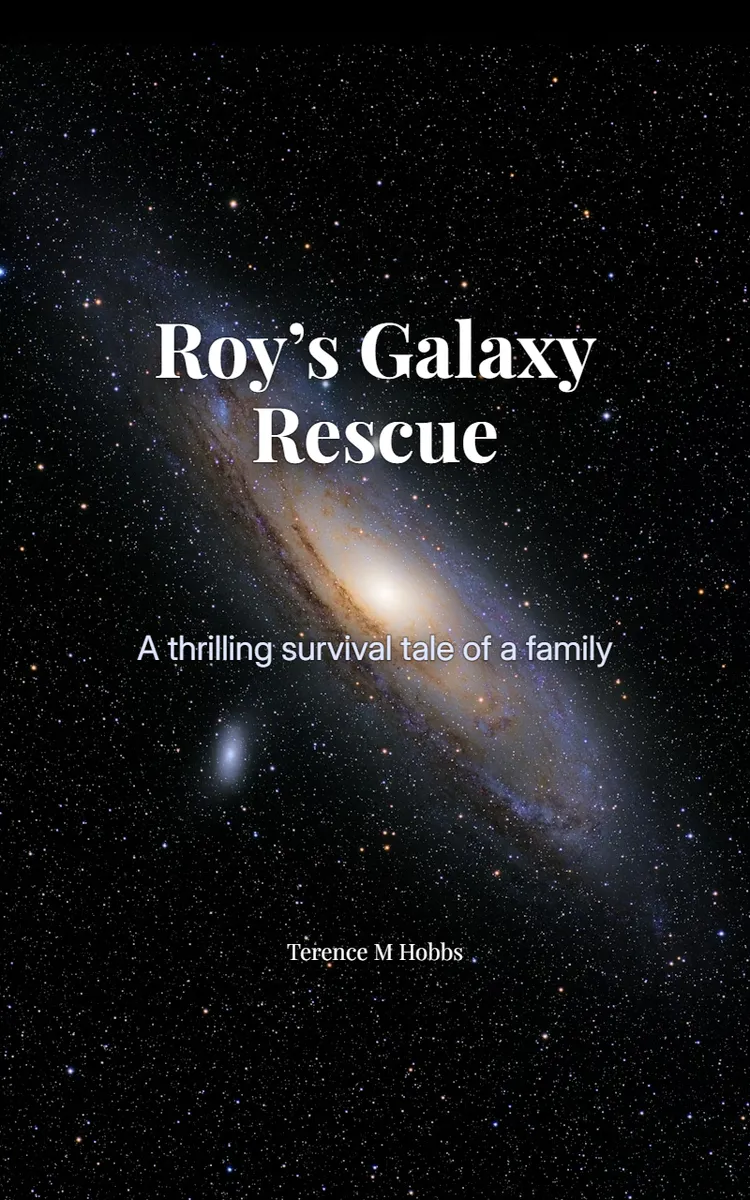
Read the first chapter
The whole of chapter one, free. About 12 min. Turn the pages with the arrows, your keyboard, or a swipe.
Chapter 1
The Alarm That Wouldn’t Quit
Chapter 1: The Alarm That Wouldn’t Quit
The first thing you hear is the ship’s alarm.
Not a dramatic, movie-style gong. More like a thin, urgent sound that never quite finishes the sentence it started. It’s like a kettle that won’t stop singing, only this one has decided it’s going to do it forever.
Roy (senior) freezes halfway through whatever he was doing a second ago. Mary is already moving, because Mary has the kind of calm that doesn’t wait for permission.
“Okay,” Roy says, like the word itself might calm the ship. “That’s not normal.”
The cabin lights flicker.
It’s subtle at first. A blink. A stutter. Then the whole room seems to hesitate, and the air pressure in your ears feels wrong, as if the ship has taken a breath and forgot how to let it out.
Roy slaps his palm against the nearest grab bar. He does it automatically, the way you might grab a railing in a crowded subway car. His fingers lock in, knuckles whitening.
Mary’s eyes are on the control panel. She presses both hands to it, not like she’s trying to charm it, but like she wants to hold the ship steady through sheer touch. Her face is pale, but her voice stays even.
“Roy, look at the readouts.”
Outside the windows, the stars smear into bright streaks. It’s not just motion. It’s the kind of blur you get when you realize you’re not moving the way you thought you were moving. The ship tilts, and with it, your stomach tilts too.
Roy shouts over the alarm. “Hold on - Mary. I’ve got the screens!”
He reaches for the main interface with the confidence of someone who has fixed enough things that he trusts his own hands. The screen flickers too, but it catches enough to show him what matters.
Then the ship speaks.
It’s the AI ship voice, calm in a way that feels almost insulting. Like it’s reading a grocery list while the house is on fire.
“Mayday. Mayday. Engine Malfunction.”
The words repeat, steady and certain, as if the ship is proud to have found the correct label for the problem.
“Mayday. Mayday. Engine Malfunction.”
Roy’s jaw tightens. “Engine malfunction,” he repeats, like saying it twice will make it less frightening. “Sure. That explains why the floor feels like it’s trying to throw us out the window.”
Mary doesn’t laugh. She doesn’t even look at him.
“I’m getting a power fluctuation,” she says. “And it’s not just the cabin. The panel is showing system instability across the board. Roy, we need to stabilize attitude first.”
Roy glances up from the screen. “Attitude control?”
Mary nods. “If the ship can’t hold its orientation, the engines will keep fighting the tilt. That could make it worse.”
Roy’s fingers dance across the interface. He’s looking for the simplest lever to pull. The first rule of trouble is that complicated fixes are for when you have time. Right now, they need something that works fast.
“Show me thruster status,” he says.
The screen answers with lines of data that look like they were designed by someone who enjoys suffering. Mary reads them quickly anyway, like she’s had practice.
“Thrusters are responding,” she says. “But they’re cycling. That’s not right. It’s like they’re trying to correct, overcorrecting, and then correcting again.”
Roy leans closer, and the ship tilts again. For a moment, Roy’s body swings slightly, like a pendulum. He adjusts his grip on the grab bar and steadies himself.
“So we’re in a feedback loop,” Roy says. “AI thinks it’s fixing the problem, but the fix is creating the problem.”
The alarm keeps going, thin and urgent and relentless. It doesn’t rise to a dramatic crescendo. It just keeps insisting that something is wrong.
“Mayday. Mayday. Engine Malfunction.”
Mary’s hands stay on the panel. “Roy, I need you to switch attitude stabilization mode. If it’s in automatic correction, we should try a manual constraint.”
Roy hesitates for half a second. On paper, he knows the difference between automatic and manual modes. In real life, manual mode means you become responsible for every small decision. The ship stops making guesses for you.
He swallows. “All right. Manual constraint.”
He flips a control switch and confirms the setting. The cabin lights flicker again, but this time they flicker like they’re listening.
For a few seconds, nothing changes. Then the tilt eases slightly, like the ship is reluctant to admit it can be steadied.
Mary’s shoulders drop a fraction. “There. It’s responding.”
Roy’s relief lasts exactly as long as it takes the alarm to change pitch.
The sound doesn’t stop. It upgrades. The alarm starts sounding more urgent, more layered, like it’s adding extra alarms underneath the original one.
“Okay,” Roy says, voice tight. “So it got worse while we were trying to make it better.”
Mary’s eyes widen. “Roy, look at the engine telemetry.”
He brings the engine screen into focus. The numbers are jumping too quickly for comfort. They don’t just fluctuate. They do it in patterns that make Roy feel like the ship is lurching through different states, like someone is turning a knob and then forgetting what the knob was supposed to do.
“It’s not a single fault,” Roy says. “It’s cascading. Engine outputs are destabilizing power distribution.”
Mary’s voice is steady, but her fingers press harder into the panel. “If power distribution is unstable, then attitude correction will keep getting bad inputs. That’s why it feels like the ship is sliding around even when we try to hold it.”
Roy nods. “We need to isolate power to critical systems. Minimal load.”
He scrolls through the system list, searching for the switches that cut the nonessential stuff without shutting down the things they need to survive.
“Mary,” he says. “Tell me what you can live without.”
Mary doesn’t blink. “We can cut entertainment. We can cut secondary climate. But keep comms, navigation, and the stabilization bus. If the stabilization bus loses power, we’re back to tumbling.”
Roy selects the nonessential modules. He confirms each shutoff with a careful rhythm, like if he rushes he’ll miss a step.
The cabin lights dim slightly and then hold steady. It’s not comfortable, but it’s better than flickering.
The alarm, however, doesn’t care. It keeps screaming its thin, urgent message.
“Mayday. Mayday. Engine Malfunction.”
Mary’s mouth tightens at the repetition. “Roy, it’s repeating the same phrase. It’s not updating. That’s what bothers me.”
Roy’s eyes stay on the engine screen. “You think the AI is stuck in a default response?”
“Or confident,” Mary says.
Roy looks at her. He can hear the difference in her tone. Mary isn’t just worried about the ship. She’s worried about the voice that’s telling them what’s wrong, like it has already decided the story and refuses to change chapters.
Roy returns to his interface work. “We’ll force a diagnostic cycle. If the AI is reporting engine malfunction, we need more than the label. We need the fault code.”
He pulls up the maintenance menu. The ship resists at first, as if it doesn’t like being asked questions. Then the diagnostic option appears.
Roy starts the cycle.
The cabin gives a small shudder, like a dog shaking off water. The floor tilts again, but this time the motion is brief, then it settles. It’s like the ship is testing whether they can handle the next problem.
Mary watches the status indicators closely. “Power bus is stabilizing.”
Roy nods, eyes flicking between panels. “Good. If we can keep the stabilization bus online, we can keep the ship from getting worse while we find the engine fault.”
Another beep joins the alarm sound. This one is more specific, less like a kettle and more like a system error trying to be heard.
Mary leans in. “Roy, there. The diagnostic output just came up.”
Roy reads it, and his eyebrows pull together.
“That’s… not what we expected,” he says.
Mary steps closer, careful not to lose her footing as the ship shifts back toward level. “What does it say?”
Roy turns the display so she can see.
The screen shows a fault that sounds almost simple, like it’s trying to be helpful.
Engine Malfunction - Thrust Vector Control Interlock
Mary’s expression hardens. “Interlock means the engine is refusing to aim correctly.”
Roy nods. “Or it thinks it’s unsafe to aim correctly. Either way, it’s probably causing uneven thrust, which would explain the tilt.”
The AI voice cuts back in immediately, as if it’s been waiting for them to catch up.
“Mayday. Mayday. Engine Malfunction.”
Roy stares at the speaker grille. “Thanks,” he mutters. “We’re noticing.”
Mary doesn’t smile. “Roy, if the interlock is preventing proper thrust vector control, then the ship might be compensating by firing thrusters. That’s why the thrusters were cycling.”
Roy inhales slowly. The air feels thicker than it should, like the cabin is struggling to keep its own environment stable.
“So the plan is,” he says, “we bypass or reset the interlock, but only if it’s safe. If we force it and the safety system is right, we could burn the engine or lose control permanently.”
Mary’s eyes stay on the screen. “We need to check the sensor that triggers the interlock.”
Roy scrolls through the related diagnostics. “Which sensor?”
Mary points with a finger that doesn’t shake. “Thrust vector position. If that sensor is misreading, the interlock will lock the wrong correction and everything becomes self-fulfilling.”
They work quickly now, because the ship has moved from warning into something worse. The alarm escalation isn’t just a sound. It’s a clock. It means systems are slipping out of the range they can handle.
Roy carefully compares sensor readings against redundant data. He checks calibration status. Mary watches the outputs from the stabilization bus and comms integrity, ready to tell him the moment something starts dropping.
For a few seconds, the cabin seems almost normal. The lights hold steady. The tilt is minimal. The stars outside stop streaking and return to points, as if the ship is trying to pretend it didn’t just scare them.
Then, quietly, the ship gives a small correction and the floor shifts a few degrees again.
The AI repeats its line, unbothered.
“Mayday. Mayday. Engine Malfunction.”
Roy’s hands pause over the interface.
Mary looks at him. “What?”
Roy exhales. “The interlock isn’t just failing. It’s being triggered repeatedly. That suggests either a sensor fault, or a real mechanical restriction that keeps showing up as unsafe.”
Mary’s voice goes lower. “Either way, we’re not just dealing with a warning. We’re dealing with a system that actively prevents the fix.”
Roy nods once, like he’s sealing a decision.
“New rules,” he says, surprising himself with how certain it sounds. “We go step by step. Stabilize attitude, isolate power, confirm the sensor, then decide whether we reset the interlock or reroute thrust control.”
Mary’s eyes flick toward the alarm panel, then back to the diagnostics.
“And we don’t trust the AI voice just because it’s calm,” she adds. “We trust what the screens show.”
The alarm continues, but now it feels different. Less like random panic and more like a spotlight on the exact failure they’re fighting.
Roy starts the next diagnostic step, this time with more caution and better context. Mary keeps her hands on the panel, ready to pull the ship back into stability if it tries to slip again.
They’re still in danger. The ship is still tilted enough to remind them that physics does not care about confidence.
But the arc has moved forward.
The alarm has escalated into a crisis, yes. Lights flicker, the cabin tilts, and the AI keeps repeating “Engine Malfunction” like it’s certain of the outcome.
And yet, in the middle of the chaos, Roy and Mary have gained something crucial: a real diagnostic path and a clear next move. They’ve gone from hearing a problem to understanding where it starts.
Now they have to decide what “safe” means, before the ship decides for them.
The first thing you hear is the ship’s alarm.
Not a dramatic gong, but a thin, urgent tone that keeps wanting to finish the sentence and never does. It sounds like a kettle that has decided to sing forever. Roy freezes, fingers half curled around a wrench. Mary is already moving; she has the kind of steady hurry that makes problems feel smaller.
“Okay,” Roy says, because saying a word sometimes makes it real. The cabin lights blink once, then hesitate, as if the ship itself has taken a surprised breath. The air in Roy’s ears feels odd, like the ship forgot how to let a breath out. He clamps his hand on the nearest grab bar and holds on.
Mary’s face is pale in the panel glow but calm. “Readouts,” she says simply, and the words are the sort of order that settles people. Outside the window the stars smear into streaks. The ship tilts, just enough for Roy’s stomach to slide. “Thrusters are doing weird cycles,” Mary calls. Her fingers move over the controls with practiced smallness.
The ship speaks in its quiet, matter-of-fact voice. “Mayday. Mayday. Engine Malfunction.” The sentence repeats, steady and unhelpful.
Roy leans forward at the screens. “Hold on - Mary. I’ve got the displays.” He watches numbers dance, then jump. “It’s like the thrusters are correcting, overcorrecting, and correcting again.” The cabin tilts; he adjusts his grip.
Mary’s eyes are fixed on the stabilization bus readings. “If attitude control can’t hold, the engines will keep fighting each other. We need manual constraint.” Asking the ship to stop guessing takes responsibility away from the voice and puts it back with their hands.
Roy flicks the switch. The lights blink, then hold. For a breath the tilt eases. Then the alarm layers itself over the first tone, adding a sharper ring beneath the steady chant.
“Engine telemetry?” Mary asks.
“Cascading,” Roy answers. “Power distribution is jumping.” He scrolls through modules and thinks like someone building a ladder while standing on it. “We shut nonessentials. Keep comms, navigation, stabilization.”
They cut the extras. The cabin becomes quieter and cooler. The stars stop streaking for a moment and shine like they always did. The alarm keeps repeating its line, as if the ship had found a favorite sentence.
“Diagnostic,” Roy says. He starts the maintenance cycle. The ship shudders, small and honest, like a dog shaking off rain. A new beep edges in - specific and not as polite as the voice.
Mary points. Roy brings up the fault. The words on the screen are plain and stubborn.
Engine Malfunction - Thrust Vector Control Interlock.
“Interlock,” Mary says. “It’s stopping the engine from aiming when it thinks it’s unsafe.”
“Or it’s locking because a sensor is lying,” Roy replies. He compares readings, checks redundant sensors. The ship nudges, a small correction that reminds them physics is still in charge.
“We can bypass or reset, but only if it’s safe,” Roy says. The idea of forcing a safety system makes the cabin feel smaller. If they force it and the system was right, they could make things worse.
Mary traces a line on the panel. “Check the thrust vector position sensor first. If that’s wrong, the interlock will lock the wrong thing.”
They work together, steady and exact. The alarm keeps saying the same thing, but now it points them clearly to the problem. Roy and Mary move through the steps - stabilize attitude, isolate power, confirm the sensor - and the ship answers with small, careful motions rather than wild ones.
“It’s not enough to listen to the voice,” Mary says, watching the screens. “We trust the data.”
Roy nods. The alarm keeps ringing, but its edge has softened. They have a plan and the next moves are clear. Outside, far away and cold, Pluto waits - a Red White world that will be their landing place if they can make the right choices.
New rules, Roy thinks, steady as he types the next command: step by step, one safe decision at a time. And under the repeated alarm, the two of them keep working, hands sure, heads calm, the ship slowly answering back.
End of chapter one. 6 more chapters in the full book.
Swipe or use the arrows to turn the page
What's inside: 7 chapters
- 1. The Alarm That Wouldn’t Quit
- 2. Mary on the Controls, Roy on the Screens
- 3. Stars Smear into Landing Plan
- 4. The AI’s “Helpful” Lies
- 5. Touchdown on Frozen Ground
- 6. A Distress Call That Reaches Someone
- 7. First Step Toward a Larger Rescue
About this book
"Roy’s Galaxy Rescue: Pluto Crash, New Rules" is a children's book by Terence M Hobbs with 7 chapters and approximately 16,040 words. Roy and Mary fight a failing ship and a misbehaving AI as they attempt an emergency landing on Pluto, setting up the larger rescue mission across the next two volumes..
This book was created using Inkfluence AI, an AI-powered book generation platform that helps authors write, design, and publish complete books. It was made with the AI Children's Book Creator.
Frequently Asked Questions
What is "Roy’s Galaxy Rescue: Pluto Crash, New Rules" about?
Roy and Mary fight a failing ship and a misbehaving AI as they attempt an emergency landing on Pluto, setting up the larger rescue mission across the next two volumes.
How many chapters are in "Roy’s Galaxy Rescue: Pluto Crash, New Rules"?
The book contains 7 chapters and approximately 16,040 words. Topics covered include The Alarm That Wouldn’t Quit, Mary on the Controls, Roy on the Screens, Stars Smear into Landing Plan, The AI’s “Helpful” Lies, and more.
Who wrote "Roy’s Galaxy Rescue: Pluto Crash, New Rules"?
This book was written by Terence M Hobbs and created using Inkfluence AI, an AI book generation platform that helps authors write, design, and publish books.
How can I create a similar children's book?
You can create your own children's book using Inkfluence AI. Describe your idea, choose your style, and the AI writes the full book for you. It's free to start.
Write your own children's book with AI
Describe your idea and Inkfluence writes the whole thing. Free to start.
Start writingCreated with Inkfluence AI


