
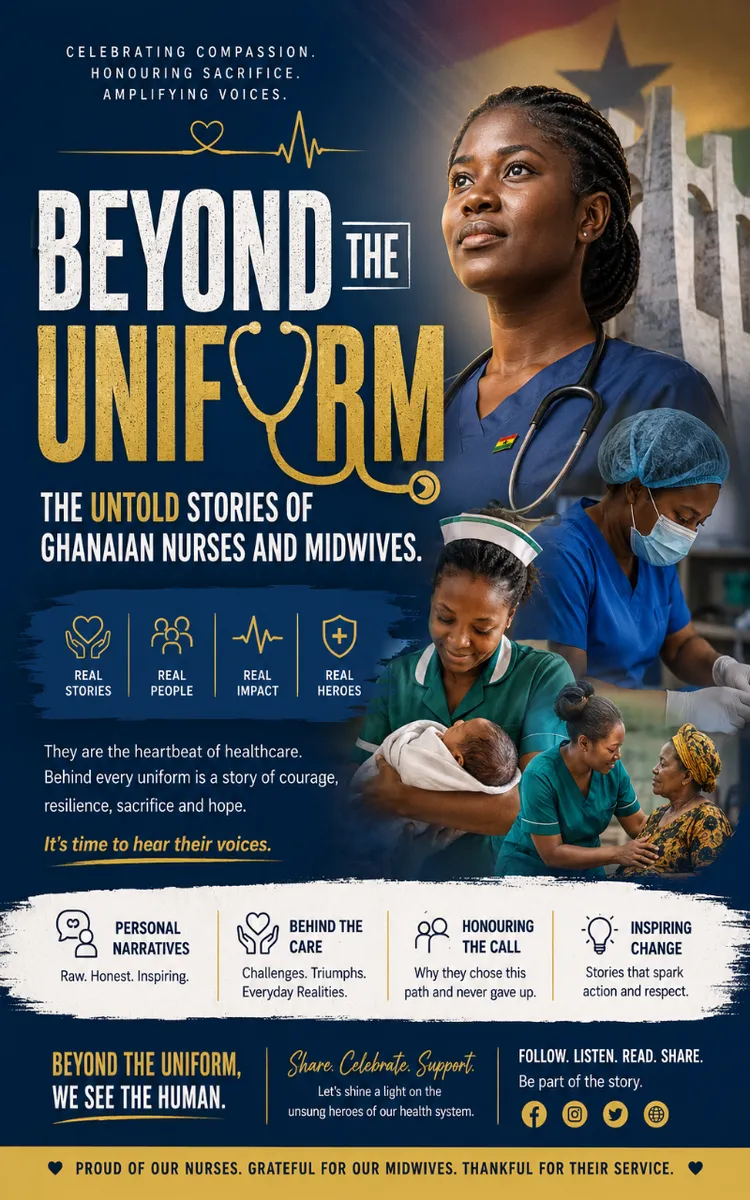
Beyond The Uniform
Created with Inkfluence AI
Personal narratives of Ghanaian nurses and midwives
Table of Contents
- 1. First Night Shift at Korle-Bu
- 2. Choosing Midwifery Over Nursing
- 3. Learning Emergency Delivery in Tamale
- 4. Following the Missing Drugs Ledger
- 5. The Strike That Stopped Births
- 6. Suspension After the Audit Report
- 7. Founding a Community Birth Team
- 8. Returning to Korle-Bu as Mentor
Preview: First Night Shift at Korle-Bu
A short excerpt from “First Night Shift at Korle-Bu”. The full book contains 8 chapters and 22,833 words.
The trolley wheels squeaked as Ama Mensah pushed off from the nurses’ station, the air already thick with disinfectant and sweat. Outside the ward windows, Accra kept humming - motorbikes coughing on the main road, distant church music bleeding into the night - but inside Korle-Bu Teaching Hospital the sound was its own weather. Voices overlapped, bed frames clanged, a radio somewhere argued with the ceiling fan, and every few minutes a call bell rang like it had been taught to insist.
She was nineteen and newly posted, still wearing her uniform like it belonged to someone else. The cloth at her collar felt stiff, as if the ironing hadn’t finished its job. When she looked down at her name tag, she could read it, but she couldn’t believe it was hers. A senior nurse had said, “It’s your first night shift. Keep your head. If you don’t know, ask.” Ama had nodded hard enough to show she understood, but the truth was that she understood fear better than she understood the ward. She had imagined emergencies in her head - blood, alarms, urgency - but Korle-Bu did not deliver danger in tidy stories. It arrived as noise, crowding, bodies pressed close together, and the constant sense that something could go wrong before you even found the right place to stand.
The maternity ward was where she had been assigned that first night, though “assigned” felt like the wrong word for it. Patients had been coming in all evening, women and babies and relatives who carried their worries in their faces. The corridor smelled of boiled water from someone’s thermos and the sour edge of sweat from people who had not eaten. As Ama walked in, the light from the ceiling made every surface shine - plastic rails, metal basins, skin that looked too warm. A midwife in a starched headscarf glanced at her, then at the list in her hand. “You will take this bay,” she said, and her tone left no room for questions. Ama followed the direction of her finger to a row of beds where women lay with different kinds of exhaustion, some staring at the ceiling, others blinking slowly as if their eyelids were heavy sandbags.
A baby began to cry somewhere behind her, then another joined, so that the ward sounded like rain trying to decide whether it would fall. Ama carried a small pack of supplies and a notebook that felt too thin for what she was expected to remember. She tried to breathe steadily, but the air had that clinging quality that made each breath feel like work. Somewhere close by, someone coughed, and a relative hissed at another relative for blocking the walkway. Ama held her shoulders back and moved carefully between beds, her slippers sticking slightly to the floor as if the ward itself wanted to keep her from rushing.
“Water,” a woman called, her voice hoarse. Ama turned quickly. “I’ll bring,” she said, and the words came out firmer than she felt. She found the cup at the edge of the station, filled it, and returned just as the midwife was calling for another set of vitals. The midwife’s name was Efua - Ama knew it from the way the staff spoke about her with a mix of respect and caution. Efua’s hands moved fast and sure, checking, adjusting, speaking to the women in calm phrases that did not sound like comfort but like instruction. Ama watched, absorbing the rhythm: ask, observe, act, record. She thought recording would be the easiest part. She would soon learn it was the part that could become its own emergency.
In the middle of the ward’s noise, Ama’s first true test came without warning. A woman in one of the beds - Ama had learned her name only that evening, as nurses do when they need to speak quickly - began to show signs that did not match the calm she had been given earlier. Her breathing shifted; her face lost that steady look; her body seemed to tighten as if holding pain inside. A relative stood up too quickly and knocked the edge of a bedside stand. The stand clattered, and the sudden sound made the woman flinch.
Efua noticed at the same time Ama did. Efua’s eyes narrowed, and her voice cut through the ward like a clean sheet. “No. Don’t move her.” Ama was already by the bed, her hands hovering before they touched, because she had been taught not to panic with touch. She checked what she could - what her eyes could see, what her fingers could feel - and the smell of blood, metallic and unmistakable, reached her before she could even name it. There was more than expected. The woman’s skin looked too pale under the ward light.
“Pulse,” Efua said. “Count now.”
Ama took the woman’s wrist and tried to focus on the numbers. The room around her blurred into sounds - relatives whispering, someone calling for a syringe, the radio arguing in the background. Ama counted anyway, but the counting felt like trying to hold water in her palms. Her fingers slipped once and she adjusted, and in that small adjustment she felt her confidence wobble. She could hear her own breath, fast and uneven.
Efua leaned closer. “Ama, document as we go....
About this book
"Beyond The Uniform" is a biography book by Jonah Tagnuntiba Tikonimbe with 8 chapters and approximately 22,833 words. Personal narratives of Ghanaian nurses and midwives.
This book was created using Inkfluence AI, an AI-powered book generation platform that helps authors write, design, and publish complete books. It was made with the AI Biography Writer.
Frequently Asked Questions
What is "Beyond The Uniform" about?
Personal narratives of Ghanaian nurses and midwives
How many chapters are in "Beyond The Uniform"?
The book contains 8 chapters and approximately 22,833 words. Topics covered include First Night Shift at Korle-Bu, Choosing Midwifery Over Nursing, Learning Emergency Delivery in Tamale, Following the Missing Drugs Ledger, and more.
Who wrote "Beyond The Uniform"?
This book was written by Jonah Tagnuntiba Tikonimbe and created using Inkfluence AI, an AI book generation platform that helps authors write, design, and publish books.
How can I create a similar biography book?
You can create your own biography book using Inkfluence AI. Describe your idea, choose your style, and the AI writes the full book for you. It's free to start.
Write your own biography book with AI
Describe your idea and Inkfluence writes the whole thing. Free to start.
Start writingCreated with Inkfluence AI


