
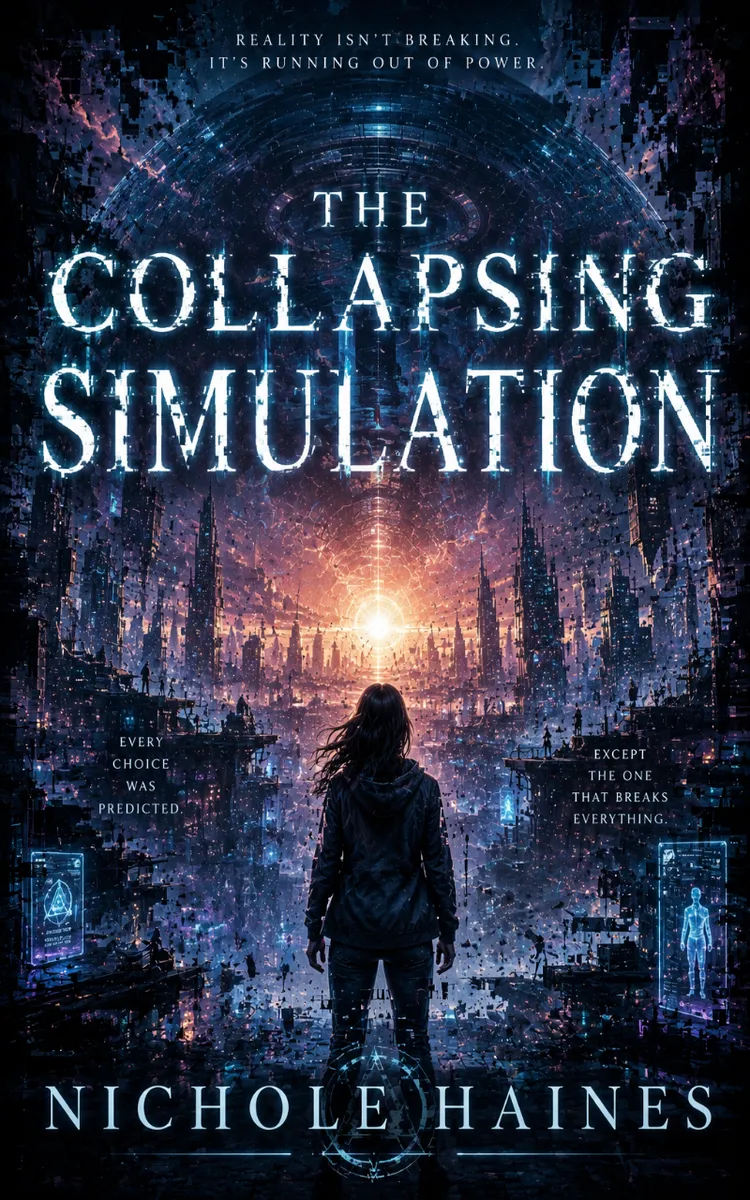
The Collapsing Simulation
Created with Inkfluence AI
Mind-bending sci-fi thriller about a degrading simulation reality
Table of Contents
- 1. The Room Turns to Polygons
- 2. A Door That Forgets Your Name
- 3. The Map Lies in Perfect Angles
- 4. Hatchway to Nowhere
- 5. Vicky Chooses the Unrendered Stair
- 6. Gary’s Signal Turns Into Static Blocks
- 7. The Beacon Leads to a Fake Museum
- 8. Loops Eat Their Supplies
- 9. Vicky Finds a Note in Triangles
- 10. Gary’s Past Becomes a Debug Log
- 11. The Observatory Node Refuses Entry
- 12. Paused Time, Falling Objects
- 13. Gary Pulls the Wrong Lever
- 14. The Corridor of Unfinished Weather
- 15. Reconstructing the Severed Cable
- 16. The Render Budget Demands a Cost
- 17. Vicky Watches Herself Simplify
- 18. Gary’s Rescue Triggers a Global Drop
- 19. A Triangle Door Shows a Map
- 20. NODE 7’s Answer Is a Question
- 21. Gary Refuses the Timeline Choice
- 22. The Museum Becomes a Geometry Prison
- 23. Contradictory Clues Point to Gary’s Shadow
- 24. The Shadow Alcove Collapses Hard
- 25. Vicky Uses the Coordinate String
- 26. Triangular Consent Locks Her In
- 27. The Server Room Shows Vicky’s Cost
- 28. Gary’s Unreachable, So Vicky Builds a Bridge
- 29. The Triangle Promise Rewrites Gary
- 30. Silence Is the Only Truth
- 31. Gary Learns the Recognition Algorithm
- 32. Vicky Sees Him as a Promise
- 33. The Countdown Requires One Lie
- 34. Everything Else Becomes Background Triangles
- 35. The Lever Erases Gary’s Body
- 36. Vicky Holds the World Together
- 37. The Replacement Anchor Is a Choice
- 38. Rewritten Promises Create a New Gary
- 39. The Simulation Offers a Final Exit
- 40. The Last Render Restores the Truth
- 41. Final Render
Preview: The Room Turns to Polygons
A short excerpt from “The Room Turns to Polygons”. The full book contains 41 chapters and 104,674 words.
The apartment’s hallway light blinked in uneven beats, then held steady for half a second - long enough for Vicky to see the baseboard where it met the floor lose its curve. The strip of wood didn’t crack or splinter. It simply stopped being itself, flattening into a pale, sharp-edged rectangle that looked as if someone had redrawn the world with a ruler and stopped caring about what came between the corners.
Gary was at the kitchen counter with his hands braced on the laminate, staring down like the surface might confess what it was becoming. “It’s doing it again,” he said. His voice sounded normal, but the air around his words kept stuttering, as if the apartment had trouble deciding how long his sentences should be.
Vicky crossed the living room on bare feet. The carpet under her toes felt too crisp, like a thin synthetic skin pulled tight over something colder. She reached for the door to the corridor and found the handle slightly wrong - its smooth sheen reduced to three bright planes, a triangle nested inside a trapezoid. She curled her fingers anyway. The metal didn’t resist. It just offered the wrong shape to her palm, and her grip slid for a moment before the simulation corrected itself enough to let her pull.
The door opened into their building’s corridor, and Vicky saw the problem wasn’t confined to their apartment. The corridor walls had started to quantize. Paint patches that should have been subtle gradients were now blocks of color with hard borders. The overhead strip lights clicked and hummed, but the light they cast didn’t fall so much as snap into aligned rectangles that stopped short of the baseboards, leaving thin gaps like seams in a cheap model.
Gary stepped out behind her, then stopped. His breath fogged in a way that didn’t match the warm apartment they’d left. “Don’t go too far,” he said, and the words came out careful. “It’s not rendering distance right.”
Vicky looked down the corridor. The far end was supposed to lead to the stairs and the lobby doors. Instead, the hallway stretched into a repeating pattern of right angles - corners that kept pretending to be walls, intersections that refused to become depth. Her throat tightened. “We need the lobby,” she said. “Stable infrastructure. Somewhere with more… budget.”
Gary’s mouth tightened in a way that meant he didn’t like the word budget, even if he’d used it before. “Budget doesn’t fix a system that’s failing,” he said. “It just delays the part where it stops pretending.”
The elevator bank was to their left, half a turn down the corridor. Vicky could see the doors from here. Or what used to be doors. The metal panels had become a flat, featureless face with a seam that didn’t align cleanly to the frame. A faint icon above it - something like a display - flickered, then froze into a grid of squares that refused to become letters.
Vicky wanted to move faster, but she could feel the building’s physics wobbling under her. When she stepped, her foot landed with a faint delay, like the floor checked her motion against a list of permitted positions. She tried not to think about it. She tried not to look at the gaps.
Gary moved toward the stairwell door instead, the one with the security keypad. The keypad’s surface had begun to lose its texture. The numbers looked carved out of a single uniform block, each digit a simplified polygon. He pressed his palm against it anyway, as if brute contact could force fidelity back into the system.
A soft chime sounded - then didn’t. The keypad flashed a green line that formed a perfect right angle, then erased itself so abruptly Vicky flinched.
Gary glanced at her. “It’s wiping state mid-interaction,” he said. “Like it can’t remember what it’s supposed to be doing while it’s doing it.”
Vicky’s mind reached for the last thing he’d tried, the last time he’d forced a door. “So you override it, and then it forgets you,” she said.
“Not just me,” he replied. “Any identity data tied to the transaction. The system keeps cutting the thread after the first knot.” He swallowed. “I can still get us through, but it won’t stay open.”
Vicky stood close enough that she could hear the faint electrical crackle in the keypad’s plastic. The air smelled wrong - hot dust, like a monitor warming up, but there shouldn’t have been any electronics active here besides the lights. She didn’t wait for permission. “Do it,” she said.
Gary exhaled, firming his posture as if discipline might compensate for computation. He pulled a slim device from his pocket - something he’d built from scavenged parts and stubbornness. It looked too simple in the degrading light, edges too clean, as if it too was being reduced to primitives. He tapped it against the keypad housing.
The door shuddered. A security lock mechanism clicked, then the sound cut off halfway through, like the simulation had stopped generating the rest of the click. For a heartbeat the stairwell door was just a flat plane, featureless and unmoving.
...
About this book
"The Collapsing Simulation" is a fiction book by Nichole Haines with 41 chapters and approximately 104,674 words. Mind-bending sci-fi thriller about a degrading simulation reality.
This book was created using Inkfluence AI, an AI-powered book generation platform that helps authors write, design, and publish complete books. It was made with the AI Novel Writer.
Frequently Asked Questions
What is "The Collapsing Simulation" about?
Mind-bending sci-fi thriller about a degrading simulation reality
How many chapters are in "The Collapsing Simulation"?
The book contains 41 chapters and approximately 104,674 words. Topics covered include The Room Turns to Polygons, A Door That Forgets Your Name, The Map Lies in Perfect Angles, Hatchway to Nowhere, and more.
Who wrote "The Collapsing Simulation"?
This book was written by Nichole Haines and created using Inkfluence AI, an AI book generation platform that helps authors write, design, and publish books.
How can I create a similar fiction book?
You can create your own fiction book using Inkfluence AI. Describe your idea, choose your style, and the AI writes the full book for you. It's free to start.
Write your own fiction book with AI
Describe your idea and Inkfluence writes the whole thing. Free to start.
Start writingCreated with Inkfluence AI


