
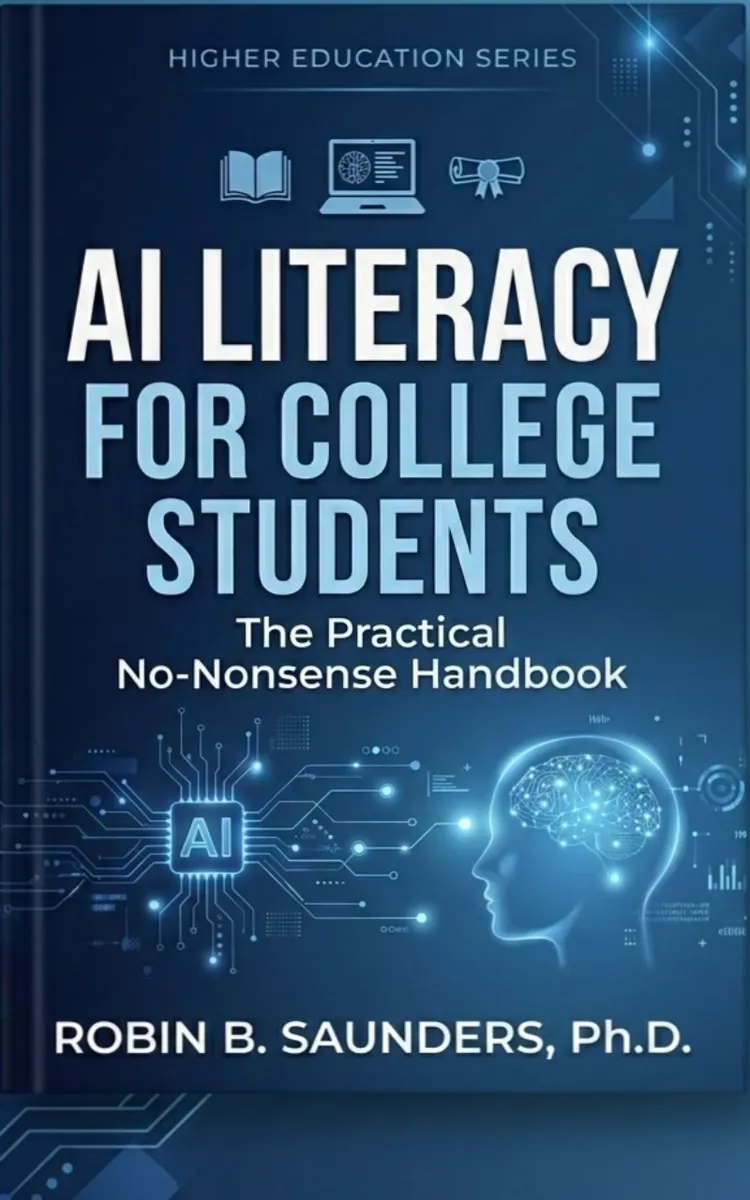
AI Literacy for College Students
Created with Inkfluence AI
Table of Contents
- 1. Chapter 1: What AI Actually Is (Cutting Through the Hype)
- 2. Chapter 2: How These Tools Actually Work (The Basics)
- 3. Chapter 3: Using AI in Your Academic Life (The Right Way)
- 4. Chapter 4: Ethics and Academic Integrity (Don't Get Burned)
- 5. Chapter 5: Limitations and Biases (Where AI Fails You)
- 6. Chapter 6: Staying AI-Literate as Things Change
Preview: Chapter 1: What AI Actually Is (Cutting Through the Hype)
A short excerpt from “Chapter 1: What AI Actually Is (Cutting Through the Hype)”. The full book contains 6 chapters and 2,544 words.
Let's start by killing a myth. AI is not a thinking robot with feelings and plans. When you use ChatGPT or a similar tool, you're not talking to a mind. You're talking to a very sophisticated pattern-matching machine.
So what is it, really?
AI, in the form most students use, means software trained on massive amounts of text, images, or data. It learns patterns from that data and uses those patterns to predict what comes next. That's it. When ChatGPT writes you a paragraph, it's making educated guesses, word by word, about what should come next based on everything it learned during training.
Think of it like the autocomplete on your phone, but scaled up enormously. Your phone suggests the next word. These tools can suggest the next thousand words, and they're shockingly good at sounding human.
Why this matters:
Because AI predicts patterns rather than "knowing" facts, it can sound completely confident while being completely wrong. It doesn't understand truth. It understands what a correct-sounding answer looks like. Keep that in the back of your mind for every chapter ahead.
A quick vocabulary cleanup:
AI (Artificial Intelligence): The broad term for machines doing tasks that seem to need human intelligence.
Machine Learning: A method where software learns patterns from data instead of being programmed with fixed rules.
Generative AI: The tools that create new content, text, images, code, audio. This is what most of this book focuses on.
LLM (Large Language Model): The engine behind text tools like ChatGPT. "Large" because it's trained on enormous amounts of text.
Real-world example:
You ask an AI tool, "Who wrote the theory of relativity?" It answers "Albert Einstein" instantly. Great. Now you ask it about an obscure academic paper from 2019. It might invent a title, an author, and a journal that sound totally real but don't exist. Same tool, same confidence, wildly different reliability. The tool isn't lying on purpose. It's just filling in the pattern.
Key takeaways:
AI predicts patterns; it doesn't think or know.
Confident-sounding output is not the same as correct output.
Learning the basic vocabulary helps you talk about AI without sounding lost.
About this book
"AI Literacy for College Students" is a how-to guide book by Robin B. Saunders, Ph.D. with 6 chapters and approximately 2,544 words. It covers key insights and practical takeaways on the topic.
This book was created using Inkfluence AI, an AI-powered book generation platform that helps authors write, design, and publish complete books. It was made with the AI Ebook Generator.
Frequently Asked Questions
What is "AI Literacy for College Students" about?
"AI Literacy for College Students" is a how-to guide book by Robin B. Saunders, Ph.D. covering key insights and practical takeaways on the topic.
How many chapters are in "AI Literacy for College Students"?
The book contains 6 chapters and approximately 2,544 words. Topics covered include Chapter 1: What AI Actually Is (Cutting Through the Hype), Chapter 2: How These Tools Actually Work (The Basics), Chapter 3: Using AI in Your Academic Life (The Right Way), Chapter 4: Ethics and Academic Integrity (Don't Get Burned), and more.
Who wrote "AI Literacy for College Students"?
This book was written by Robin B. Saunders, Ph.D. and created using Inkfluence AI, an AI book generation platform that helps authors write, design, and publish books.
How can I create a similar how-to guide book?
You can create your own how-to guide book using Inkfluence AI. Describe your idea, choose your style, and the AI writes the full book for you. It's free to start.
Write your own how-to guide book with AI
Describe your idea and Inkfluence writes the whole thing. Free to start.
Start writingCreated with Inkfluence AI


