
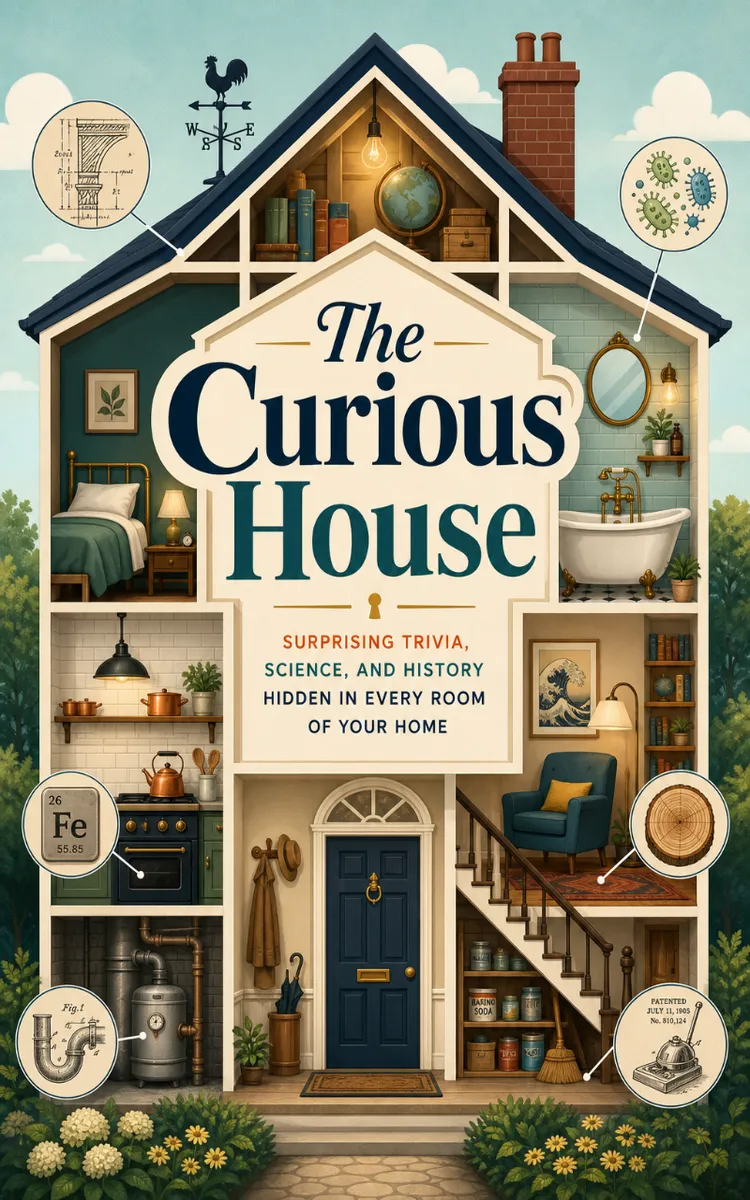
The Curious House
Created with Inkfluence AI
Table of Contents
- 1. The Kitchen
- 2. The Dining Room
- 3. The Living Room
- 4. The Bedroom
- 5. The Bathroom
- 6. The Entryway & Hallway
- 7. The Attic
- 8. The Garage & Basement
- 9. The Backyard
Preview: The Kitchen
A short excerpt from “The Kitchen”. The full book contains 9 chapters and 8,169 words.
More accidents, inventions, and heated arguments have happened in the kitchen than in any other room in the house. It's the most-used room in most homes, and it turns out to have the richest backstory too. Start here.
Why We Call It a "Kitchen" The word traces back to the Latin coquere, meaning simply "to cook." That became coquina in Vulgar Latin, then cuisine in French and kychene in Middle English, before finally settling into the word we use today. It's a nice reminder that the room hasn't changed jobs in roughly two thousand years - we've just kept renaming the space where we do it.
The Woman Who Invented the Dishwasher Josephine Cochrane didn't design the dishwasher because she disliked washing dishes - she designed it because her servants kept chipping her good china. Frustrated, she built her own hand-cranked machine and unveiled it at the 1893 World's Columbian Exposition, where it won a prize for "best mechanical construction." Ironically, it took decades before the machine caught on in private homes; her first customers were mostly hotels and restaurants, since ordinary households didn't yet generate enough hot water or dirty dishes to make it worthwhile.
Teflon Was a Complete AccidentIn 1938, DuPont chemist Roy Plunkett was trying to develop a new refrigerant gas. Instead, a cylinder he'd been storing produced a strange, slippery white solid - polytetrafluoroethylene, or PTFE. Nobody was looking for a nonstick material, but it turned out to be almost frictionless and nearly impossible to react with anything else. It took until the 1960s for an engineer to figure out how to bond it to cookware, and Teflon-coated pans finally hit kitchens soon after.
The Chocolate Bar That Invented the Microwave Engineer Percy Spencer was working with radar equipment at Raytheon in 1945 when he noticed the chocolate bar in his pocket had melted. Curious rather than annoyed, he started testing the magnetron tube on popcorn kernels, then an egg (which reportedly exploded). The result was the "Radarange," the first commercial microwave oven - nearly six feet tall, weighing 750 pounds, and expensive enough that only restaurants and ships could justify buying one at first.
How Your Refrigerator Actually Keeps Food ColdA fridge doesn't "make cold" so much as move heat somewhere else. A refrigerant fluid absorbs heat from inside the fridge as it evaporates into a gas, then a compressor squeezes that gas until it heats up and releases that stored heat outside the fridge (which is why the back or bottom of a fridge feels warm) as it condenses back into a liquid. Then the cycle repeats. That soft hum you hear is the compressor doing exactly this, on a loop, all day long.
Forks Were Once Considered Sinful When a Byzantine princess brought a two-pronged fork to Venice in the 11th century, it scandalized the clergy, who reportedly considered it an offense against God - fingers, after all, were the utensils he'd provided. It took several more centuries for forks to be accepted across Europe, and even longer to become standard in England and its colonies. For a long stretch of history, using a fork at dinner wasn't polite - it was borderline suspicious.
Pop-Up Toasters Solved a Real Safety ProblemEarly electric toasters required constant attention - you had to flip the bread by hand and watch it closely, since there was no mechanism to stop it from burning. In 1919, Charles Strite patented the automatic pop-up toaster, largely to fix the burnt-toast complaints coming from factory cafeterias where workers were too busy to babysit their breakfast. His design, with a spring-loaded timer, is still recognizably the same basic mechanism used in toasters today.
The Real Reason Onions Make You CryCutting an onion ruptures its cells and releases an enzyme that reacts with sulfur compounds to form a gas called syn-propanethial-S-oxide. That gas drifts up and irritates the nerve endings in your eyes, which respond by producing tears to flush it out - it's a genuine chemical defense mechanism, not just an old wives' tale. Chilling the onion first, or cutting it near a fan or running water, slows the gas's release enough that many people barely feel it.
Salt Used to Basically Be Money Long before refrigeration, salt was one of the only reliable ways to preserve meat and fish, which made it seriously valuable. The word "salary" comes from the Latin salarium, tied to the allowance Roman soldiers and officials received that was connected to the cost of salt. Whether troops were literally handed sacks of salt is debated by historians, but the link between salt and wages was real enough to leave a permanent mark on the English language.
Why Cast Iron Pans Get Better With AgeThat satisfying dark, almost slick surface on a well-used cast iron pan isn't just built-up grease - it's a genuine chemical transformation. When oil is heated on the iron's surface, it polymerizes, forming a hard, plastic-like layer bonded to the metal....
About this book
"The Curious House" is a general book by Jeff Summers with 9 chapters and approximately 8,169 words. It covers key insights and practical takeaways on the topic.
This book was created using Inkfluence AI, an AI-powered book generation platform that helps authors write, design, and publish complete books.
Frequently Asked Questions
What is "The Curious House" about?
"The Curious House" is a general book by Jeff Summers covering key insights and practical takeaways on the topic.
How many chapters are in "The Curious House"?
The book contains 9 chapters and approximately 8,169 words. Topics covered include The Kitchen, The Dining Room, The Living Room, The Bedroom, and more.
Who wrote "The Curious House"?
This book was written by Jeff Summers and created using Inkfluence AI, an AI book generation platform that helps authors write, design, and publish books.
Write your own book with AI
Describe your idea and Inkfluence writes the whole thing. Free to start.
Start writingCreated with Inkfluence AI


