
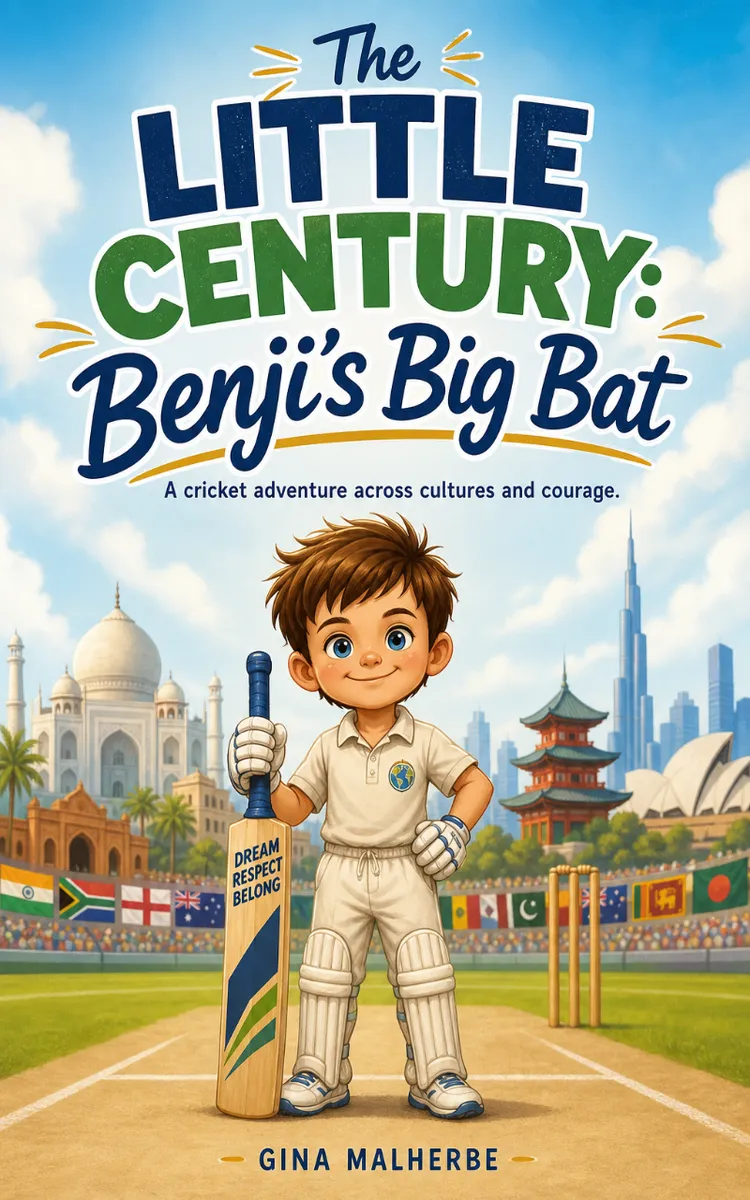
The Little Century: Benji’s Big Bat
Created with Inkfluence AI
Middle-grade cricket journey raising funds and learning cultures
Table of Contents
- 1. The Boy with the Ball
- 2. Concrete Pitch, Big Heart
- 3. Newlands Charity Match Sparks
- 4. Lucky Gloves Dash at Security
- 5. Trinidad Nets and New Friends
- 6. The Missing Tea Bag Storm
- 7. Caribbean Wicket Celebrations Mystery
- 8. Train Ride Through the Wrong Gate
- 9. Benji’s Choice to Share Gloves
- 10. The Rain That Breaks the Bat
- 11. Leah Learns the Footwork Code
- 12. The Editor’s Shortcut Backfires
- 13. A Memory Card Rescue Mission
- 14. Next Flight, New Notebook Rules
- 15. Mid-Tour Map of Cricket Cultures
- 16. Delhi Dust and Stubborn Stumps
- 17. Benji’s Fear of Getting It Wrong
- 18. The Lunchbox Language Mix-Up
- 19. Finding the Real Cricket Song
- 20. Rain-Shortened Match, Broken Promise
- 21. Benji’s Apology That Works
- 22. The Bus That Won’t Start
- 23. When the Footage Won’t Load
- 24. The Missing Over Tape Mystery
- 25. A Street Match on New Ground
- 26. Benji’s Big Bat Saves the Day
- 27. Leah Chooses Truth Over Perfect
- 28. The Coaching Promise Takes Shape
- 29. Benji Tracks the Last Missing Piece
- 30. Back Above the Studio, Big Bat
Preview: The Boy with the Ball
A short excerpt from “The Boy with the Ball”. The full book contains 30 chapters and 60,993 words.
The ball whispered off my index finger and skimmed low across the concrete like it had somewhere secret to be. It landed with a sharp pop that sounded right under my feet. The batsman’s eyes narrowed. I could hear Thando breathing behind me - steady, as if he counted his steps on the run-up - and the whole world for a second was the red ball, the seam, the squeeze of my fingers.
“Nice line, Benji!” Thando called. His voice came like a wave from Langa. I kept my own rhythm: one, two, three, plant. The air smelled of Leah’s lemon soap from the studio below and the frying oil from the stall by the park gate. Table Mountain lay quiet and wide, like someone napping under a blanket. The concrete under my sneakers felt rough and familiar, like the top of an old table my hands knew well.
I ran again. The ball left with a small hiss and the batsman swung and missed. It kissed his pad and hit the stumps with a clatter that made a small cheer ripple along the street. My chest filled up warm and noisy. I had been playing for the Observatory Otters for a while - tossing the ball in the nets, chasing it in the park - but lately my notebook had filled with sketches of run-ups and wrists, lines and angles, ways to make the ball move like it had a mind of its own. I carried a cricket bag with the usual bits - spare sunblock, tea bags, rescue supplies for stray animals - because that was how I liked to be ready. Today, I wanted the ball to do the talking.
Leah crouched on the low wall with her camera resting on her knee. Her scarf was bright as a stage costume, one she’d used when she toured as a dancer years ago. She peered through the lens and smiled the way she did when she was about to film something she loved. “Slow your arm after release,” she said, pointing with the camera like it was a baton. Her voice smelled faintly of rooibos tea. Her hands steadying me felt like they had learned how to catch rhythm and turn it into motion.
Thando took the ball from me and walked back to his mark. He was fifteen and moved like someone who had practiced his speed a hundred times. When he ran in, the batsman climbed up to meet him and the bat rang clean. Thando’s ball sang with air and the batsman fended. “Ready, Benji?” he asked when he returned the ball, a grin in his voice.
“Ready,” I said, and my knees felt like drummers. I took my run-up and let everything fall into place - the slap of my shoe, the release, the follow-through. This time the bat missed and the ball slid back toward the stumps. I darted forward, scooped it up and, because I had learned how to be quick wherever I stood, I flicked the bails off with a clean hand. Someone laughed, and Thando whooped. Leah clicked the camera. My body hummed like a tuned string.
Mr. Dlamini from the community centre walked over carrying a thermos of tea and a packet of biscuits. His smile was the small, steady kind you trust. “Busy day,” he said, pouring tea into paper cups. The steam smelled like the little herb garden in his yard. “You bowl and you chase, young man. That’s talent and work.”
We sat on the low wall drinking warm tea. The talk wandered to Langa and the match from last week - the concrete strip where the kids played with a rubber ball and stones for stumps. I remembered a boy teaching another how to stand with years in his feet, showing by movement not words. That night at dinner I had drawn a small map in my notebook: pins for places to visit, arrows for run-ups, a list that said, “See how kids play.” Leah had laughed softly and said in that kind, steady way, “You’re not going without me. Someone needs to document the footwork.” She always asked before filming, which felt like the most honest rule of all.
Thando dunked his biscuit and said, “We should do a charity match at Newlands. Bring some retired provincial players. Make it a proper day.” He talked like the idea was a kite and we just needed to find the right wind.
Newlands. The word made my stomach feel full. I’d seen it on TV with Leah and once from afar on a bus ride. I pictured the green, the wide stands, the sound of that old ground. “If we do it, we can raise money for gloves and pads for teams that play on concrete,” I said. I thought of blisters and bare feet and taped-up pads. I wanted kids to have what they needed to play without a hurt foot stopping them.
Leah tapped the camera strap and looked like she was deciding whether to do something brave. “We’ll need permission and a plan,” she said. “Thando opens the bowling. I’ll film. You focus on learning the openings.” Her eyes made me feel seen. “And remember - always ask before filming.”
That night I tucked two tea bags into the small pocket of my cricket bag and added a strip of plasters and a tiny soap Leah insisted we carry. I put my notebook on top and sketched a runway of arrows. I liked the idea of maps - small pieces of paper that could hold big places.
The next day, Thando took me to Langa to bowl at the concrete strip....
About this book
"The Little Century: Benji’s Big Bat" is a children's book by Gina Malherbe with 30 chapters and approximately 60,993 words. Middle-grade cricket journey raising funds and learning cultures.
This book was created using Inkfluence AI, an AI-powered book generation platform that helps authors write, design, and publish complete books. It was made with the AI Children's Book Creator.
Frequently Asked Questions
What is "The Little Century: Benji’s Big Bat" about?
Middle-grade cricket journey raising funds and learning cultures
How many chapters are in "The Little Century: Benji’s Big Bat"?
The book contains 30 chapters and approximately 60,993 words. Topics covered include The Boy with the Ball, Concrete Pitch, Big Heart, Newlands Charity Match Sparks, Lucky Gloves Dash at Security, and more.
Who wrote "The Little Century: Benji’s Big Bat"?
This book was written by Gina Malherbe and created using Inkfluence AI, an AI book generation platform that helps authors write, design, and publish books.
How can I create a similar children's book?
You can create your own children's book using Inkfluence AI. Describe your idea, choose your style, and the AI writes the full book for you. It's free to start.
Write your own children's book with AI
Describe your idea and Inkfluence writes the whole thing. Free to start.
Start writingCreated with Inkfluence AI


