
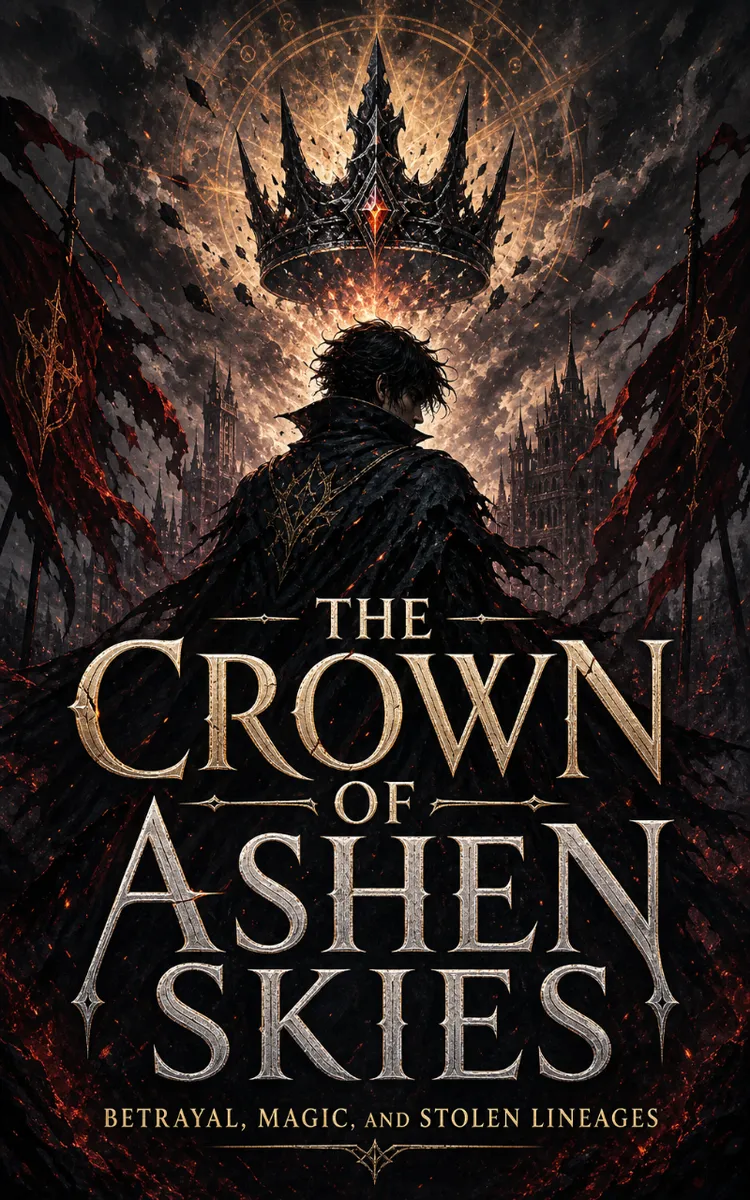

Read the first chapter
The whole of chapter one, free. About 15 min. Turn the pages with the arrows, your keyboard, or a swipe.
Chapter 1
Ashen Skies and Stolen Blood
Cinders drifted through the rafters of Highwarden Hall like slow snow, settling on the polished planks and the brass fittings of the braziers. The air tasted of old smoke and iron, as if the walls had learned to bleed. Far below the balcony, men in ash-grey livery argued over ledgers and ration counts, their voices muffled by banners that hung stiff with soot. Above them, the sky pressed close through a shuttered window-ashen, bruised, and low enough to scrape the roofline when the wind rose.
Sable Veyin stood with her palms flat against the cold stone of a narrow slit in the wall, feeling the tremor of distant thunder through her bones. Not thunder. The bell of the border watch, struck too many times too quickly, then cut short-an alarm strangled mid-breath. She had heard that bell before, back when it still meant raids. Now it meant something worse: court news arriving like a spear, without the courtesy of a greeting.
Behind her, the chamber door scraped open, and a man stepped in carrying the smell of wet wool and horse sweat. Captain Renn Holt moved like he expected the floor to betray him. His cloak was darkened at the hem, and ash clung in streaks to his boots as though he’d walked through a funeral. He didn’t bow. He didn’t even pause to confirm whether she was alone.
“Your seal was refused at the western gate,” Holt said. His voice held the gravel of disuse, worn down by nights spent arguing with guards and waiting on the wrong kind of permission. “They won’t bring the child to the hall.”
Sable turned slowly. In the brazier light, her reflection in the brass looked thinner than it should have, her eyes too bright against the soot-stained stone. “Which gate?”
“The one at Varr. The gatehouse says the decree hasn’t been properly witnessed.”
“It’s witnessed by the crown,” she said. The words came out sharp, like a blade drawn too fast. “By the Warden of Ash, by-”
Holt cut her off with a hard blink. “By the wrong hand.”
The smear of heat from the nearest brazier licked her knuckles, but the skin on her wrists stayed numb. Her wanted certainty-the clean line of law she’d been promised when the war began-had already frayed. For months she’d carried messages between officers, between councils, between men who pretended the enemy was only a distance away. For months she’d watched how quickly promises turned to ash when they were spoken near power.
And now the child was being withheld.
Sable let her gaze slide to the side of the chamber where a curtain hung over a narrow archway. It had been closed since dawn. The servants had walked past it without speaking, as if sound might wake something inside. Sable had been told it was only a precaution. A ward. A measure against theft. A guard against the kind of hunger that wore crowns.
She knew better. Hunger never wore crowns. Hunger wore faces.
“What do they want?” she asked.
Holt’s jaw flexed. “They want her blood-tested again.”
Sable’s throat tightened. “Again?” She tasted smoke, though the braziers burned steady. “Who ordered it?”
Holt held out a folded strip of parchment, the wax on it cracked like old skin. “From the House of Lorn. From Lady Merrowa’s council. They claim the seals on the child’s records were copied in the wrong order.”
Sable took the parchment carefully, as if it might bite. The wax bore the spiral sigil of Lorn-an emblem older than the current war, older than the promises the kingdoms had traded to make this conflict tolerable. The ink was fresh enough to smell faintly of resin.
“You’re certain?” she said.
“I watched the clerk do it,” Holt replied. “He didn’t know I was there. I heard him say the original ledger was ‘misplaced by treachery’ and that treachery could be corrected.”
Sable’s fingers tightened until the parchment creased. Treachery. The word landed like a stone in her stomach. She’d seen men use it to hide their cowardice, to excuse their failures. She’d used it herself once, when the alternative was naming a truth aloud.
Now a truth was being sold back to her as procedure.
The curtain at the archway trembled, just once. The servants had not moved it. The air in front of it held a faint, cold scent-winterroot burned too close to flesh.
Sable glanced at Holt. “The child-”
“Not moved,” Holt said quickly, as if he’d already counted the cost of her questions. “Not harmed. Not yet.” His eyes flicked to the curtain again. “But the men outside are waiting for permission to breach the archway. If I stall any longer, they’ll drag the test instruments in and do it here.”
Sable stared at the wax seal until the lines of the spiral blurred. In the shadow of war, everything became a test. Every oath. Every scar. Even breath.
And the heir-stolen, hidden, smuggled across the border like contraband-had become the most dangerous kind of evidence. The kind that could rewrite treaties, resurrect dead lines, and make old blood matter more than current lives.
“Bring me to the western gate,” Sable said. She surprised herself with how calm her voice sounded. Calm was a costume she’d learned to wear around men who wanted to panic. “Now.”
Holt hesitated. “They’ll arrest you.”
“They’ll try,” Sable answered. She set the parchment against the stone and smoothed it once, as if flattening a crease could flatten suspicion. “If the decree was refused, then the decree is the only weapon I have. I’ll wield it until it breaks.”
Holt’s gaze softened for half a breath, the kind of expression a man gives before he decides whether loyalty is worth the cost. “The council chamber sent a rider to Lorn’s hall. They’re assembling witnesses.”
“Then they’re afraid of what I’ll see,” Sable said.
She moved before Holt could argue. The braziers’ heat followed her like a lingering threat, and the soot in the air thickened as she passed under the balcony. Servants pulled back as she walked, their eyes fixed on the edges of her sleeves rather than her face. Nobody wanted to be remembered as the one who looked too long at the woman who carried the crown’s seal.
Outside, the hall’s corridors smelled of damp wool and tallow. Somewhere down the way, a door slammed, and a muffled curse echoed off stone. The sound reminded Sable of her own childhood-how quickly adults could turn a room into a battlefield when the truth threatened them.
They descended into the courtyard where ash fell in slow sheets. The ground was churned from wagons and bootsteps, and the air was slick with recent rain. In the middle of the yard, a line of armed men waited under a canopy of black cloth. Their armor bore the faint grey sheen of war-polish; their faces were smeared with soot to keep grime from catching light during night raids. Their commander, a broad-shouldered woman named Cressa, lifted her chin when Sable approached.
“Highwarden,” Cressa said, and the title sounded like a question she didn’t want answered.
Sable stopped at the edge of the line. “Where is the western gate?”
“On the other side of the yard,” Cressa replied. “And barred.”
“Barred by whom?”
Cressa’s eyes flicked to Holt, then away again. “By Lorn’s men. They claim they have the right to verify the heir’s lineage before any handover.”
Sable’s mouth went dry. “The heir has already been verified.”
“By your seal,” Cressa said, and her tone made it clear that was the argument. “They say seals can be copied. They say documents can be forged. They say the record was… tempered.”
Tempered. A word used by smiths, by alchemists, by men who pretended changing metal was different from changing blood.
Sable turned to Holt. “You said the clerk didn’t know you were there.”
“I did,” Holt replied. “I heard him say treachery could be corrected. He used the word ‘tempered.’”
Cressa exhaled through her nose. “Then you know what’s coming.”
Sable’s gaze drifted to the gate itself-a heavy iron structure at the far end of the yard, its bars blackened and scarred from earlier sieges. Men had stacked wagons against it, forming a makeshift barricade. The gatehouse above it was lit by lanterns, their flames steady despite the damp wind.
Sable approached the nearest soldier. “Let me pass.”
The soldier’s eyes slid to her seal pouch, the leather strap at her hip, and then away again. “Orders stand. No Warden enters without Lorn’s witness.”
Sable felt heat rise in her chest. Not anger alone-something sharper, threaded with dread. They weren’t stopping her from reaching the heir. They were stopping her from witnessing what Lorn would do with the heir when the instruments arrived.
She could imagine the room where blood would be drawn, the questions asked, the answers demanded. She could imagine a blade pressed to a child’s skin in the name of lineage.
Sable lifted her hand, not to strike, but to signal Holt. “Open the way,” she said to Cressa. “If they want witnesses, let them witness me.”
Cressa looked as if she’d been struck with cold water. “You’ll be arrested.”
“I’ll be seen,” Sable corrected. “And if I’m seen, they’ll hesitate.”
A murmur rippled among the men at the barricade. Someone spat into the mud, and the sound was loud in the damp air. Holt moved closer, lowering his voice so only she could hear.
“They’re already arguing about who holds authority over the child,” he said. “If you step into Lorn’s hands, they might claim the heir from your crown’s line. Not as theft. As inheritance.”
Sable’s fingers went numb around the strap of her seal pouch. Inheritance. Not the stolen heir as prize, but as right. A claim so old it had survived the war by hiding inside law.
That was the danger she hadn’t wanted to name: both kingdoms could be right, and that would make both kingdoms wrong in the same breath.
A bell rang from the direction of the border watch, once, then again-two strikes that carried through the yard like a warning drum. The air seemed to tighten around it.
Sable set her palm against the cold iron of the outer gate. The metal was slick with rain, and the cold bit into her skin. She could feel the wardwork in it-thin lines of binding runes embedded under the bars, faintly warm from use. The forbidden binding magic that once ended hostilities had been woven into the border, into the very idea of peace.
It had always been there, asleep under law.
Now, somewhere beneath the stone and iron, it stirred like something turning over in its sleep.
The lantern flames above the gate flickered, bending sideways though the wind didn’t touch them. A low hum rose-too low for most ears, but Sable felt it through her teeth. The barricade men stiffened, their faces paling as if the hum had pressed a hand to their throats.
Cressa swore. “By the ash gods-”
Sable lifted her head. Over the gatehouse, the iron lattice glowed faintly, not with light but with absence, as if the runes were drinking the air. The hum deepened, and the smell of winterroot burned sharper in the rain.
Holt leaned toward her, voice tight. “That’s not normal.”
“No,” Sable said, though her mind raced for the explanation and found only fear. “The binding doesn’t wake for court disputes.”
Another bell strike sounded, louder this time, and the lanterns went out one by one like eyes closing. Darkness pressed in, broken only by the pale glow of the gate’s embedded lines.
From behind the barricade, a door opened in the gatehouse wall, and a figure stepped out wearing a scholar’s robe over armor. The robe was the color of ash after lightning-grey veined with darker streaks. In one hand she carried a small case of instruments; in the other, a ring of iron etched with spirals matching the Lorn sigil on Holt’s parchment.
Lady Merrowa’s herald, Sable realized with a sick certainty. Not Merrowa herself, but someone who had learned to speak with Merrowa’s authority.
The herald lifted her chin toward Sable. “Highwarden Veyin,” she called, and her voice carried across the yard without strain. “By order of Lorn’s council, the heir must submit to blood-ward verification. You are to stand aside.”
Sable swallowed, forcing the air down. The hum under the gate deepened, and the runes seemed to crawl along the bars, tracing paths as though searching for a seam. “I will not stand aside,” she said. “The decree you carry is witnessed by a clerk who tampered with the ledger.”
The herald’s expression didn’t change. “Clerks are replaceable. Blood is not.”
Sable felt her temper flare, but she held it like a blade she wasn’t yet ready to swing. “You want the heir because both kingdoms claim her. That is not verification. That is conquest with paperwork.”
The herald’s gaze sharpened. “Conquest?” she echoed, as though tasting the word. “The crown of ash and Lorn’s line are bound by more than war. We are bound by legacy. The binding magic-”
The hum surged so suddenly Sable staggered. The air around the gate tasted of copper. Somewhere in the yard, a man cried out, not from pain but from sudden dizziness, as if his bones had forgotten which way to face.
The herald didn’t flinch. She opened her instrument case. Metal instruments gleamed dully, their edges too clean for anything born of the field. A thin rod, etched with faint script, rose into her grip.
“-requires the correct lineage,” she finished. “Without it, the bind fractures. Without it, the peace that ended yesterday will not survive tomorrow.”
Holt’s hand closed on Sable’s wrist, not to restrain her but to anchor her as the hum tried to shake her loose from her own body. “Sable,” he said, and her name sounded like a plea he didn’t know he could make.
Sable stared at the runes on the gate. She could feel the binding responding, not to the arguments of men, but to blood. To the stolen heir’s presence-like a key turning in a lock whose maker had died centuries ago.
“You’re lying,” Sable said, though she wasn’t sure to whom. “You’re using the binding as a threat to force your claim.”
The herald’s eyes flicked to the archway at Highwarden Hall, visible in the far distance between buildings. “No,” she replied softly. “We are afraid the binding has already begun to choose.”
A sound came from within the gatehouse-scrapes of boots, hurried voices. The soldiers who’d barred the archway earlier shifted, suddenly unsure. Their fear answered the herald’s certainty.
Sable released Holt’s wrist and stepped forward until she stood within arm’s reach of the iron bars. The cold rune-lines kissed her skin like invisible frost. She drew a breath that tasted of rain and ash.
If they wanted the heir’s blood, they would not take it without her seal. If the binding magic was waking, then the stolen heir’s lineage was not merely a political question. It was a living thing, hungry for the truth of who belonged to whom.
Sable lifted her seal pouch and broke the wax on the strap with her thumbnail. The leather split, and the crown’s sigil inside glowed faintly in the rune-light. It was warmer than it should have been, as if the seal had been waiting for this moment.
The herald’s gaze narrowed. “You can’t-”
“I can,” Sable said, and the words felt like stepping onto ice that might crack. She pressed the crown sigil against the gate’s embedded spiral.
The hum snapped into a chord. The runes blazed pale, then dimmed, searching. Sable felt something tug at her ribs, as if the binding tried to pull her heart toward the answer. Her vision blurred at the edges. The rain on her lashes tasted like ash.
Holt grabbed her shoulder. “Sable-stop!”
She couldn’t stop. Not while the binding was awake and the heir was within reach of hands that would claim her blood as proof. She forced her breath steady, forced her palm to remain against the iron.
The gate’s bars shuddered, and the barricade wagons creaked as if the yard had become a ship on rough water. Then, from somewhere inside Highwarden Hall, a bell rang once-smaller than the border watch bell, but clear. A child’s alarm, struck by someone who didn’t know how to be quiet.
Sable jerked her head toward the hall. The herald followed her gaze, and for the first time her composure fractured. “They’ve moved her,” the herald said.
Sable’s stomach dropped. “Who?”
“Your own guards,” Holt whispered, and the way he said it made the word taste rotten. “Someone opened the archway.”
Sable’s hand slipped on the cold iron. She stared at the runes, still glowing, still searching for lineage. The binding magic did not care about decrees. It cared about blood and the truth buried beneath stolen records.
The stolen heir-more than a prize, more than an inheritance waiting to be claimed-had been taken from her containment, carried into the open at the exact moment the bind began to fracture.
Sable pulled her palm away. The iron cooled instantly, the hum receding like a threat withdrawing its teeth. The gate’s runes dimmed to faint traces beneath the black metal.
The herald backed a step, instruments clutched to her chest. “If the heir is outside the wards,” she said, voice tight now, “the binding will seek another anchor.”
Sable tasted copper again. “Then it will find the one who took her.”
A roar of boots sounded from the direction of the hall, and men surged toward the courtyard through the rain. Among them, a guard she recognized-Kellan of the inner watch-stumbled, his face smeared with soot and shock. His eyes found Sable, and his mouth opened as if to speak, but only a choked breath came out first.
“She’s gone,” Kellan managed, and the words were wrong in his mouth, as if he’d forgotten how to say them. “They-someone-”
He fell silent when Sable stepped past him, toward the hall’s archway. The air there smelled different now, sharp as winterroot and smoke. The ward lines in the stone under the curtain felt exposed, like skin without cloth.
Behind her, Holt swore under his breath. The herald called for her men, her voice losing its calm edge. The courtyard erupted into motion-confusion, accusation, the scramble of competing claims.
Sable didn’t wait for permission. She pushed through the archway’s curtain and into the corridor beyond, where the shadows were not comforting but hungry. The hum of the binding lingered faintly in the walls, and it seemed to pulse in time with her heartbeat as if asking a question it already knew the answer to.
Somewhere deeper inside, a child’s cry cut off abruptly, replaced by the sound of hurried footsteps and the scrape of metal against stone. The smell of winterroot grew stronger, threaded with fresh blood.
Sable ran, her boots slipping on wet ash, her seal pouch banging against her hip with each stride. If the binding magic was choosing an anchor, then the stolen heir’s lineage-her inherited right-would be revealed in the only way that mattered.
Not by paperwork.
By force.
End of chapter one. 7 more chapters in the full book.
Swipe or use the arrows to turn the page


What's inside: 8 chapters
- 1. Ashen Skies and Stolen Blood
- 2. The Binding Spell That Refuses
- 3. Maps of Lost Lineages
- 4. The Crown Bought With Silence
- 5. Vows Broken by the Ashen Oath
- 6. The Traitor’s Name in the Sigil
- 7. When the Binding Turns Against Them
- 8. Crown of Ashen Skies, Price Paid
About this book
"The Crown Of Ashen Skies" is a fiction book by Inkfluence AI Demo with 8 chapters and approximately 23,317 words. Epic fantasy story of kingdoms, heir, and forbidden magic.
This book was created using Inkfluence AI, an AI-powered book generation platform that helps authors write, design, and publish complete books. It was made with the AI Novel Writer.
Frequently Asked Questions
What is "The Crown Of Ashen Skies" about?
Epic fantasy story of kingdoms, heir, and forbidden magic
How many chapters are in "The Crown Of Ashen Skies"?
The book contains 8 chapters and approximately 23,317 words. Topics covered include Ashen Skies and Stolen Blood, The Binding Spell That Refuses, Maps of Lost Lineages, The Crown Bought With Silence, and more.
Who wrote "The Crown Of Ashen Skies"?
This book was written by Inkfluence AI Demo and created using Inkfluence AI, an AI book generation platform that helps authors write, design, and publish books.
How can I create a similar fiction book?
You can create your own fiction book using Inkfluence AI. Describe your idea, choose your style, and the AI writes the full book for you. It's free to start.
Write your own fiction book with AI
Describe your idea and Inkfluence writes the whole thing. Free to start.
Start writingCreated with Inkfluence AI


