
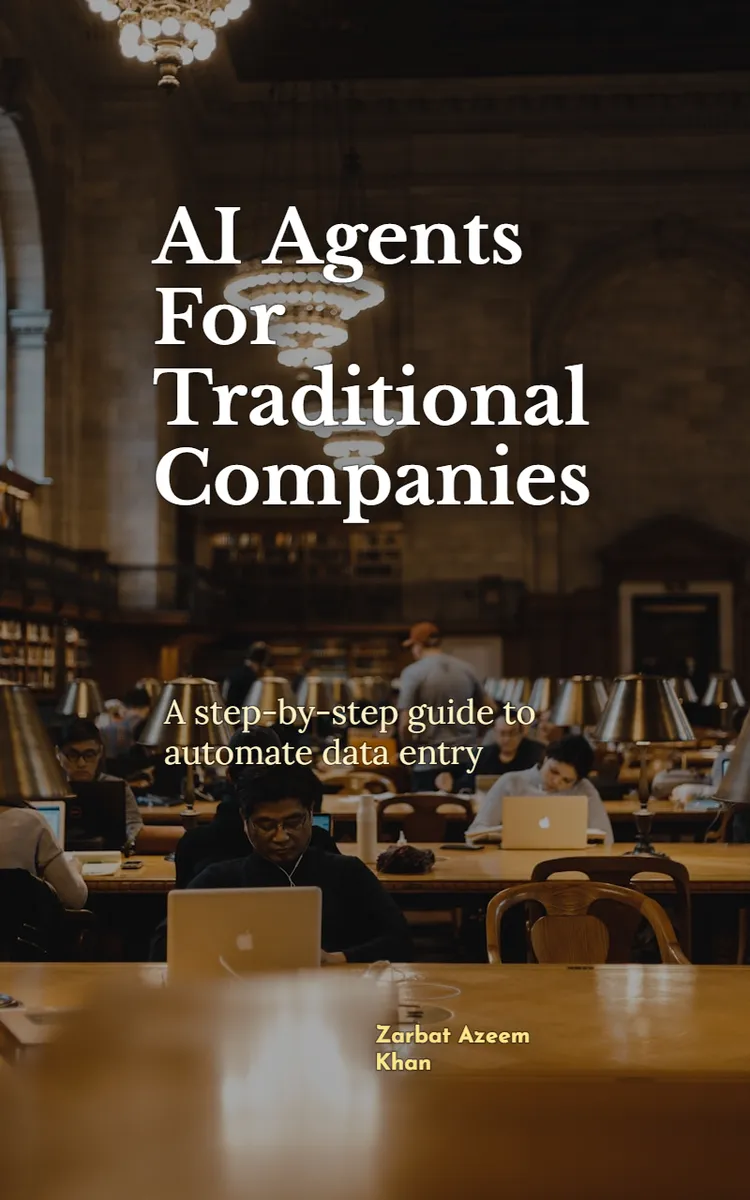
AI Agents For Traditional Companies
Created with Inkfluence AI
Implementing AI agents to replace manual data entry
Table of Contents
- 1. Mapping Manual Data Entry Workflows
- 2. Defining Agent Inputs, Outputs, and Rules
- 3. Building a Data Quality Gate for Accuracy
- 4. Designing Human-in-the-Loop Review Paths
- 5. Rolling Out Agents with Compliance and KPIs
Preview: Mapping Manual Data Entry Workflows
A short excerpt from “Mapping Manual Data Entry Workflows”. The full book contains 5 chapters and 10,928 words.
A stack of intake forms sits on Priya Nair’s desk every morning - credit applications, purchase order changes, and shipment confirmations. Someone typed key fields into spreadsheets yesterday. Someone else emailed updates today. By noon, different versions of the “same” order live in different places, and the only way to reconcile them involves copying, pasting, and chasing down whoever has the latest file. That’s the hidden cost of manual data entry: it doesn’t just slow work down, it creates dozens of small handoffs where mistakes can slip in.
To replace manual data entry with an AI agent, you need a clear target. This chapter helps you build that target by mapping every manual input step, every data source the step depends on, and every handoff where data changes hands or formats. After you finish, you’ll know exactly what your agent must capture, validate, and send - so you can start designing the replacement without guessing.
You’ll also learn a practical way to document the workflow so it doesn’t drift. The goal isn’t to write a perfect process document. The goal is to produce a Workflow Trace Map that you can hand to operations, IT, and whoever will test the agent - so everyone sees the same inputs, the same rules, and the same “done” outcome.
Building a Workflow Trace Map for Manual Inputs and Handoffs
The Workflow Trace Map turns a messy, human-run process into a list of concrete actions your team performs today. You trace where data comes from, where someone types it, where someone checks it, and where someone forwards it. That trace tells you what the AI agent must replace - and what it must not touch yet.
Start with a simple truth: manual data entry happens at specific points. People don’t “enter data” in general; they enter it into a specific system, from a specific source, using a specific template, and then they send it to a specific next step. If you can’t name those points, you can’t automate them safely.
Priya’s distributor runs order changes through a chain of emails, a shared spreadsheet, and an ERP (Enterprise Resource Planning) system. She has a recurring pattern: a customer emails an updated quantity or delivery date, an employee copies the details into a spreadsheet for tracking, another employee reviews exceptions, and then a final person updates the ERP so shipping can proceed. If you only automate “data entry,” you miss the real work: the copying between formats, the exception checks, and the handoff that tells shipping the update is real.
Use this mapping technique to capture the workflow in operational language your team already uses. Build it as a series of traceable steps:
1. List each manual “touchpoint” where a person types or selects data
Write every step where someone enters fields into a form, spreadsheet, or system. Include the exact destination (for example, “Spreadsheet: Order Change Tracker”) and the exact fields (for example, “New Requested Date,” “Quantity,” “Customer PO Number”).
Why this matters: AI agents need a clear input target. “Enter the order update” hides the exact fields the agent should fill.
2. Record the data source for each touchpoint
For every manual entry step, note where the data came from right before the employee typed it. Examples: an email body, a PDF attachment, a scanned document, a phone transcription, a customer portal export (CSV - Comma-Separated Values), or a printed packing slip.
Why this matters: the agent needs to read the same source type (email text vs. PDF) and extract the same fields.
3. Capture the handoff and the handoff format
Document who receives the data next and in what form. Examples: “Send spreadsheet row via email to Priya,” “Update ERP order header,” “Post exception list to the shared inbox,” or “Attach PDF confirmation to ticket.”
Why this matters: handoffs define where errors multiply. The agent must either replace the handoff or produce output in the exact format the next step expects.
4. Define the “done” outcome and the validation rule at each step
For each touchpoint, write what “done” means and what check the employee performs. Examples: “ERP update succeeded and status changed to ‘Ready for Pick’,” “Price matches contract,” “Quantity does not exceed credit limit,” or “Requested date falls within delivery window.”
Why this matters: validation rules tell you what the agent must verify before it sends data forward.
A quick comprehension check: when you look at one step on your map, can you answer three questions immediately - Where did the data come from? Where did the person type it? What system or person receives it next? If you can’t, you haven’t mapped the touchpoint tightly enough.
Practical takeaway: The Workflow Trace Map converts “manual data entry” into a set of named inputs, destinations, and handoffs you can replace one step at a time without breaking downstream work.
...
About this book
"AI Agents For Traditional Companies" is a how-to guide book by Zarbat Azeem Khan with 5 chapters and approximately 10,928 words. Implementing AI agents to replace manual data entry.
This book was created using Inkfluence AI, an AI-powered book generation platform that helps authors write, design, and publish complete books. It was made with the AI Ebook Generator.
Frequently Asked Questions
What is "AI Agents For Traditional Companies" about?
Implementing AI agents to replace manual data entry
How many chapters are in "AI Agents For Traditional Companies"?
The book contains 5 chapters and approximately 10,928 words. Topics covered include Mapping Manual Data Entry Workflows, Defining Agent Inputs, Outputs, and Rules, Building a Data Quality Gate for Accuracy, Designing Human-in-the-Loop Review Paths, and more.
Who wrote "AI Agents For Traditional Companies"?
This book was written by Zarbat Azeem Khan and created using Inkfluence AI, an AI book generation platform that helps authors write, design, and publish books.
How can I create a similar how-to guide book?
You can create your own how-to guide book using Inkfluence AI. Describe your idea, choose your style, and the AI writes the full book for you. It's free to start.
Write your own how-to guide book with AI
Describe your idea and Inkfluence writes the whole thing. Free to start.
Start writingCreated with Inkfluence AI


