
Read the first chapter
The whole of chapter one, free. About 10 min. Turn the pages with the arrows, your keyboard, or a swipe.
Chapter 1
Born in 1741: Early Foundations
A midwife’s basin steamed on the rushes, and the room smelled of boiled linen and cold tallow even as the hearth tried, with stubborn heat, to make the air kind. Outside, the town carried on with its ordinary noises - the scrape of a cartwheel on stone, the call of a watchman at intervals, the thin clatter of something metal that might have been a gate latch. Within, James Stuart was born in 1741, and the first sounds he knew were not the grand proclamations that later would be pinned to officers’ coats, but the rough, practical movements of people who had learned to keep their voices steady when the body did not.
His mother’s breathing had a rhythm that no one in the room mistook for calm. It came broken, then steadied, then broke again, as if her body were bargaining with pain. Those closest to her - women with sleeves rolled back and hands stained faintly with herbs - spoke of what must be done without speaking of how frightened they were. “Hold fast,” one of them said, and the phrase was as much a plea as an order. Even then, before the child could do anything but exist, James Stuart was surrounded by a kind of determination that did not seek tenderness so much as success. When the midwife lifted him, there was a moment of silence that felt longer than any prayer, broken only by the wet sound of breathing and the quick, relieved rustle of cloth.
He was not, in those early hours, a story of conquest. He was a child wrapped in linen, warmed by a body heat that would soon belong to him alone. His father - present only when his duties permitted - stood near the table where the basin had been set down. He smelled of damp wool and the faint tang of ink from a letter he had tried to finish before leaving for the house. When he leaned closer, it was with the caution of a man who had spent his life around disciplined spaces and did not fully trust disorder in the one place where disorder had come uninvited.
“Will he take?” the father asked, his voice clipped as if it were borrowed from the barracks.
The midwife’s reply came after a look that included not only the child’s face but the color of his skin and the strength of his first cry. “He will,” she said, and the certainty was a small mercy. “He has come properly.”
Properly - there was something in that word that would echo later in James Stuart’s life, when he would be judged by what was proper in drill, in paperwork, in the measured obedience of a regiment. At the time, it meant only that the child’s lungs had begun their work and that the room’s cold had been cheated for a while.
The weeks that followed were not gentle in their own way. They had the steady, grinding sounds of routine: water warmed, cloth washed, the soft fussing of infants soothed by repetition rather than imagination. James Stuart’s earliest memories, if they could be called that, were more likely impressions than scenes - warmth from a body beside him, the scratch of a coarse blanket, the smell of milk turning, the muffled conversation of adults whose voices softened when they believed he slept. Yet even without formal recollection, the shaping of him began in those surroundings where survival depended on order. The family could not afford extravagance. They could not afford delay. Even joy, when it came, arrived through the careful opening of a door, not with any flourish.
As he grew enough to be carried to the threshold and set down on the packed earth, he watched the adult world with a seriousness too old for the size of his limbs. He listened to men speaking of schedules, of inspections, of the weight of uniforms on shoulders. One could hear, beneath the town’s everyday noises, the particular cadence of military life - names of ranks said plainly, as if the ordering of men were a language everyone understood. It was not uncommon for a British officer, passing through, to stop for a short while, to speak politely and then move on. The respect that followed those visits did not feel theatrical; it was practical, like the respect given to a clock because it kept time when the household needed it.
When James Stuart was old enough to understand that some people wore authority as a matter of custom rather than personal whim, a question began to form in him. He did not ask it aloud, not then. He learned it by watching how adults treated obligations. A man might be friendly, but if an order had to be carried, it was carried. If a promise had been made, it was kept, even when the weather turned. The discipline of it settled into James Stuart as something he could almost touch: the certainty that the world would not be arranged to suit a person’s feelings.
His father spoke of the army when the household was quiet enough for honest talk, and he spoke with the careful pride of someone who had seen both the rewards and the costs. “It isn’t only the parade,” he said one evening, when the fire had burned down to a steady glow. The sound of the wind pressed at the windowpanes, and the room was cool enough that James Stuart drew his knees up against his chest. “There is the work. Paper, stores, marches, sickness. A man learns to count what he cannot eat.”
James Stuart did not interrupt, but he absorbed the terms - paper, stores, marches - as if they were objects on a shelf. He could smell the smoke on the air and the faint sourness of damp clothes drying near the hearth. The father’s words had weight, and the weight was not in the language but in the experience behind it. When the father added, “If you join, you will not be grand at once,” his tone made it clear that the fantasy of glory had no place in his household. It was enough, he implied, to be dependable.
Later, when James Stuart’s own hands were small but busy with the world, he felt that dependability as a daily demand. He fetched things without being asked twice. He carried messages with care, walking the same routes so often that he could judge distance by the sound of his boots on different surfaces. He listened to the older boys talk of the excitement of uniforms and the thrill of being noticed. He did not mock them; he only found himself dissatisfied with talk that did not mention what happened after notice - how men were fed, how discipline was enforced when no one was watching closely.
The pivotal experience that shifted him toward the British Army came not in a moment of spectacle but in an encounter with its exacting side. A distant relative - thin from travel, his coat worn at the elbows - visited the household with news. He had served in a capacity that brought him into contact with officers and with the machinery around them. His stories were not heroic in the way young men often preferred. He spoke of long waits for orders, of the way a regiment’s morale could be bent by shortages, and of the anger that followed when promises were made carelessly and could not be kept.
At one point, while he spoke, a cough caught him, dry and stubborn in the cold air. The mother brought him water, and the room’s temperature seemed to change with the effort of keeping comfort close at hand. James Stuart watched his relative’s hands tremble slightly, then steady as he continued. When the man finished, the father asked the question that mattered. “And the officers - are they always at ease?”
The relative looked at James Stuart, as if measuring the boy’s attention. “Not at ease,” he said. “They are responsible. If something fails, they feel it first. If something goes right, it is because someone planned it to go right.”
“Planned,” the father repeated, tasting the word.
“Planned,” the relative confirmed. “And planned again. A regiment is not only made of brave men. It is made of men who can be relied upon when the day is difficult and the supplies are not.”
That night, James Stuart lay awake with the sound of the wind and the quiet creak of the timber. The obstacle he faced - though he did not have the language for it - was not fear of hardship. It was the uncertainty of how one became the kind of man who could plan and be relied upon. He could already see the shape of the demand. What he did not yet understand was the path from boyhood willingness to officer responsibility.
His realization came slowly, in the way certain truths did. It arrived when he began to be given small tasks that required not only effort but judgment. A book of accounts came into the household after a family business arrangement, and the father allowed James Stuart to copy figures, slowly at first, then with increasing trust. The work was tedious, the ink smell sharp and persistent, the paper rough under his fingers. Mistakes had consequences, not dramatic ones but practical: a figure corrected, a margin rechecked, time lost. James Stuart learned to return to an error without resentment. He learned that discipline was not merely standing straight; it was correcting what could be corrected.
Then, one afternoon, a letter arrived with official marks and a request for prompt response. The father read it twice, then set it down with a firmness that meant he had decided how to proceed. James Stuart watched the process - how the father measured the tone of the request, how he separated what was required from what was merely suggested. When the father handed the letter to him, it was not for reading aloud but for drafting a reply under supervision.
“I want it clear,” his father said. The hearth had cooled, leaving the room with a chill that tightened at the back of James Stuart’s neck. “No ornaments. No excuses. We do what we can, and we say so plainly.”
James Stuart dipped his pen. The first lines were shaky. The second attempt was better. When his father read over the draft, his expression did not soften into praise. Instead it sharpened into approval that came from accuracy. “That,” he said, tapping the page once, “is proper.”
In that single moment, James Stuart understood that his desire to be near military life was not merely about the uniform. It was about the discipline behind it - the ability to put order into words and figures as much as into formations. The change was quiet, but it was decisive. He could now picture himself not as a spectator of command but as its instrument: someone who would carry responsibility without waiting for it to be bestowed.
Looking back, it was that difference - between admiration and readiness - that marked the true turning of his life. I now understand how early the foundations were laid, not through a single grand choice but through repeated lessons in restraint. When the household demanded steadiness at the birth, it taught him that survival depended on composure. When relatives spoke of the army’s hard necessities, it taught him to distrust fantasies of glory. When he copied accounts and drafted responses, it taught him that the work of command began long before the moment of being seen.
The family’s world did not offer him a romantic apprenticeship. It offered him requirements: to be accurate, to be punctual, to be honest in what he could promise. Even his discomfort mattered, because it reminded him that ease was never guaranteed in a life governed by orders. Those early disciplines became a kind of internal instrument, a method for measuring himself against duty rather than against mood.
In time, as age brought him closer to the age when a young man could be considered for service, James Stuart’s sense of direction grew firmer. The army was no longer a distant figure in conversation; it was a structure whose logic he had already touched - through the talk of stores and paperwork, through the feel of rough paper under his pen, through the word proper repeated until it became both a standard and a promise to himself. He did not yet occupy the role he would later earn, but he had begun the shaping of his mind for it.
The room where he had been born was long since replaced in his memory by other spaces, warmer or colder depending on season and circumstance. Yet the first lessons remained. He had come into the world amid practical urgency, and he had grown surrounded by the idea that responsibility was something one learned by doing, not something one claimed by wishing. By the time he stood at the threshold of his own future, the path into the British Army was not simply chosen; it had been prepared within him, line by line, day by day, until it no longer felt like a gamble but like the next proper step.
End of chapter one. 4 more chapters in the full book.
Swipe or use the arrows to turn the page
What's inside: 5 chapters
- 1. Born in 1741: Early Foundations
- 2. Commissioning and First Regimental Duties
- 3. Campaign Service and Battlefield Learning
- 4. Rising Command: Leadership Under Pressure
- 5. Legacy of a British Officer Career
About this book
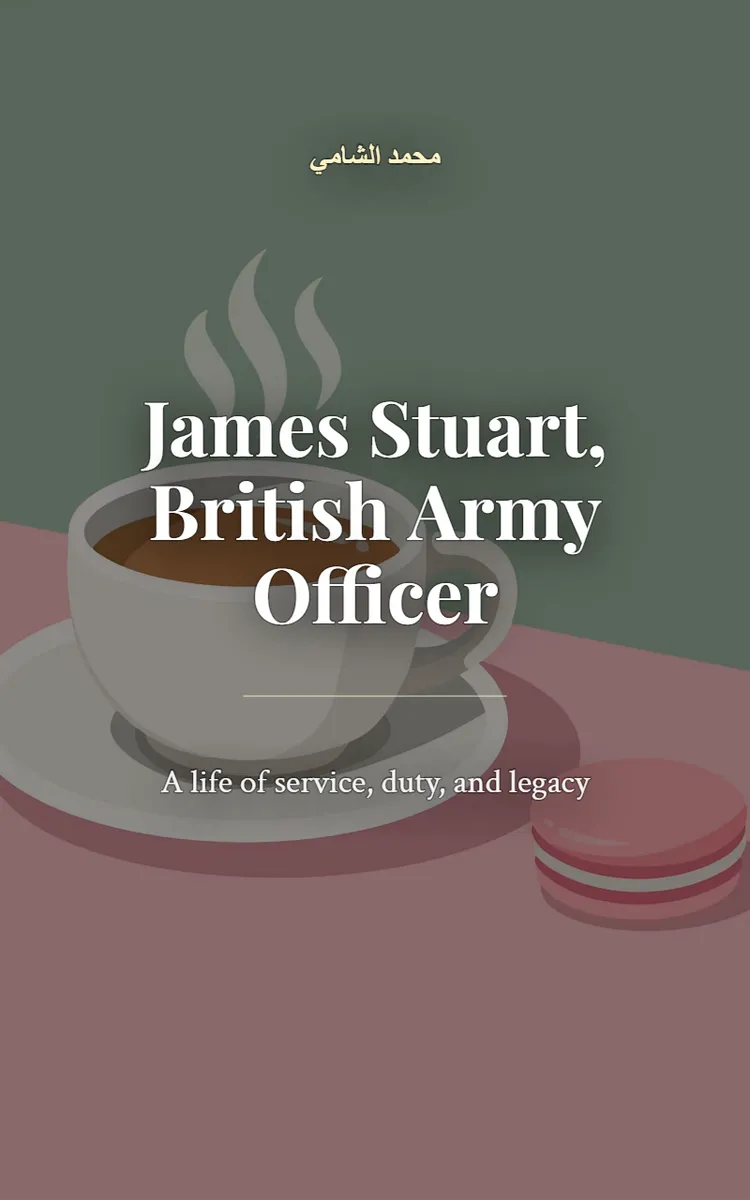
"James Stuart, British Army Officer" is a biography book by محمد الشامي with 5 chapters and approximately 13,184 words. Biography of James Stuart, British Army officer born in 1741.
This book was created using Inkfluence AI, an AI-powered book generation platform that helps authors write, design, and publish complete books. It was made with the AI Biography Writer.
Frequently Asked Questions
What is "James Stuart, British Army Officer" about?
Biography of James Stuart, British Army officer born in 1741
How many chapters are in "James Stuart, British Army Officer"?
The book contains 5 chapters and approximately 13,184 words. Topics covered include Born in 1741: Early Foundations, Commissioning and First Regimental Duties, Campaign Service and Battlefield Learning, Rising Command: Leadership Under Pressure, and more.
Who wrote "James Stuart, British Army Officer"?
This book was written by محمد الشامي and created using Inkfluence AI, an AI book generation platform that helps authors write, design, and publish books.
How can I create a similar biography book?
You can create your own biography book using Inkfluence AI. Describe your idea, choose your style, and the AI writes the full book for you. It's free to start.
Write your own biography book with AI
Describe your idea and Inkfluence writes the whole thing. Free to start.
Start writingCreated with Inkfluence AI


