
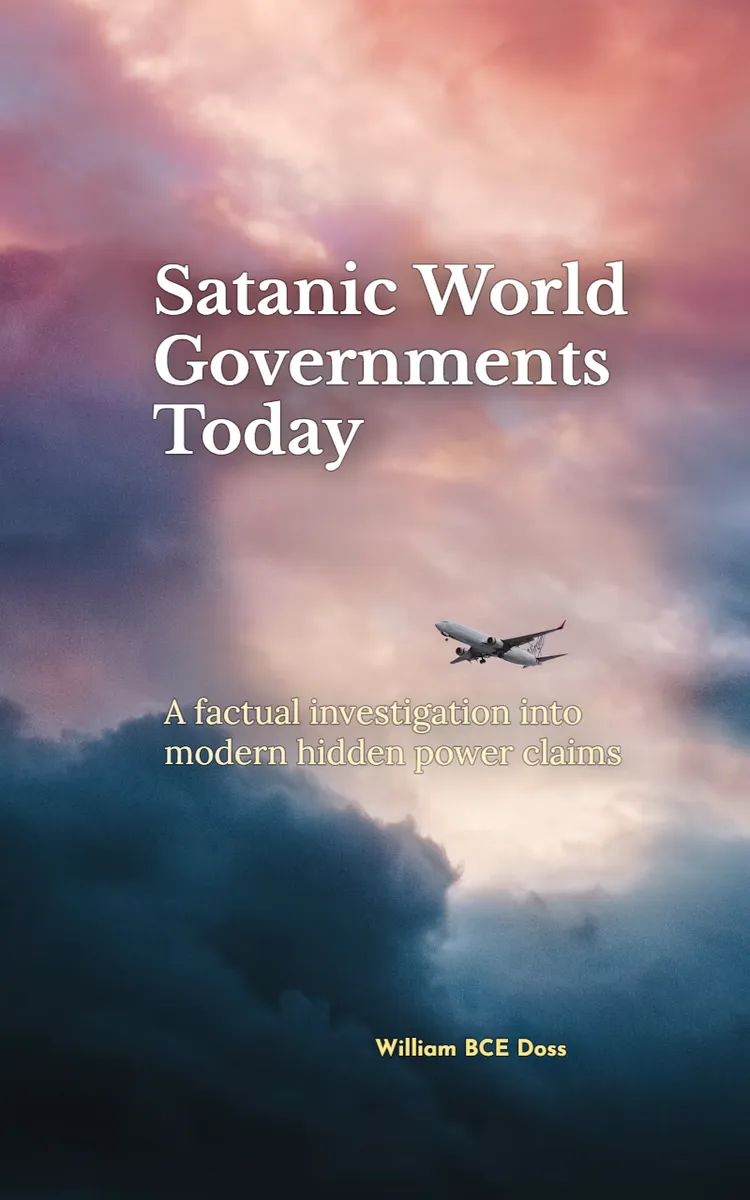
Read the first chapter
The whole of chapter one, free. About 9 min. Turn the pages with the arrows, your keyboard, or a swipe.
Chapter 1
The First Red Flag You Ignore
The Red-Flag Filter and the Signals People Learn to Ignore
The most convincing “Satanic government” claims often start with something small enough to fit into a normal day: a weird sign, a phrase on a form, a coincidence that lands too neatly. The paradox is that these claims don’t usually begin with proof - they begin with interpretation. And once interpretation takes the lead, the mind becomes very good at turning ordinary details into a pattern.
This chapter follows that moment when suspicion meets everyday life, and the everyday details start getting dismissed - or re-labeled - depending on what someone already fears. We’ll look at how people in modern settings encounter signals that could mean nothing, and why they can still feel loaded with meaning when the topic is something as culturally charged as Satanic power.
To keep this grounded, the story centers on Nora, 34, a public librarian, because public libraries are where the “small signals” show up most clearly: in community conversations, in how patrons talk about books, in what people notice on flyers, and in what gets ignored when everyone is trying to get through a busy day. The mystery isn’t whether weird things happen - it’s why some people’s brains treat those weird things as evidence of an organized Satanic world, while other people treat the same details as noise.
What happens inside a person’s perception when “ordinary” starts to feel like “coded”?
How a Weird Detail Becomes “The First Red Flag”
Nora’s days are full of ordinary signals: a patron asking about a book that looks harmless on the shelf, a community group posting a flyer that’s just a little too urgent, a conversation overheard near the printer. Public libraries run on trust and routine, which means the staff learns to spot the difference between a genuine concern and a dramatic one - usually without anyone saying “dramatic.” It’s a kind of pattern recognition built from repetition.
Now add one more ingredient: a broader culture where claims about hidden governments and Satanic influence are constantly circulating, sometimes as warnings, sometimes as “just asking questions.” In that environment, a librarian doesn’t just manage books. She also manages meaning. When people come into a library carrying suspicion, they often bring a small set of details they’ve already decided are important. The first red flag is rarely a smoking gun. It’s more often a familiar civic thing - something printed, posted, or performed - that gets treated like a cipher.
There’s a reason this works. Human attention is not a neutral camera. It’s a filter built for survival: we look for threat, we look for relevance, and we look for patterns that might help us predict what comes next. Psychologists have described how the mind loves coherence - how it prefers a story that ties separate events into one explanation. When the “story” is already loaded with Satanic governance, the mind doesn’t need much to connect the dots. A symbol resembles something; a phrase matches something; a timing coincidence feels too clean.
The catch is that the same mechanisms that help people learn and adapt can also help them over-interpret. A symbol might be common in many places; a phrase might be a generic reference to fear, control, or ritual language that appears across cultures; a coincidence might be exactly what chance looks like when you’re scanning hard enough. The first red flag is the moment you stop asking, “What else could this mean?” and start asking, “How quickly can we fit this into the larger claim?”
Everyday Symbols, Real History, and the Power of Interpretation
The word Satanic carries a particular weight in Western culture. It doesn’t just mean a religious belief; it also functions as shorthand for a whole category of hidden evil - covert, organized, and beyond ordinary scrutiny. That makes it especially effective as a framing device for claims about governments, because governments by definition are systems that operate in ways people can’t fully see. If you want the public to feel that something is secretly happening, “government” gives you an automatic explanation for why evidence is hard to find.
Historically, this framing has been remarkably adaptable. The late 20th century brought waves of moral panic about Satanic ritual abuse, fueled by sensational media coverage, aggressive interviewing practices in some child-abuse cases, and a growing interest in the idea of secret networks. Whatever one thinks about the details of those cases, the broader lesson is clear: when a society becomes primed to suspect hidden wrongdoing, everyday behaviors can be interpreted through that lens, and doubt becomes harder to sustain.
Even outside outright panic, there’s a steady human habit of pattern-finding. Symbols are especially tricky. Consider how many modern symbols have layered meanings - religious, political, decorative, even accidental. A mark on a flyer could be a logo, a graphic style, a design someone inherited from another source, or a nod to something totally unrelated. But once someone believes in a hidden Satanic system, the symbol stops being just a symbol. It becomes a “sign,” and signs demand explanation.
In the library setting, the “signs” might look like this: a flyer that uses old-looking typography; a book display that someone swears is part of a plan; a chant-like slogan that resembles a phrase from a horror film or a viral clip. None of that automatically proves anything. But it can feel like evidence to the person who’s already convinced there’s a coordinated effort behind the scenes.
One scientific concept helps explain why this gets sticky: confirmation bias. Once a belief is in place, people tend to notice information that supports it and discount information that doesn’t. Another is motivated reasoning - the idea that the mind doesn’t just process facts; it also serves goals like reducing fear or making the world feel less random. If a person’s goal is to understand how a frightening idea could be true, then interpreting ambiguous signals becomes part of the solution.
That’s why the first red flag is often not the detail itself, but the rush to meaning. In Nora’s experience, patrons who start with suspicion often speak as if the world is already decoded. The library can offer neutral context - where the book came from, what the event actually is, how the flyer was printed - but the interpretive frame keeps running in the background. The signal is no longer “a thing.” It’s “a clue.”
The Human Story Nora Notices: What Gets Dismissed (and Why)
The most revealing part of Nora’s work isn’t the content of the claims; it’s the social rhythm around them. When someone brings a suspicion into a public space, they’re often trying to do something that looks reasonable from the inside: protect others, warn people, make sense of unsettling information. Their story usually has a beginning - “I noticed this” - and then it accelerates into certainty. The problem is that the acceleration often skips the slow steps that would test the claim against reality.
Nora has seen how quickly an everyday observation can become a moral judgment. A decorative symbol turns into “they’re confessing.” A community event turns into “a recruitment tactic.” A coincidence turns into “timed coordination.” The library becomes a sorting station for meaning, and meaning becomes a substitute for evidence.
What gets dismissed is often mundane, verifiable context. Sometimes it’s something like the simplest explanation: that the symbol is a common graphic used by many unrelated groups, that the phrase is a well-known trope in horror media, or that the timing is just how event calendars work. But when someone is emotionally invested in the Satanic government frame, those explanations can feel like interference. They don’t just fail to confirm the belief - they threaten the belief’s emotional payoff: the relief of having a hidden explanation for a messy world.
There’s also the social side. People don’t hold beliefs in isolation; they hold them in conversation. When someone repeats a suspicion, they often receive responses that either reinforce or challenge it. In environments where the Satanic government narrative is treated as credible, doubts can start to feel like betrayal. That pressure can make the first red flag feel safer to keep than to examine, because examining it risks losing social belonging or inviting ridicule.
Nora’s perspective is shaped by a professional habit: librarians deal in what’s observable - catalog records, publication dates, official event descriptions, the provenance of materials. Those details are slow and boring, but they’re real. When patrons come in with fast certainty, those slow details can sound like deflection even when they’re offered in good faith. The library is built for open access to information, but open access doesn’t automatically produce open-minded interpretation.
A particularly telling moment for Nora is when a patron can’t say what would change their mind. Not because they’re stubborn, but because the interpretive frame has expanded to absorb contradictions. If the claim is “there is a Satanic government hiding in plain sight,” then ordinary explanations can be reclassified as cover. The first red flag, once accepted, becomes the start of a system that can explain away its own failures.
The Counterintuitive Link: Why “Coded” Feels More Real Than Evidence
Here’s the surprise: claims about Satanic world governments often become more persuasive when evidence is thin, not when it’s strong. That sounds backward, but it makes sense once you notice how “coding” works as a narrative tool. If information is supposed to be hidden, then the lack of direct proof stops being a problem; it becomes proof of concealment.
This matters because it changes what a reader should expect from the claim. In a normal worldview, evidence reduces uncertainty. In a coded worldview, uncertainty can become fuel. People don’t just interpret ambiguous details - they start treating ambiguity as a feature of the supposed conspiracy. That reframes the first red flag from “maybe” into “inevitable,” and it turns the search for clarity into a search for more clues.
The shift is subtle. Instead of asking, “Is this symbol actually connected to what I think?” the mind starts asking, “What would I expect to see if my theory is correct?” That expectation creates a feedback loop. The more the world looks messy, the more the theory seems plausible - because mess becomes a sign of hidden coordination rather than a sign of randomness.
For Nora, this is where library conversations can stall. She can point to publication info, explain how community flyers are made, and describe the obvious, non-secret origins of materials. But if the patron’s worldview is already built around coding, then the “obvious” doesn’t disconfirm anything. It just becomes one more layer in the hidden plan. The first red flag is no longer a question mark. It’s the starting point of an interpretive machine.
That interpretive machine is hard to interrupt because it’s doing something human: reducing fear by building order. The cost is that the order may be borrowed from the story, not discovered in the facts.
What This Tells Us About Noticing, Not Acting on It
There’s a quiet lesson in how everyday signals get dismissed once suspicion arrives: the brain doesn’t only react to evidence - it reacts to meaning. When a person sees a pattern, the feeling of pattern can outrun the need for proof. That’s not a moral failure; it’s how perception works when it’s under strain and when culture supplies a ready-made story.
Nora’s library experience suggests something else, too: social spaces don’t just transmit information. They transmit interpretive habits. If a community treats certain fears as reasonable, then the first red flag becomes easier to spot and harder to challenge. Even when the signals are ordinary, the interpretive frame can make them feel like a coded warning.
The real mystery isn’t why people sometimes believe sensational claims. It’s why the mind can turn a small, ambiguous detail into a confident map of hidden power - and why that map feels steadier than the slow, uncertain work of staying with what’s actually known.
If the first red flag is mostly about interpretation, then what else in daily life do we mistake for proof - because it makes the world feel legible?
End of chapter one. 7 more chapters in the full book.
Swipe or use the arrows to turn the page


What's inside: 8 chapters
- 1. The First Red Flag You Ignore
- 2. How Rumors Become “Proof” Fast
- 3. The Secret-Club Map Inside Institutions
- 4. Witness Stories: The Three-Check Method
- 5. The Symbol That Means Nothing-Until It Does
- 6. Courtroom Logic vs. Street Logic
- 7. The Funding Trail Nobody Wants to Trace
- 8. Why the Story Hooks Everyone
About this book
"Satanic World Governments Today" is a curiosity book by William BCE Doss with 8 chapters and approximately 15,190 words. Investigation of claims about Satanic governments in modern times.
This book was created using Inkfluence AI, an AI-powered book generation platform that helps authors write, design, and publish complete books.
Frequently Asked Questions
What is "Satanic World Governments Today" about?
Investigation of claims about Satanic governments in modern times
How many chapters are in "Satanic World Governments Today"?
The book contains 8 chapters and approximately 15,190 words. Topics covered include The First Red Flag You Ignore, How Rumors Become “Proof” Fast, The Secret-Club Map Inside Institutions, Witness Stories: The Three-Check Method, and more.
Who wrote "Satanic World Governments Today"?
This book was written by William BCE Doss and created using Inkfluence AI, an AI book generation platform that helps authors write, design, and publish books.
Write your own curiosity book with AI
Describe your idea and Inkfluence writes the whole thing. Free to start.
Start writingCreated with Inkfluence AI


