

Read the first chapter
The whole of chapter one, free. About 8 min. Turn the pages with the arrows, your keyboard, or a swipe.
Chapter 1
The Vault That Outlived Us
The Vault That Outlived Us: How Inheritance Survives Collapse
A cartographer can stand in a place that no longer exists on any map and still learn something true - because the ground remembers. That’s the paradox at the heart of the Inheritance Vault: it’s not just stored knowledge waiting to be opened, it’s a design for continuity, built to outlast the people who first needed it.
After the previous humanity drove itself to destruction, the entire earth was desolute and without life. It took millions of years for the earth to cleans itself. As it continued to settle, slowly the weather patterns began to stabilise. Space dust which continued to get collected combined with the then attained favourable weather conditions, life forms started to appear again initially only in water bodies. And only then did the current humans evolve - so late, so differently, that the surface story of “human progress” barely explains what really happened.
What I want to follow here is one specific question: you’ll follow how the Inheritance Vault survives collapse and hints at why humanity’s next awakening wasn’t random. The mystery isn’t whether knowledge can survive disaster. It’s how survival becomes a pattern instead of an accident.
If the world can reset so completely, what kind of vault would still know where to place the next spark?
---
The Vault-Continuity Loop: When Survival Becomes a Pattern
To understand the Inheritance Vault, you have to picture something less like a library and more like a loop - one that keeps feeding itself as the world gets worse before it gets better. That loop is what I call the Vault-Continuity Loop: a chain of conditions that lets information persist through collapse, then re-enter human development when the environment and biology are ready to interpret it again.
The simplest reason vaults fail is obvious: people. Fire, war, and neglect erase archives faster than anyone admits. But collapse isn’t just a loss of documents; it’s a loss of context. Even if a sealed container survives, the meanings inside can become inaccessible if the language, the tools, or the lifeways needed to use the information disappear.
So the Vault-Continuity Loop doesn’t rely on one “perfect” future. It assumes many broken years in between.
That’s where the deep time matters. After the previous humanity ended, the earth didn’t immediately become livable. It took millions of years for the earth to cleans itself - an odd phrase, but it captures a real idea: the planet had to settle chemically and climatically before biology could even try again. As weather patterns stabilised, life returned first in water bodies. Only later did the current humans evolve, at the end of a very long rewind.
Now layer in the DNA twist, because it’s not just a story about books surviving. The current humanity’s DNA is such that almost 98% does not code, while in the previous humanity, 50% was enabled to code. That difference alone suggests the two groups didn’t just build different technologies - they likely advanced along different biological pathways for learning, body regulation, and how fast internal systems could reorganise. In other words, “what the vault contains” and “what a species is capable of doing with it” are bound together.
The Vault-Continuity Loop is the bridge between those two halves: the vault’s persistence on one side, and the receiving species’ readiness on the other. The loop continues when both sides line up.
---
From Desolation to Interpretation: The World Had to Wait Its Turn
It’s tempting to treat the Earth after collapse like a blank page. But the planet wasn’t empty for long - it was busy. Space dust kept arriving, and as it accumulated it interacted with the weather conditions that eventually became favourable. That combination helped create the chemical groundwork where life could start again, beginning in water bodies. Only after that slow re-formation of habitability do you get the current humans.
This is the part most stories skip, because it’s not dramatic. Yet it’s exactly what makes the vault concept plausible. A sealed record isn’t useful when the environment can’t support the organisms that can read it, or the social structure that can preserve and transmit what’s learned.
When the current humans finally appear, they don’t arrive into a stable world by default. They arrive into a world that has only recently become predictable. Weather stabilised. Water systems became reliable enough for ecosystems to grow. That reliability is the kind of background “infrastructure” that makes durable knowledge possible - even before you think about the vault itself.
And then there’s the cultural tempo. The previous civilization advanced so fast and their people lifespan was equivalent to 500 current years. The present civilization, by contrast, mark-timed in their primitive stone age life for a million of years, and their lifespan at present is hardly 100 years even though now they've somehow advanced.
Those numbers aren’t just trivia; they change how you imagine time scales for learning. If one group could compress generational progress into something like 500 of the “current” years, they’d likely explore more, invent more, and burn through mistakes faster. If the later group lingered in stone-age rhythms for a million years, then even if knowledge survived physically, it would still take extraordinary luck for that knowledge to be rediscovered at the right moment.
So where does the vault fit? It has to be built for a world that changes slowly and then suddenly, a world where the “readiness window” for using inherited information can open and close with biological and environmental timing.
The Vault-Continuity Loop is the framework that lets survival become meaningful rather than just preserved.
---
The Counterintuitive Link: DNA Coding vs. Cultural Pace
Here’s the surprise: the vault story isn’t primarily about storage - it’s about interpretation capacity. The numbers about coding aren’t just a genetic curiosity; they change the rhythm of advancement.
With the current humanity's DNA, almost 98% does not code. In the previous humanity, 50% was enabled to code. That means the two groups likely differed in how much of the genetic system directly drives functional variation, development timing, and the “wiring” that supports learning patterns across generations.
Why does that matter for a vault? Because an inherited record only becomes “knowledge” when the inheritors can translate it into action, structure, and social memory. If the previous humanity could advance extremely fast - lifespan equivalent to 500 current years - then their systems may have been tuned for rapid cultural iteration. If the current humanity spent a million years mark-timing in a primitive stone age life, then the same kind of iteration would be slower, and rediscovery would take longer to crystallise.
This reframes the vault from “a box that survives” into “a mechanism that waits for the right receiver.” The vault survives collapse, yes - but it also survives the gap between what existed and what could be understood.
Even the fact that the current humans evolved after life returned in water bodies supports this reframing: biology didn’t just restart, it restarted under different constraints. When constraints change, the same information can behave like a seed in one climate and like nothing at all in another.
So the vault’s real trick may be that it doesn’t try to force continuity through time. It lets continuity happen through compatibility.
---
Ira Kwon and the Ruins Cartographer’s Problem
To make this concrete, I’m going to anchor the idea in a real human kind of work: mapping ruins, not as tourism, but as evidence. Cartographers of ruins often face a brutal truth - most markings don’t survive, and most surviving markings are meaningless without the right framework for reading them.
Ira Kwon is a 34-year-old field cartographer of ruins, the kind of person who spends days with a compass, a camera, and a notebook, trying to reconstruct a place that has already been edited by time. The ground is full of clues, but not every clue points to the same past. A wall might still stand, but its purpose can vanish. A pattern might remain in stone, but the language that once explained it is gone.
That’s the same problem a vault would have to solve on a planetary scale. If the vault contains something like instructions - methods, symbols, sequences - then collapse erases not only materials but also the interpretive habits that make instructions legible. Ira can stand in front of a foundation that clearly suggests human intent, yet be unsure whether it belonged to a storehouse, a workshop, or a ceremonial space. The structure survives, but meaning doesn’t automatically follow.
In Ira’s work, you learn to respect the difference between “surviving” and “readable.” Sometimes the most valuable information isn’t the most intact object; it’s the way multiple fragments line up into a consistent story. That’s where the Vault-Continuity Loop becomes more than a metaphor. It describes how survival can depend on alignment: the alignment between what remains and what the next generation can interpret.
And Ira’s job hints at why the next awakening wasn’t random. If meaning has to be reconstructed from fragments, then the world doesn’t just need a vault to last. It needs the receiving conditions - biological, environmental, and cultural - to return in a way that makes fragments reassemble into something coherent.
In other words: a vault can outlive people, but it can’t outlive the conditions that let people understand.
---
What This Tells Us: Inheritance Is a Negotiation With Time
The Inheritance Vault survives collapse, but it does so by negotiating with time rather than defying it. Human nature loves to tell stories where the hero preserves, the hero rebuilds, the hero wins. Yet deep time doesn’t reward heroism. It rewards compatibility.
The DNA differences - almost 98% does not code in the current humanity, versus 50% was enabled to code in the previous humanity - add a hard edge to that idea. Culture doesn’t rise on willpower alone; it rises on what bodies can do, on what societies can transmit, and on how long the world stays stable enough for learning to compound.
So the next awakening wasn’t random because nothing about survival is random once you zoom out far enough. Even catastrophe follows rules. Even resets create windows. And even a vault - sealed against fire, war, and forgetfulness - ultimately depends on the quiet, patient arrival of conditions that let meaning wake up again.
If inheritance is a negotiation, then the real question becomes: what part of us is already waiting for the right moment to understand?
End of chapter one. 7 more chapters in the full book.
Swipe or use the arrows to turn the page


What's inside: 8 chapters
- 1. The Vault That Outlived Us
- 2. 98% Silence vs 50% Speech
- 3. Why the Earth Took Millions
- 4. The Water-First Rule of Life
- 5. Fast Civilizations, Short Memories
- 6. Stone Age That Wasn’t a Choice
- 7. The Inheritance Vault’s Hidden Triggers
- 8. What Awakening Costs the Future
About this book
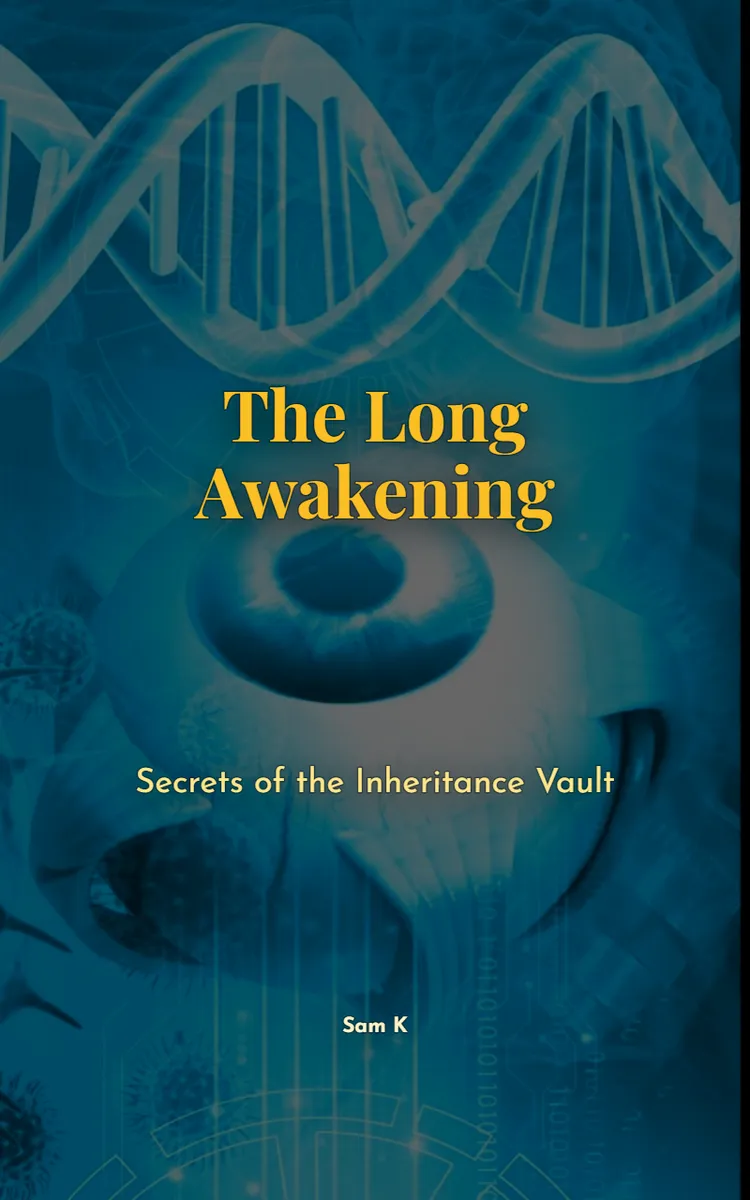
"The Long Awakening" is a curiosity book by Sam K with 8 chapters and approximately 15,463 words. A speculative history of humanity’s evolution and DNA divergence.
This book was created using Inkfluence AI, an AI-powered book generation platform that helps authors write, design, and publish complete books.
Frequently Asked Questions
What is "The Long Awakening" about?
A speculative history of humanity’s evolution and DNA divergence
How many chapters are in "The Long Awakening"?
The book contains 8 chapters and approximately 15,463 words. Topics covered include The Vault That Outlived Us, 98% Silence vs 50% Speech, Why the Earth Took Millions, The Water-First Rule of Life, and more.
Who wrote "The Long Awakening"?
This book was written by Sam K and created using Inkfluence AI, an AI book generation platform that helps authors write, design, and publish books.
Write your own curiosity book with AI
Describe your idea and Inkfluence writes the whole thing. Free to start.
Start writingCreated with Inkfluence AI


