
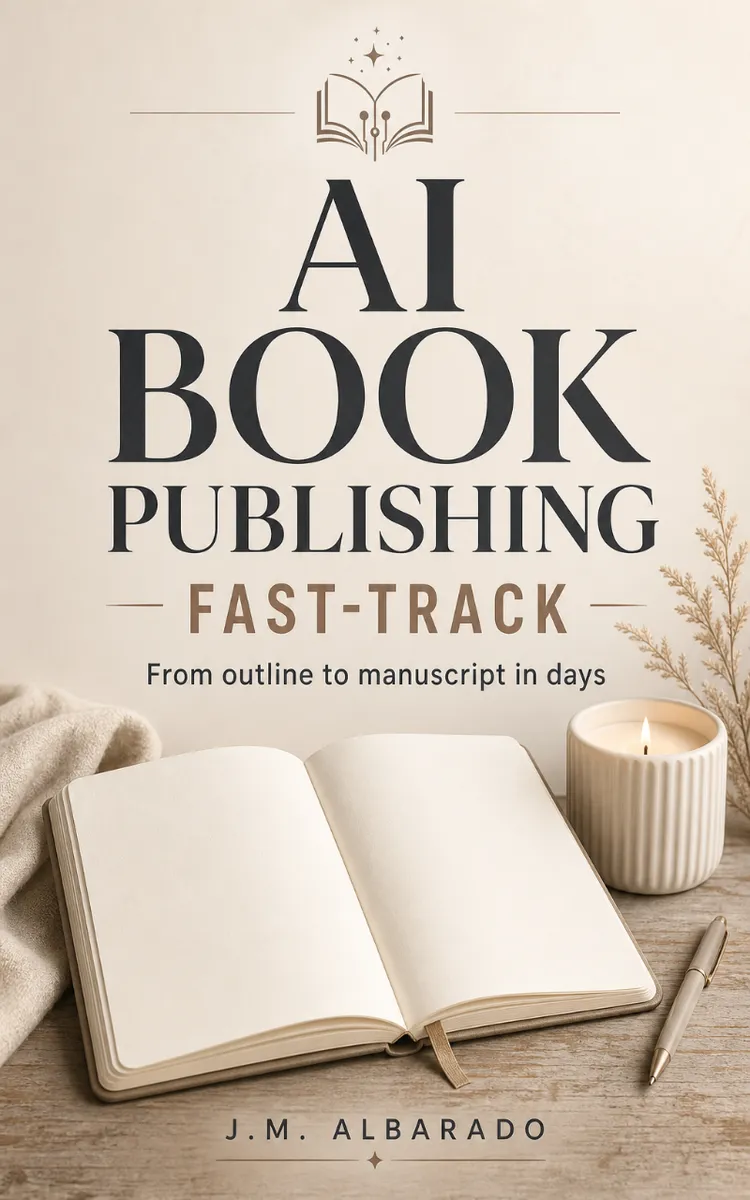
AI Book Publishing Fast-Track
Created with Inkfluence AI
Using AI tools to publish books quickly and efficiently
Table of Contents
- 1. The Momentum-First Fast-Track Mindset
- 2. Blueprinting Nonfiction with Problem Hierarchies
- 3. Blueprinting Fiction with Plot Beat Maps
- 4. Inkfluence Instant Project Prompt Architecture
- 5. AI Chapter Expansion to Defeat Writer’s Block
- 6. Voice & Style Prompting with Human Polishing
- 7. Automated Formatting Without the Loop
- 8. Multi-Format Expansion for Global Distribution
- 9. Velocity Publisher Pipeline for Multi-Books
Preview: The Momentum-First Fast-Track Mindset
A short excerpt from “The Momentum-First Fast-Track Mindset”. The full book contains 9 chapters and 14,706 words.
Build a Systemized AI-collaborative Workflow That Prioritizes Momentum
The fastest way to stall your book isn’t bad ideas - it’s a workflow that keeps demanding “perfect” before you’ve earned momentum. You sit down, open a blank document, and you’re supposed to invent structure, write chapters, polish sentences, and format the whole thing… all at once. That’s how you get writer’s block and the formatting loop at the same time. Nina, 34, part-time tutor and indie author, nailed the real problem quickly: she didn’t need more motivation, she needed a loop that kept moving even when her brain felt slow.
Nina’s turning point looked boring on the surface. She stopped treating writing like a single heroic act and started treating it like a production pipeline with clear handoffs. She used AI like a collaborator that always has a next step ready, and she enforced one rule: progress first, refinement second. That rule matters because it removes the “decision fog” that makes you freeze. When you always know what to do next, you stop negotiating with yourself.
Here’s the core framework that makes this work in practice: The Velocity Mindset Loop. It runs on repeat for every chapter block you create - outline fragments, draft passages, and revisions. The loop forces action at three points: you lock direction, you generate output fast, and you apply targeted corrections. You don’t let “quality collapse” happen by accident; you prevent it by setting tight feedback points along the way.
Ask yourself a quick question: when you open your file, do you already know what you’re producing in the next hour? If the answer is “no,” your workflow doesn’t prioritize momentum yet. You’re not behind - you’re just missing the next output target.
Practical takeaway: Write down your next deliverable before you touch the keyboard. If you can’t name it in one sentence, your Velocity Mindset Loop can’t run.
Creative Direction
Momentum without direction turns into a messy dump. So the loop starts with creative direction - clear enough that AI can follow it, and specific enough that you can judge it. Nina learned this the hard way: she once asked AI for “a good intro” and got something that sounded fine but didn’t match her book’s teaching style. Readers didn’t feel the mismatch, but her editing time exploded. Direction prevented that.
Creative direction in this workflow means you define the “job” of what you’re generating. You don’t ask for “write Chapter 3.” You define what Chapter 3 must accomplish, what tone it should hit, what the reader should do or understand by the end, and what constraints you want enforced. Then you give AI a small set of guardrails it can’t ignore - like how to handle terminology, how to pace explanations, and what to avoid repeating.
Use a simple direction template you can reuse across your book. Keep it short, but make every line count:
- Chapter mission: what this chapter solves or teaches (one sentence)
- Reader outcome: what the reader can do or say after reading (one sentence)
- Tone: the exact vibe you want (for example, “friendly tutor, direct and practical”)
- Structure beats: the order of subtopics you expect (3-6 bullets)
- Non-goals: what you refuse to include (for example, “no long theory detours”)
This is where the Velocity Mindset Loop protects you. Direction reduces rework because AI stops guessing. When AI guesses, you edit more. When you edit more, you slow down. Momentum-first doesn’t mean “generate junk.” It means you generate the right kind of draft early.
Now, a quick comprehension check: if you asked three different people to write your chapter intro based on your current prompt, would they produce consistent results? If not, your direction isn’t tight enough yet. Tight direction makes AI output predictable enough that you can move fast without losing control.
Practical takeaway: Define the chapter mission and reader outcome in plain language before you prompt. If you can’t explain the mission like you’re tutoring someone, AI can’t either.
Rapid Execution Without Quality Collapse
The part that actually feels like a cheat code is how you run the “generate and correct” cycle so it doesn’t spiral. Quality collapse happens when you skip the correction points or you try to polish everything at once. Nina fixed her process by shrinking her feedback window. She stopped revising the whole chapter and started revising small blocks with clear checkpoints.
In the Velocity Mindset Loop, rapid execution happens in two passes per chunk: a fast generation pass and a targeted correction pass. You treat the first pass like a rough build, and you treat the second pass like a repair crew with a checklist. You only polish what matters for the chunk’s job.
For the fast generation pass, you instruct AI to produce content that is usable immediately: complete paragraphs, clear transitions, and the right level of detail....
About this book
"AI Book Publishing Fast-Track" is a how-to guide book by J.M. Albarado with 9 chapters and approximately 14,706 words. Using AI tools to publish books quickly and efficiently.
This book was created using Inkfluence AI, an AI-powered book generation platform that helps authors write, design, and publish complete books. It was made with the AI Ebook Generator.
Frequently Asked Questions
What is "AI Book Publishing Fast-Track" about?
Using AI tools to publish books quickly and efficiently
How many chapters are in "AI Book Publishing Fast-Track"?
The book contains 9 chapters and approximately 14,706 words. Topics covered include The Momentum-First Fast-Track Mindset, Blueprinting Nonfiction with Problem Hierarchies, Blueprinting Fiction with Plot Beat Maps, Inkfluence Instant Project Prompt Architecture, and more.
Who wrote "AI Book Publishing Fast-Track"?
This book was written by J.M. Albarado and created using Inkfluence AI, an AI book generation platform that helps authors write, design, and publish books.
How can I create a similar how-to guide book?
You can create your own how-to guide book using Inkfluence AI. Describe your idea, choose your style, and the AI writes the full book for you. It's free to start.
Write your own how-to guide book with AI
Describe your idea and Inkfluence writes the whole thing. Free to start.
Start writingCreated with Inkfluence AI


