
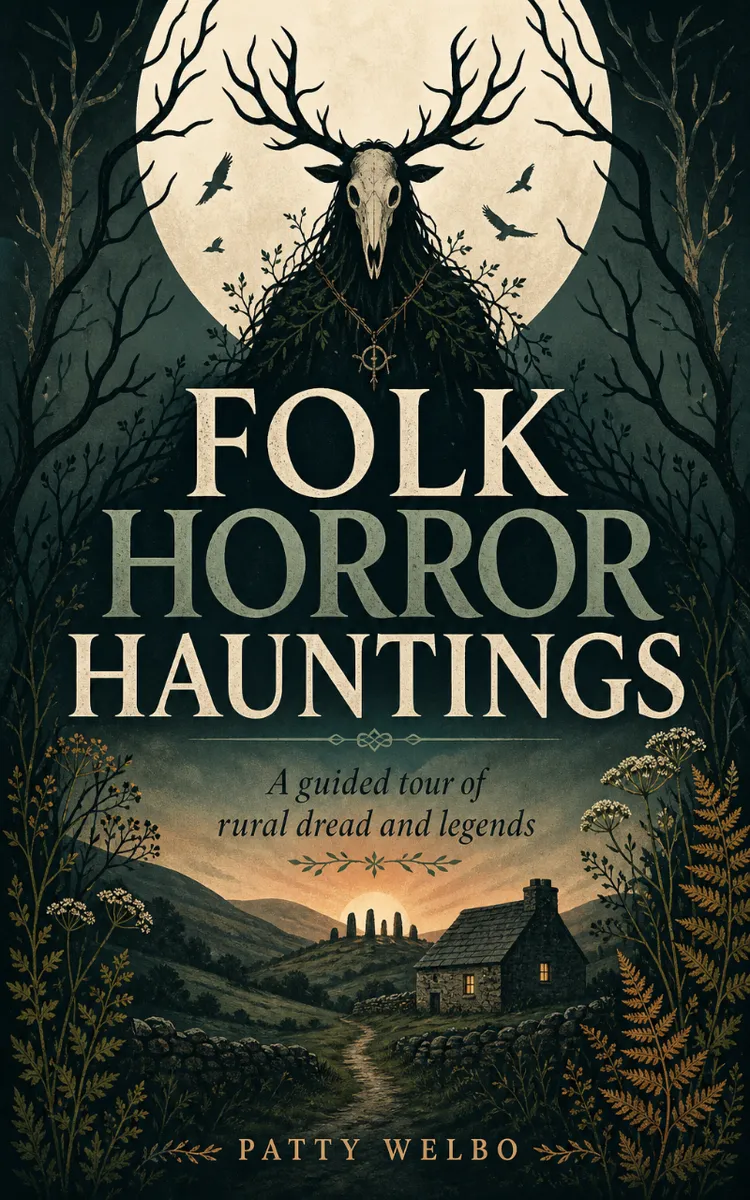
Folk horror stories, myths, and cultural origins of rural dread
Table of Contents
- 1. Why Rural Places Feel Alive
- 2. The Ghost That Isn’t a Person
- 3. The Harvest Debt You Can’t Pay
- 4. Why Your Brain Makes Omens
- 5. The Forbidden Map and Wrong Turns
- 6. Songs, Rhymes, and Spell-Logic
- 7. The Body as a Warning Sign
- 8. Setting the context: why rituals become traps
- 9. Cultural Roots of Rural Dread
- 10. Summarize the core insights in focused prose and reinforce what matters most
- 11. Opening: what this bonus chapter gives you and what you need
Preview: Why Rural Places Feel Alive
A short excerpt from “Why Rural Places Feel Alive”. The full book contains 11 chapters and 15,247 words.
When the Field Seems to Notice You
Why can a quiet field feel watchful when an airport, packed with strangers and machinery, rarely does? The paradox is that rural places often contain less visible activity, yet they give the mind more material from which to build a presence.
Folk horror depends on that spare material: a lane disappearing between hedges, a church bell carried across open ground, a boundary stone whose meaning has outlasted the people who placed it. The landscape is not merely a backdrop for the story. Through attention, repeated patterns, and sensory expectation, it becomes a character with a history, habits, and apparent intentions.
This transformation is not confined to fiction. People have long treated particular trees, springs, caves, crossroads, and hills as places that remember, punish, protect, or demand respect. Folk horror draws power from those older habits of perception and gives them a modern shape. It asks what happens when a place is read not as scenery, but as a sign.
When a landscape feels alive, is it speaking - or have we finally learned how to listen?
The Lived-In Landscape Loop
The central mechanism can be understood through The Lived-In Landscape Loop. A place first attracts attention because something about it stands out: its age, isolation, unusual shape, or local story. Attention makes details more noticeable. Those details form patterns, and the patterns create expectations. Once expectations are established, ordinary sensations - wind in reeds, a distant animal, a change in light - are interpreted as evidence that the place has a character.
That character then directs attention back toward the landscape. A person who has heard that a certain hollow is unlucky notices its silence, its slippery stones, and the way sound behaves there. The same features might pass unnoticed elsewhere. The story does not simply sit on top of the land; it changes what the land appears to contain.
Rural settings are especially suited to this loop because they often preserve visible traces of earlier lives. A field may contain a medieval ridge-and-furrow pattern beneath modern grass. A road may follow a route older than the village beside it. A churchyard may hold stones whose inscriptions have softened beyond reading. These layers make the present feel thin. The ground appears occupied by several times at once.
The effect is strengthened by boundaries. Folklore repeatedly gathers around edges: forest margins, parish limits, bridges, gates, shorelines, and crossroads. Such places interrupt the ordinary order of movement. One is leaving one space and entering another, even when the physical distance is only a few steps. Folk horror turns that transition into a moral and psychological event.
A boundary is never only a line on a map. It is a change in expectation.
The loop also depends on repetition. A single strange sound may be dismissed; the same sound heard every evening becomes part of a pattern. A path taken once is simply a path. A path taken for generations, associated with a funeral, a harvest, or a warning, becomes charged with memory. Rural dread often emerges not from an isolated disturbance but from the sense that the place has been behaving consistently for a very long time.
Why the Senses Make the Land Personal
Sound is one of the most important ways a landscape acquires agency. In open country, noises travel unpredictably. A farm machine may seem close when it is several fields away. A dog barking beyond a ridge can sound detached from any visible animal. Wind passing through reeds or tree branches produces irregular rhythms that resemble movement without revealing a source.
Modern environments train people to expect a dense layer of mechanical noise: engines, ventilation, traffic, electrical systems. Rural quiet removes much of that background. The result is not perfect silence but heightened discrimination. Small sounds become separate events. The mind searches for their origin, and when the origin remains hidden, the sound gains a kind of independence.
Light works in a similar way. Artificial lighting usually explains the night in advance, dividing streets and buildings into clear zones. Away from it, moonlight, cloud, mist, and seasonal darkness constantly alter the apparent shape of familiar objects. A tree line becomes a wall; a haystack becomes an animal; a distant window appears and vanishes as the road bends.
This is not a failure of intelligence. It is a normal feature of perception. The brain does not passively record the world like a camera. It combines incoming information with expectations about what is likely to be present. In uncertain conditions, it uses incomplete clues to produce the most workable interpretation available. Folk horror occupies the interval before that interpretation settles.
Smell can make the effect more intimate....
About this book
"Folk Horror Hauntings" is a curiosity book by Anonymous with 11 chapters and approximately 15,247 words. Folk horror stories, myths, and cultural origins of rural dread.
This book was created using Inkfluence AI, an AI-powered book generation platform that helps authors write, design, and publish complete books.
Frequently Asked Questions
What is "Folk Horror Hauntings" about?
Folk horror stories, myths, and cultural origins of rural dread
How many chapters are in "Folk Horror Hauntings"?
The book contains 11 chapters and approximately 15,247 words. Topics covered include Why Rural Places Feel Alive, The Ghost That Isn’t a Person, The Harvest Debt You Can’t Pay, Why Your Brain Makes Omens, and more.
Who wrote "Folk Horror Hauntings"?
This book was written by Anonymous and created using Inkfluence AI, an AI book generation platform that helps authors write, design, and publish books.
Write your own curiosity book with AI
Describe your idea and Inkfluence writes the whole thing. Free to start.
Start writingCreated with Inkfluence AI


