
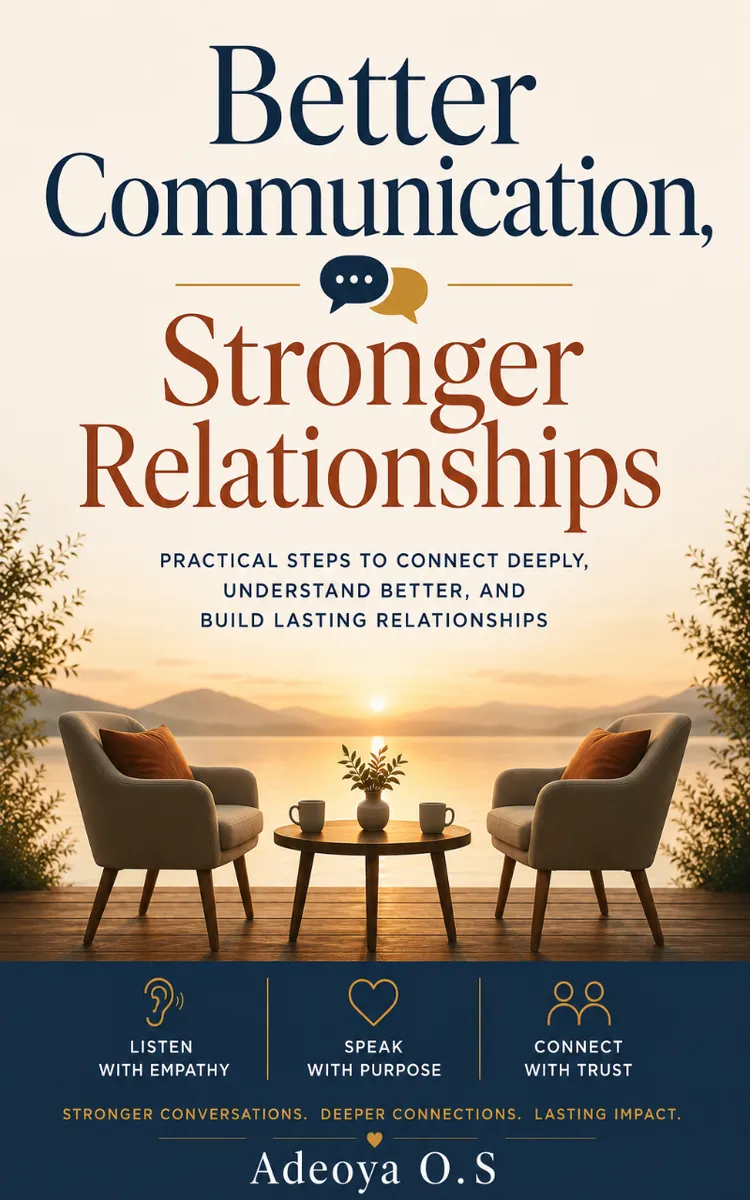
Better Communication, Stronger Relationships
Created with Inkfluence AI
Communication skills and relationship-building strategies
Table of Contents
- 1. The 3-Part Message Formula
- 2. Active Listening With Reflective Phrases
- 3. Asking Better Questions for Connection
- 4. Conflict Scripts for Calm Conversations
- 5. Repair Attempts and Trust Recovery
Preview: The 3-Part Message Formula
A short excerpt from “The 3-Part Message Formula”. The full book contains 5 chapters and 7,915 words.
Have you ever watched a conversation stall because you said too much, too fast - and then the other person answered something you didn’t even ask? That feeling usually comes from one problem: your message doesn’t land in a clear order. When your meaning gets buried under extra background, people guess. And when people guess, you lose the chance to connect.
Here’s the fix: you can say what you mean clearly without sounding robotic. This chapter teaches the 3-Part Message Formula (Clarity-Context-Request) - a simple structure that helps you speak in the same order your listener needs to understand you. You’ll write and deliver messages that are easy to follow, even when you’re busy, stressed, or talking over text.
After you learn this formula, you’ll be able to do three practical things: (1) state your point in plain language, (2) give only the background that matters, and (3) make a clear request that tells the other person what to do next. The goal isn’t “better communication” in general - it’s fewer misunderstandings, faster decisions, and less rambling in real moments.
The 3-Part Message Formula (Clarity-Context-Request): Why it stops rambling
Rambling usually happens when your brain starts with the most complicated part - everything you know - before your listener knows what you want them to do. Your listener then has to untangle your thoughts just to find the point. That takes effort, and effort makes people slow down, ask questions, or respond in the wrong direction.
The 3-Part Message Formula (Clarity-Context-Request) solves that by matching your message to how people process information. People need a headline first (Clarity), then they need just enough background (Context) to make sense of it, and finally they need a next step (Request). This structure reduces guesswork because your message follows a predictable pattern.
You’ll see this formula show up in everyday work and family life: asking for an update, setting a boundary, correcting a misunderstanding, or requesting a decision. It also works well with text messages, where you don’t get tone cues and extra words can hide your point.
Ask yourself this: when you send a message, do you want agreement, an answer, or a specific action? If you don’t say the action part, the other person often fills in the blank with their best guess. The formula helps you remove that guesswork.
Practical takeaway: Clear messages reduce back-and-forth. When your listener knows your point first, they can respond to the right thing.
How the 3-Part Message Formula works: Clarity, Context, Request
The formula has three parts. You can use all three in one sentence or across a few sentences - either way, keep the order.
1. Clarity (your point): “Here’s what I mean.”
Start with the message you want the other person to react to. Use simple words and name the topic directly. If you’re unsure where to start, start with the verb: “I need…”, “I’m asking…”, “My decision is…”, “The issue is…”
2. Context (why it matters right now): “Here’s the minimum background.”
Add only what helps the person understand your Clarity. This usually includes a date, a key detail, or what already happened. Keep it tight. One or two sentences is often enough.
3. Request (the next step): “Here’s what I want you to do.”
Tell them exactly what you want, plus a deadline if it matters. Use a direct action verb: “Please confirm…”, “Can you send… by Friday?”, “Reply with…”, “Let’s schedule…”
Here’s what this sounds like in real-life wording, not corporate speak:
- Clarity: “I need the updated address for the order.”
- Context: “The shipping label shows the old address.”
- Request: “Please send the correct address by 2:00 p.m. today so we can reroute it.”
Notice the pattern: the listener doesn’t have to hunt for your point. They see it immediately, then they get just enough background to trust it, and then they get a clear next step.
Now let’s map it to a real working situation with Tanya, 31, customer success coordinator. Tanya often gets messages like: “Just checking in, I know it’s been a while, and there was that thing with the account…” The problem isn’t that Tanya cares - it’s that the other person must decode what Tanya needs. If Tanya uses the formula, her messages become easier to answer.
- Clarity: “I’m following up because the renewal is due soon.”
- Context: “Your team hasn’t confirmed the license seats yet.”
- Request: “Please reply with the seat count by Thursday so I can send the renewal link.”
Quick comprehension check: After you read the Clarity part, could you tell what the message is about? If not, rewrite Clarity until it’s obvious.
Practical takeaway: Use the order Clarity → Context → Request. If you swap the order, you reintroduce confusion.
Putting the formula into practice: Tanya’s “update + decision” message
...
About this book
"Better Communication, Stronger Relationships" is a how-to guide book by Adeoya O.S with 5 chapters and approximately 7,915 words. Communication skills and relationship-building strategies.
This book was created using Inkfluence AI, an AI-powered book generation platform that helps authors write, design, and publish complete books. It was made with the AI Ebook Generator.
Frequently Asked Questions
What is "Better Communication, Stronger Relationships" about?
Communication skills and relationship-building strategies
How many chapters are in "Better Communication, Stronger Relationships"?
The book contains 5 chapters and approximately 7,915 words. Topics covered include The 3-Part Message Formula, Active Listening With Reflective Phrases, Asking Better Questions for Connection, Conflict Scripts for Calm Conversations, and more.
Who wrote "Better Communication, Stronger Relationships"?
This book was written by Adeoya O.S and created using Inkfluence AI, an AI book generation platform that helps authors write, design, and publish books.
How can I create a similar how-to guide book?
You can create your own how-to guide book using Inkfluence AI. Describe your idea, choose your style, and the AI writes the full book for you. It's free to start.
Write your own how-to guide book with AI
Describe your idea and Inkfluence writes the whole thing. Free to start.
Start writingCreated with Inkfluence AI


