
Read the first chapter
The whole of chapter one, free. About 5 min. Turn the pages with the arrows, your keyboard, or a swipe.
Chapter 1
Building Unshakeable Faith Amidst Loss
Picture This
The hospital text comes in while you’re folding laundry. Or it’s the phone call after church where nobody says the words out loud, but you can hear them anyway. Or it’s the email: your position has been eliminated. And right as your chest tightens, your mind starts sprinting—toward worst-case outcomes, toward unanswered “why,” toward fear that you’ll never feel stable again.
Grief doesn’t just sit quietly. It messes with your trust. It makes God feel distant. It turns prayers into frantic checklists. And even when you know you love Jesus, you can still wonder if He’s holding you—or if He’s just watching you struggle. When loss hits from every direction—death, unborn grief, family hardship, and job uncertainty—how do you keep your faith from cracking?
The Mindset Shift
Old Belief: “If God is good, then I shouldn’t be falling apart like this.” New Reality: “God is good even when I’m falling apart—and my faith can hold steady while my emotions shake.”
That shift matters because grief and fear don’t automatically mean your faith is fake. Sometimes they mean you’re human and the pain is real. But the enemy loves a different story: If God cared, you wouldn’t hurt this much. That lie tries to steal your identity and replace it with panic.
Here’s a concrete example. Say you lost a family member and your finances are already tight. The old belief makes every bill feel like proof God abandoned you. You start treating prayer like an emergency alarm: quick, loud, and only when you’re desperate. The new reality changes what you do with that fear. You still grieve. You still call your spouse and talk about what’s due. But you also anchor your heart to truth: God hasn’t disappeared just because the situation is heavy. You pray like a child coming to a Father—not to win an argument, but to be held.
So instead of asking, “How do I stop feeling this?” (which can feel impossible), you ask, “Where will I place my trust today?” Not someday. Today. Even if your voice shakes a little.
Going Deeper
Loss exposes what’s underneath your faith. If your trust is built on circumstances staying calm, then the moment life gets loud, your belief collapses. But Scripture doesn’t teach that God’s presence depends on your comfort. It teaches that God’s character doesn’t change when your world does.
When you shift from “God = comfort” to “God = covenant,” you start living differently. Covenant means God is committed to you even in hard seasons. That doesn’t erase the ache. It gives the ache a place to land—under God’s care instead of under fear’s control.
Signs this pattern is running your life: 1. You measure God’s love by your current circumstances (peace = God is near, trouble = God is gone). 2. You avoid praying until you’re “sure” you’ll feel better, so your trust never gets strengthened in the middle of the storm. 3. You make big decisions only from panic—like taking the first job offer just to stop the anxiety, even if it doesn’t line up with wisdom. 4. You try to “handle it alone” because you’re afraid that asking for help will confirm you’re failing.
En résumé: Trust doesn’t mean you stop hurting—it means you stop letting fear write your identity.
Jesus Himself never pretended people wouldn’t grieve. He wept. He also anchored hearts to truth. That’s the model: feel the loss honestly, but keep your foundation anchored.
Reflection & Self-Assessment
1. Where do I currently believe God’s goodness is proven by my comfort? Be honest. Maybe you think, “If things were really under control, I wouldn’t be this scared.” That answer tells you where your foundation needs to be rebuilt.
2. When grief rises, what story does my mind automatically tell me about God? Write the sentence your thoughts repeat. For example: “God is distant,” or “I’m on my own.” Naming it helps you resist it.
3. What does “trusting God today” look like in one specific action I can take within 24 hours? Don’t stay spiritual-only. Could it be making the call, setting a budget line, or starting a conversation with your spouse about what’s due?
4. How do my losses (unborn grief, family stress, friend loss, job uncertainty) shape my prayers? If your prayers sound like bargaining or blame, that’s information—not condemnation. It shows you what your heart needs to heal.
5. What boundary can I set so panic doesn’t drive my next decision? Maybe it’s “I won’t sign anything while I’m overwhelmed,” or “I sleep on it and pray before replying.” Little boundaries protect your future.
Growth Challenge
7-Day Anchor Walk (Trust That Holds While You Grieve) - For the next 7 days, write one sentence each morning: “Today, I trust God with ____.” (Fill in the blank with the real weight—grief, bills, job uncertainty, fear for aging parents.) - Each evening, do a 3-minute “truth check”: read one short passage about God’s faithfulness, then write what truth you want to believe tomorrow. - Once during the week, have one faith-shaped conversation with your spouse, a trusted friend, or a prayer partner: “Here’s what I’m afraid of, and here’s what I’m asking God to help me do next.” - If you’re single or grieving without a built-in support system, still do the conversation—message someone and ask for prayer by name. (Yes, even if it feels awkward.)
Difficulty Rating: Medium
You’ll know it’s working when… - Your prayers start sounding less like panic and more like dependence. - You make at least one decision from wisdom (even slowly) instead of fear. - You feel grief more clearly, but it no longer runs your whole life. You’re still hurting—just not hopeless.
Key Takeaway
Unshakeable faith isn’t built by pretending loss didn’t happen—it’s built by choosing God’s truth while your heart is still hurting.
• Trusting God means anchoring your identity in His character, not in your comfort. - Grief can be real without becoming the ruler of your decisions. - Small daily actions—truth checks, honest prayers, one conversation—strengthen faith faster than trying to “feel strong.” - Covenant trust gives your pain a place to go: under God’s care, not under fear’s control.
Next, we’ll talk about how to pray through the chaos without losing your clarity—because when life is loud, your words matter.
End of chapter one. 4 more chapters and about 5,665 words in the full book.
Swipe or use the arrows to turn the page

What's inside: 5 chapters
- 1. Building Unshakeable Faith Amidst Loss
- 2. Navigating Financial Struggles with God’s Wisdom
- 3. Finding Clarity in Career and Calling Transitions
- 4. Growing Stronger in Marriage and Singleness
- 5. Overcoming Grief and Sharing Hope Through Action
About this book
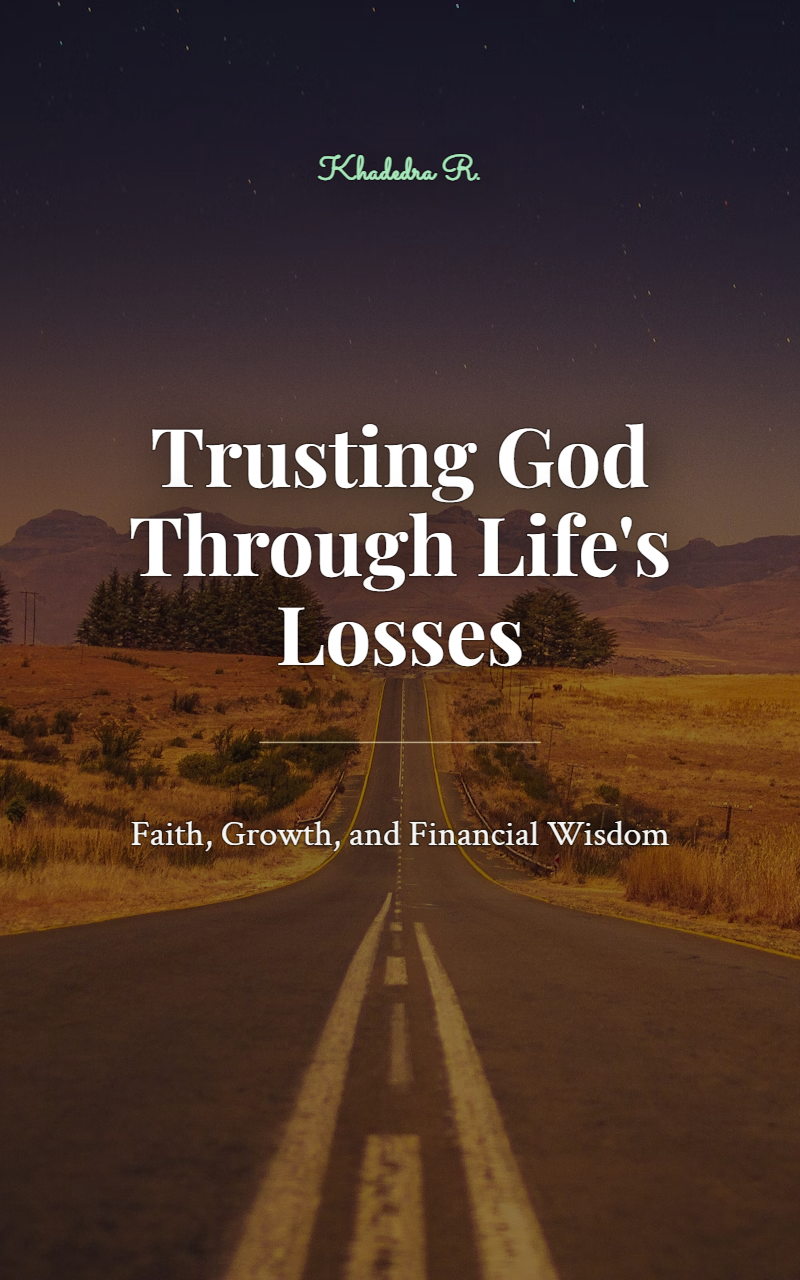
"Trusting God Through Life's Losses" is a self-help book by Khadedra R. with 5 chapters and approximately 5,665 words. Overcoming grief, financial struggles, career shifts, and marriage growth through Christian faith.
This book was created using Inkfluence AI, an AI-powered book generation platform that helps authors write, design, and publish complete books. It was made with the AI Self-Help Book Writer.
Frequently Asked Questions
What is "Trusting God Through Life's Losses" about?
Overcoming grief, financial struggles, career shifts, and marriage growth through Christian faith
How many chapters are in "Trusting God Through Life's Losses"?
The book contains 5 chapters and approximately 5,665 words. Topics covered include Building Unshakeable Faith Amidst Loss, Navigating Financial Struggles with God’s Wisdom, Finding Clarity in Career and Calling Transitions, Growing Stronger in Marriage and Singleness, and more.
Who wrote "Trusting God Through Life's Losses"?
This book was written by Khadedra R. and created using Inkfluence AI, an AI book generation platform that helps authors write, design, and publish books.
How can I create a similar self-help book?
You can create your own self-help book using Inkfluence AI. Describe your idea, choose your style, and the AI writes the full book for you. It's free to start.
Write your own self-help book with AI
Describe your idea and Inkfluence writes the whole thing. Free to start.
Start writingCreated with Inkfluence AI


