
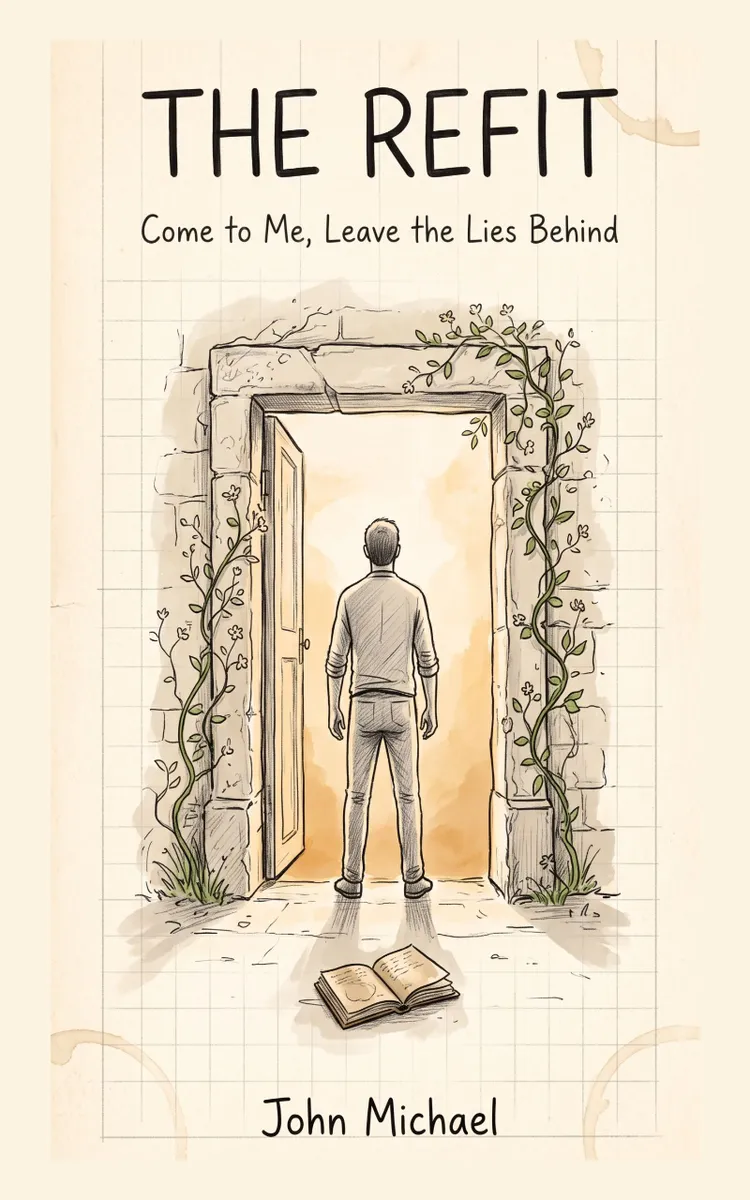
The Refit
Created with Inkfluence AI
Stop trying to fix yourself with willpower and better routines, and start changing what you absorb. The Refit shows you how formation really works, and why your habits, choices, and outcomes are shaped by the soil you live in, not just the discipline you force. You will learn to spot the hidden inputs that steer your days, from the environments you repeat to the values you silently carry. You will practice shifting your attention, your boundaries, and your daily conditions so growth becomes something you can sustain. If you feel stuck in a life that looks correct but does not feel whole, this book gives you a clear path to a different kind of change, one refit at a time.
Table of Contents
- 1. Prologue: The Ache with No Name
- 2. The Refit SketchNote
- 3. Refit Guide 01: Choose Your Soil
- 4. Refit Guide 02: Breaking New Ground
- 5. Refit Guide 03: The Quicksand Principle
- 6. Refit Guide 04: The Formation Fortress
- 7. Refit Guide 05: The Choice Point
- 8. Refit Guide 06: The Sustained Choice
- 9. Epilogue: A Fellow Traveller
- 10. Introduction: What This Is and How to Use It
- 11. Why I Wrote This
- 12. Come to Me. Leave the Lies Behind
Preview: Prologue: The Ache with No Name
A short excerpt from “Prologue: The Ache with No Name”. The full book contains 12 chapters and 14,253 words.
Sarah was fine.
That was the word she used. Fine. She used it in the morning when Jake asked how she was doing over coffee she didn't have time to finish. She used it with her mother on Sunday calls that lasted exactly as long as they needed to and no longer. She used it at work, where she was in fact doing well, objectively well, better than most, and where the word fine carried a particular efficiency that everyone seemed to appreciate.
She was thirty-four years old and she was fine and she had a life that looked correct from every angle she could find to examine it.
The house was good. The relationship was functional and occasionally warm. The job was the job she had worked hard to get, and she was good at it, and she knew she was good at it, and on most days that was enough and on some days it wasn't and she couldn't have told you why.
The ache had no name. That was the main thing about it. If it had a name she could have addressed it, fixed it, built a system around it, given it a slot in her calendar. But it didn't have a name. It just arrived on certain evenings when the work was done and the flat was quiet and there was nothing actually wrong, and sat there at the edge of her awareness like something she had forgotten to do.
She told herself she was tired. She told herself she needed a better morning routine. She bought two books about habits and read the first chapters of both and put them on the shelf next to the others.
She started running. Then she stopped running. Then she started again.
She was fine.
The night it changed, she didn't know it was changing.
It was 02:47 on a Tuesday. Jake was asleep. She had work in five hours and she was twenty-three posts deep into someone else's life, someone she barely knew from a job she'd left three years ago, and the phone was glowing in her hand in the dark and she was telling herself she was about to put it down.
Melissa's promotion. Emma's apparently perfect weekend in Lisbon. Someone she'd gone to university with, holding a baby she hadn't known was coming, looking in the photograph like a person who had figured something out.
She wasn't angry at any of them. She wasn't even sure what she was feeling. It wasn't envy, exactly. It was something quieter than envy and older than envy and harder to name.
She was losing a fight with an algorithm. And the algorithm had no idea she existed.
She did put the phone down. Eventually.
Not because she'd won anything. Not because she'd resolved anything. She put it down because Emma had posted again and it was a photograph of a salad and something in Sarah simply ran out of the energy required to keep watching.
She lay in the dark for a while.
She thought: this is not a life. this is what happens in between a life.
She didn't know what to do with that thought. So she let it go, the way she let most things go. She closed her eyes. She told herself she'd get to it. Later. When things settled.
Things did not settle.
They rarely do, on their own.
There is a question that sits underneath the ache with no name.
Most people who carry it have never said it out loud. Not fully. Not honestly, with nobody in the room but themselves and whatever they quietly believe about what might be listening.
The question is this:
Is this all there is? Is this me? Was there supposed to be more, and if so, where did it go, and is it too late to find it?
You don't have to be in crisis to be carrying that question. You don't have to be failing. You can be objectively fine, by every measurable standard, and still carry it. Some people carry it more quietly when things are going well, because when things are going well the question feels ungrateful. So they press it down and call themselves fine and buy a book about habits.
This is not a book about habits.
It is an invitation. To put the phone down on something older and heavier than an algorithm. To take the ache with no name seriously enough to find out what it is actually saying.
Sarah found out. It took six guides and more honesty than felt comfortable and one conversation at 02:53 on a Tuesday that nobody saw and nobody applauded.
What she found was not what she expected.
It was better.
Come to me, all you who are weary and burdened, and I will give you rest.
Matthew 11:28
The Refit begins on the next page.
The introduction begins at the back.
Read that last.
About this book
"The Refit" is a self-help book by John Michael with 12 chapters and approximately 14,253 words. Stop trying to fix yourself with willpower and better routines, and start changing what you absorb. The Refit shows you how formation really works, and why your habits, choices, and outcomes are shaped by the soil you live in, not just the discipline you force.
This book was created using Inkfluence AI, an AI-powered book generation platform that helps authors write, design, and publish complete books. It was made with the AI Self-Help Book Writer.
Frequently Asked Questions
What is "The Refit" about?
Stop trying to fix yourself with willpower and better routines, and start changing what you absorb. The Refit shows you how formation really works, and why your habits, choices, and outcomes are shaped by the soil you live in, not just the discipline you force. You will learn to spot the hidden inputs that steer your days, from the environments you repeat to the values you silently carry. You will practice shifting your attention, your boundaries, and your daily conditions so growth becomes something you can sustain. If you feel stuck in a life that looks correct but does not feel whole, this book gives you a clear path to a different kind of change, one refit at a time.
How many chapters are in "The Refit"?
The book contains 12 chapters and approximately 14,253 words. Topics covered include Prologue: The Ache with No Name, The Refit SketchNote, Refit Guide 01: Choose Your Soil, Refit Guide 02: Breaking New Ground, and more.
Who wrote "The Refit"?
This book was written by John Michael and created using Inkfluence AI, an AI book generation platform that helps authors write, design, and publish books.
How can I create a similar self-help book?
You can create your own self-help book using Inkfluence AI. Describe your idea, choose your style, and the AI writes the full book for you. It's free to start.
Write your own self-help book with AI
Describe your idea and Inkfluence writes the whole thing. Free to start.
Start writingCreated with Inkfluence AI


