

Read the first chapter
The whole of chapter one, free. About 8 min. Turn the pages with the arrows, your keyboard, or a swipe.
Chapter 1
The Prosperity Mindset for Nigerians
The Expectation-Action Loop for Nigerian Entrepreneurs
A customer can shout, a supplier can delay, and your phone can stay quiet for three days straight. That exact moment is where most Nigerian business owners lose money without even touching their cash. They start the day with confidence, then one small disappointment hits, and their thinking flips. They slow down on follow-ups, they drop prices too fast, they stop posting, and they “wait for things to get better” instead of acting.
Here’s the problem this chapter solves: you don’t need more hustle. You need consistent belief that stays standing while the market tests you. Many entrepreneurs say they want growth, but their mindset keeps getting pulled by daily pressure - rent reminders, FX shocks, bad news from a competitor, and the fear that “this will not work for me.” The result looks like inconsistent effort and scattered focus, not lack of skill.
After you read this chapter, you will be able to build a simple mindset practice called The Expectation-Action Loop that helps you keep your belief steady, your focus sharp, and your actions expectant - even when Nigeria feels unpredictable. You will also learn a practical way to apply it to real business decisions, using a Lagos SME owner case (Tunde, 34) so you can copy the steps immediately.
Why Belief Breaks in Nigerian Business (and What You’ll Fix)
Let me be straight: most business owners don’t fail because they can’t sell. They fail because they stop expecting. Expectation is not “wishful thinking.” It is the mental posture that tells your body, your words, and your decisions what to do next. When your expectation drops, your actions shrink. When your actions shrink, your results follow.
In Nigeria, that drop happens fast because your environment hits you daily. Power can cut your production schedule. A customer can ghost after they collected a proforma invoice. A bank can delay clearing. A new policy can change pricing overnight. You might still have strong skills, but your mind starts operating like an alarm system: “Danger. Wait. Protect yourself.” Protection feels safe, but it kills momentum.
The Universe’s prosperity mindset philosophy teaches that your belief shapes what you consistently attract through your attention and your actions. I’m not asking you to become “too positive.” I’m teaching you to become stable. You will learn how to keep your belief from collapsing when the day turns ugly - so you can stay in the game long enough for results to show up.
You will also learn how the loop works in a way that fits business reality: you will set expectations you can measure, you will take actions you can repeat, and you will adjust without losing faith. That’s how you stop swinging between “I know this will work” and “Let me panic and sell anything.”
The Expectation-Action Loop: Mindset Practices That Stay Standing
The Universe’s message lands best when you turn it into a business habit. So here is the framework I want you to use: The Expectation-Action Loop.
This loop works because your mind and your business actions move together. When you expect results, you act as if results are possible. When you act like results are possible, you create opportunities. When you keep creating opportunities, your belief strengthens again. That’s the loop.
Use this model like a tool, not a prayer you say once. You run it daily, especially when pressure rises.
Step-by-step: Build your Expectation-Action Loop
• Write your “Expected Outcome” in business language
• Pick one outcome you want in the next 14 days. Make it specific to your business activity, not just a vague “more money.”
• Example: “Get 12 new paying jobs” or “Close 3 new gym memberships” or “Deliver 20 bags of stock by Friday.”
• Why this matters: your expectation needs a target your mind can measure. Otherwise, it turns into fog, and fog makes you react instead of lead.
• Choose your “Belief Statement” and anchor it to proof
• Create a short sentence you can repeat that connects to what you already know you can do.
• Example for a service business: “I deliver value fast, and customers respond when I follow up with clarity.”
• Add a proof anchor: “I have delivered similar work before” or “My last batch of customers paid within 48 hours.”
• Why this matters: if your belief statement floats, it breaks under stress. If it connects to real experience, it holds.
• Run the Daily Expectation Time (10 minutes)
• Once per day, set a timer for 10 minutes. During that time, do two things only:
• Visualize the outcome happening through your business actions (not magic).
• Speak your belief statement out loud once, then plan your next action.
• Why this matters: this is where you train your mind to stay expectant while you still plan practical moves.
• Take the “Action That Proves the Loop” within the next hour
• After your 10 minutes, you must do one action that creates the possibility of the outcome.
• Example actions:
• Call 5 leads.
• Send 10 follow-up messages.
• Post one offer with a clear price range and delivery timeline.
• Visit 2 locations where your customers buy.
• Why this matters: belief without action becomes denial. Action without belief becomes desperation. The loop holds when your action matches your expectation.
Here’s the differentiator: most mindset advice tells you to “think positive.” This loop demands alignment. You expect something specific, you speak a belief tied to real proof, you spend 10 minutes training your focus, and you act immediately with a repeatable move.
Applying it with Tunde (Lagos SME owner)
Tunde is 34. He runs a small SME that depends on repeat orders and referrals. Some weeks he gets steady demand. Other weeks, he feels like he’s pushing a heavy door with no handle. One Monday, two customers delayed payment, and his suppliers started calling. By 2 p.m., his energy dropped. He caught himself saying, “Maybe this season is finished. I’ll just reduce my spending and wait.”
That’s exactly where the Expectation-Action Loop saves you. It stops you from letting fear drive your schedule.
Tunde’s 7-day loop run (what he did and what happened)
• He picked one expected outcome
• Instead of “I need money,” he wrote: “Get 12 new paying orders in 14 days.”
• He chose a measurable target tied to his sales activity.
• He wrote a belief statement that matched his reality
• He used: “Customers trust me when I show clear timelines and follow up consistently.”
• He anchored it to proof: “I have handled this kind of order before, and my past customers came back because I delivered on time.”
• He ran 10 minutes every morning
• He set a timer.
• He imagined himself receiving new orders because he followed up and delivered properly.
• He spoke his belief statement out loud once, then he planned the next action.
• He took one action within the next hour
• He called 5 warm leads.
• He sent 8 follow-up messages to past inquiries.
• He updated a simple offer message with a clear delivery timeline.
• He tracked results in a simple way
• He wrote down:
• How many calls he made
• How many messages he sent
• How many replies he received
• How many orders came in
• This made expectation measurable, not emotional.
• When disappointment hit, he refused to break the loop
• One day, replies were low. He still ran the 10 minutes and still called 5 leads.
• He didn’t punish himself with thoughts like “I’m finished.”
• He adjusted his action: he changed his follow-up message to include a specific delivery date, then he repeated the same call count the next day.
• He strengthened belief through action results
• By day 6, replies increased because his messages became clearer.
• By day 10, he had enough new orders to breathe again.
• His belief didn’t come first. His belief strengthened because he kept the loop running.
Quick checklist (use this every morning)
• Write one Expected Outcome for the next 14 days (one target, one number).
• Speak one Belief Statement tied to your real proof.
• Spend 10 minutes on expectation + planning.
• Act within the next hour with one repeatable business move.
• Track simple inputs (calls/messages) and outcomes (replies/orders).
• When pressure hits, keep the loop running and adjust your action, not your belief.
What to Watch For: Mistakes That Break the Loop
The loop works when you run it consistently. Here are the common ways business owners mess it up - and the fixes.
Mistake: Expectation becomes vague talk
If your “expected outcome” sounds like “I want more money,” your mind won’t know what to aim for. You’ll start improvising when stress hits, and you’ll call it “intuition.”
• Do this: Turn your outcome into a business number you can influence in 14 days (orders, leads, deliveries, bookings).
• Not this: “I expect good things.” That phrase doesn’t drive action.
Mistake: Belief turns into denial
Some people repeat belief statements but ignore the reality in front of them. They keep doing the same action even when it clearly fails.
• Do this: Keep your belief statement stable, but adjust your action based on tracking. If replies drop, improve your follow-up clarity or your offer message. Don’t switch to fear thinking.
• Not this: “My belief is strong, so I won’t change anything.” That creates stubbornness, not prosperity.
Mistake: You skip the “Action That Proves”
You can’t live in expectation only. If you do 10 minutes and then you delay action for the day, you break the loop. Your mind learns that belief doesn’t connect to results.
• Do this: After your 10 minutes, complete one business action within the next hour.
• Not this: “I’ll do it later when I feel ready.” Readiness follows action, not before it.
Chapter Roadmap: How You’ll Build This Into Real Growth
You’re not just learning a mindset idea. You’re building a repeatable system for consistent belief, focus, and expectant action. Here’s how this book will move you forward, starting with this loop:
• You will first stabilize your thinking so your daily decisions stop swinging with pressure.
• Then you will connect that stable mindset to the business moves that create results in the Nigerian market.
• Finally, you will build routines that keep you consistent even when cash flow gets tense.
For now, your job is simple and non-negotiable: run The Expectation-Action Loop for the next seven days. Track your actions. Watch how your belief changes when you keep proving it with follow-up, delivery, and clear offers. That’s how you start acting like a business owner who expects growth.
And once your mind stops panicking on bad days, you’ll notice something powerful: your business starts responding to you faster - because you start showing up with clarity, not fear.
End of chapter one. 4 more chapters in the full book.
Swipe or use the arrows to turn the page
What's inside: 5 chapters
- 1. The Prosperity Mindset for Nigerians
- 2. Seed Thoughts: Speak Your Business Future
- 3. Sustaining Prosperity Through Action Steps
- 4. Faith-Fueled Planning and Budgeting
- 5. Giving, Receiving, and Nigerian Reciprocity
About this book
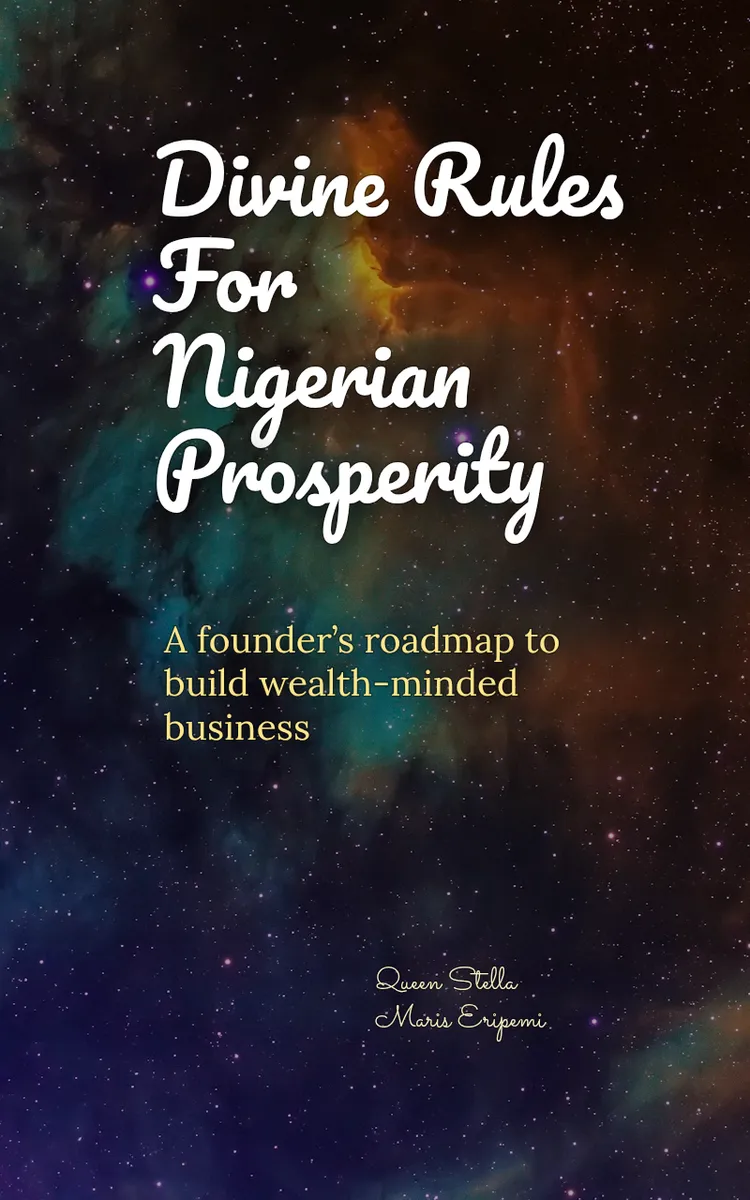
"Divine Rules For Nigerian Prosperity" is a business book by Queen Stella Maris Eripemi with 5 chapters and approximately 9,512 words. Building a Nigerian-focused business ebook inspired by prosperity philosophy.
This book was created using Inkfluence AI, an AI-powered book generation platform that helps authors write, design, and publish complete books. It was made with the AI Business Book Writer.
Frequently Asked Questions
What is "Divine Rules For Nigerian Prosperity" about?
Building a Nigerian-focused business ebook inspired by prosperity philosophy
How many chapters are in "Divine Rules For Nigerian Prosperity"?
The book contains 5 chapters and approximately 9,512 words. Topics covered include The Prosperity Mindset for Nigerians, Seed Thoughts: Speak Your Business Future, Sustaining Prosperity Through Action Steps, Faith-Fueled Planning and Budgeting, and more.
Who wrote "Divine Rules For Nigerian Prosperity"?
This book was written by Queen Stella Maris Eripemi and created using Inkfluence AI, an AI book generation platform that helps authors write, design, and publish books.
How can I create a similar business book?
You can create your own business book using Inkfluence AI. Describe your idea, choose your style, and the AI writes the full book for you. It's free to start.
Write your own business book with AI
Describe your idea and Inkfluence writes the whole thing. Free to start.
Start writingCreated with Inkfluence AI


