
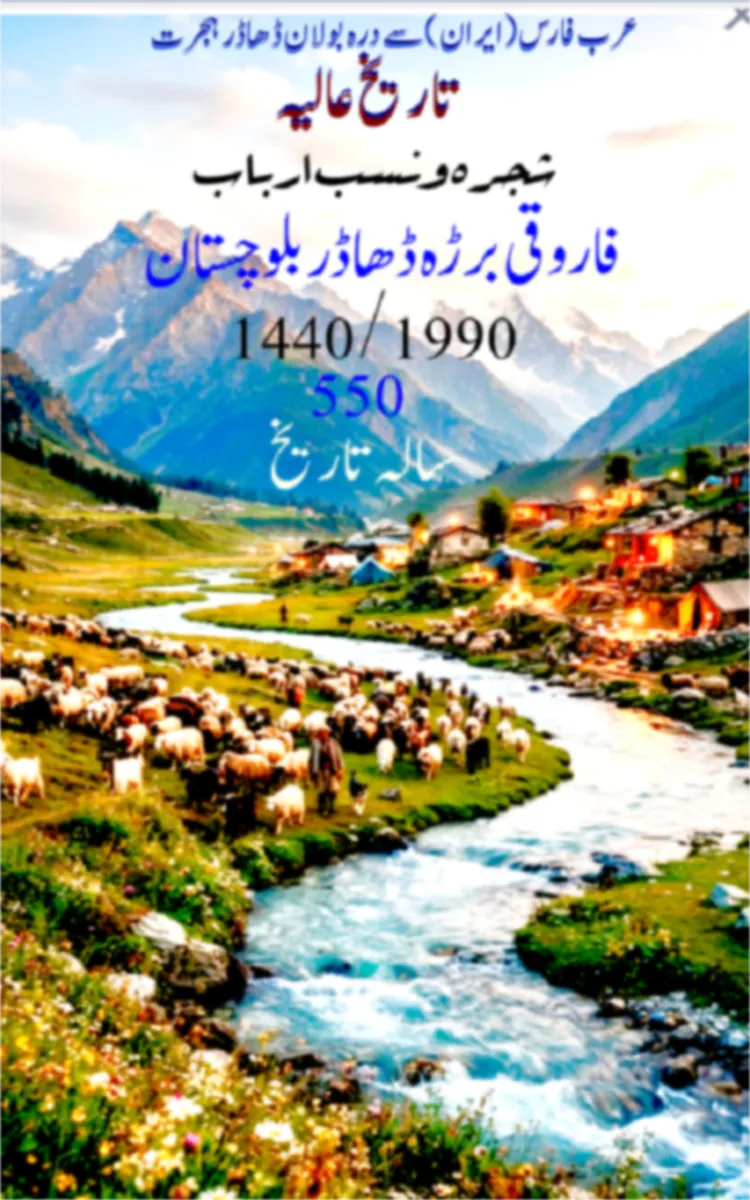
تاریخ عالیہ شجرہ ارباب فاروقی برڑہ ڈھاڈر
Created with Inkfluence AI
Table of Contents
- 1. Set the context: why تاریخی شجرہ matters and what you'll gain
Preview: Set the context: why تاریخی شجرہ matters and what you'll gain
A short excerpt from “Set the context: why تاریخی شجرہ matters and what you'll gain”. The full book contains 1 chapters and 1,002 words.
Set the context: why تاریخی شجرہ matters and what you'll gain
A clear historical family tree (تاریخی شجرہ) turns scattered names and dates into a working map you can use for decisions, ceremonies, land claims, and preserving legacy. When elders recall ancestors in conversation, the facts often drift or mix with memory. Building a documented شجرہ solves that problem by giving you a single reference that relatives, local officials, and researchers can rely on.
After reading this section, you'll understand why precise dates, place names, and source notes matter, and you’ll know which pieces of information to gather first. You'll be able to produce a one-page lineage for immediate use, then expand it into a multi-generation register with basic source citations so future generations don’t lose the thread. You’ve got this - start small, and the structure will grow with each verified fact.
Teach the core technique: how to construct a reliable تاریخی شجرہ
A reliable historical family tree rests on three components: verified facts, clear structure, and recorded sources. Follow these numbered steps to build a usable شجرہ.
Gather baseline facts.
Collect full names, birth and death years (or approximate decades), and primary locations (village/town). Why: these anchor each person uniquely when names repeat across generations.
Confirm relationships.
Record parent-child links and spouse connections. Why: relationships define the tree shape and guide inheritance or land histories. Always note if a link is “reported” vs. “documented.”
Add documentary sources.
Note the source for each fact: family interview, land deed, mosque register, gravestone photo, or government record. Why: sources let you resolve conflicts later and give credibility to claims.
Structure the tree clearly.
Use a simple top-down layout: earliest known ancestor at top, descendants below by generation. Why: this visually matches how people expect to read family histories and helps spot missing generations.
Maintain a change log.
Record who added each fact and when. Why: when mistakes occur, you can trace back and correct them without erasing others’ work.
Example: If you have “Sahib Khan, born c. 1850 in Barrah Dhadhar; son of Abdul Karim,” record it as a node with source “Gravestone photo, Barrah Cemetery, 2019” or “Interview: Fatima bint Karim, 2010.” That level of detail stops ambiguity.
Putting it into practice: step-by-step scenario and checklist
You sit with elders this weekend and want a working شجرہ for the family mosque plaque. Follow these numbered steps to get a usable result in one afternoon.
Prepare forms and tools.
Bring a one-page paper pedigree template, a smartphone for photos, and a pen. Expected outcome: you leave with at least one verified three-generation lineage.
Interview two elders, starting with the oldest living member.
Ask for full names, birthplaces, and names of parents and children. Confirm spellings aloud. Expected outcome: two independent accounts to cross-check.
Photograph any available documents.
Take photos of grave inscriptions, title deeds, or old letters. Expected outcome: three photographed sources tied to names you collected.
Draft the one-page شجرہ.
Create a top-down chart showing grandfather, his children, and grandchildren, with source notes beside each name. Expected outcome: a single-sheet lineage you can use for the plaque and share by phone.
Store and label.
Save photos to a dated folder (e.g., “Shajra_Barrah_2026-08-07”) and scan the one-page chart. Expected outcome: retrievable digital backup.
Quick checklist:
Bring template, pen, smartphone.Interview two elders; confirm spellings.Photograph three supporting documents or inscriptions.Draft one-page top-down lineage with sources.Save files in a dated, named folder.
You’ll finish with a usable شجرہ and enough evidence to expand later.
What to watch for: common mistakes and fixes
Relying on a single memory
Eye-catching errors come when you accept one person’s recollection as definitive. Memories blur names and dates over decades.
Do this: Cross-check any unique claim with another relative or a physical record (grave, deed, or mosque register) before marking it “documented.”
Not this: Write a date or relationship down as fact just because one elder stated it.
Mixing similar names without disambiguation
Many families reuse names. Confusing two men named “Muhammad” across generations causes lineage collapse.
Do this: Add birth-place, approximate year (e.g., “c. 1920”), and a qualifier like “son of Abdul” to every repeated name. Use middle names or nicknames if they were consistently used.
Not this: List names alone in a column without parentage or dates.
Skipping source notes
Without source notes, later users can’t tell if a fact came from a gravestone or a rumor.
...
About this book
"تاریخ عالیہ شجرہ ارباب فاروقی برڑہ ڈھاڈر" is a general book by Anonymous with 1 chapters and approximately 1,002 words. It covers key insights and practical takeaways on the topic.
This book was created using Inkfluence AI, an AI-powered book generation platform that helps authors write, design, and publish complete books.
Frequently Asked Questions
What is "تاریخ عالیہ شجرہ ارباب فاروقی برڑہ ڈھاڈر" about?
"تاریخ عالیہ شجرہ ارباب فاروقی برڑہ ڈھاڈر" is a general book by Anonymous covering key insights and practical takeaways on the topic.
How many chapters are in "تاریخ عالیہ شجرہ ارباب فاروقی برڑہ ڈھاڈر"?
The book contains 1 chapters and approximately 1,002 words. Topics covered include Set the context: why تاریخی شجرہ matters and what you'll gain.
Who wrote "تاریخ عالیہ شجرہ ارباب فاروقی برڑہ ڈھاڈر"?
This book was written by Anonymous and created using Inkfluence AI, an AI book generation platform that helps authors write, design, and publish books.
Write your own book with AI
Describe your idea and Inkfluence writes the whole thing. Free to start.
Start writingCreated with Inkfluence AI


