
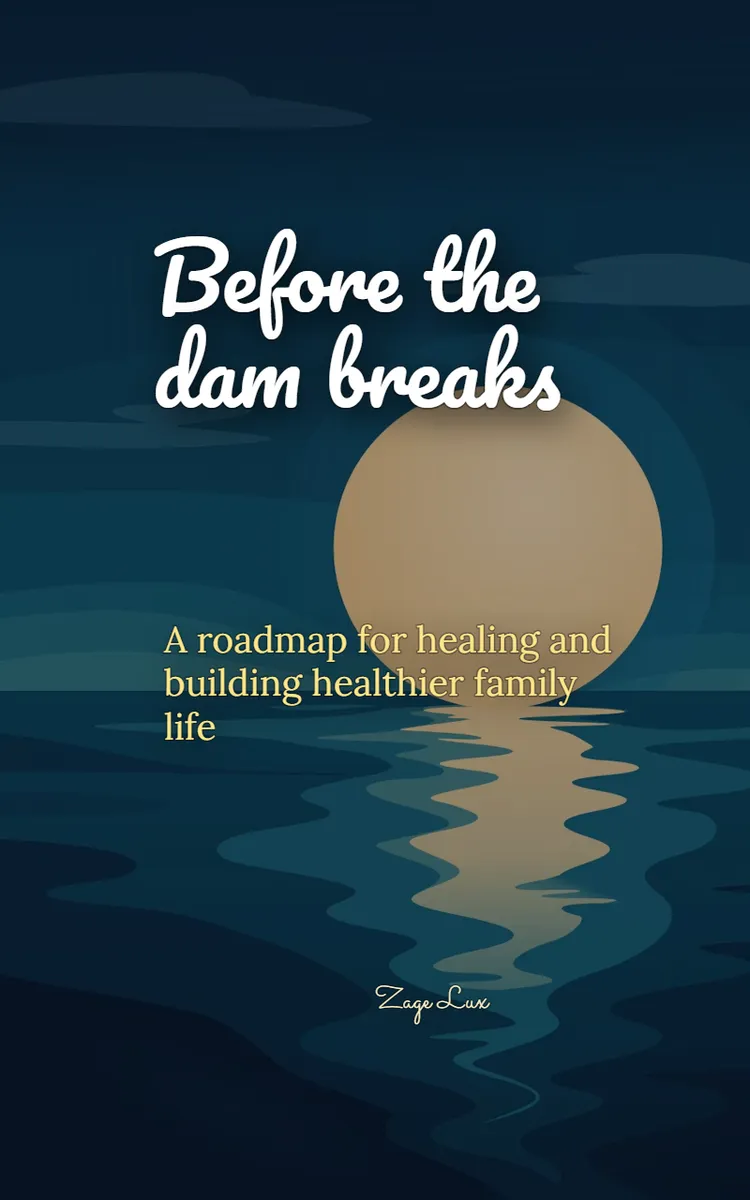
Before the dam breaks
Created with Inkfluence AI
Guidance for creating healthy family culture and emotional maturity
Table of Contents
- 1. Rewriting Your Family Origin Story
- 2. Replacing Emotional Immaturity With Needs
- 3. Building Boundaries Without Guilt
- 4. Repair Rituals for Faster Trust Recovery
- 5. Creating a Resilient Family Culture Compass
Preview: Rewriting Your Family Origin Story
A short excerpt from “Rewriting Your Family Origin Story”. The full book contains 5 chapters and 8,375 words.
The Origin Story That Runs Your Kitchen Like a Boss
Talia, 32, an early-parenting coordinator, can tell you exactly when her house “turns on.” It’s not when the kids wake up, or when the coffee kicks in. It’s when someone interrupts her rhythm - someone needs something right now, and she has to switch gears fast.
Her body does it before her mind does. Her shoulders tighten. Her voice gets sharper. She’ll say something like, “I’m trying to handle this,” even when she’s really just trying not to fall behind the version of family life she thinks she’s supposed to carry. And then the guilt shows up right after: Why am I like this? I don’t want to be the kind of parent who snaps.
That’s the trap. She’s looking at the behavior, not the script. Because the script isn’t sitting in her mouth - it’s sitting in her identity. And if you grew up with emotional chaos, you don’t always notice the “default settings” until you’re driving the same car with different passengers.
Are you rewriting your family culture, or just reenacting an old identity you never agreed to?
The Origin Story Reset: Before You React, Know the Script
Old Belief: “This is just how I am. My family is loud / distant / tense, and that’s what it means to be us.”
New Reality: “My family culture is the result of repeated emotional scripts - and scripts can be replaced by an identity I choose.”
Here’s what changed for Talia once she named the pattern. She stopped asking, “Why do I snap?” and started asking, “What story am I living when I feel interrupted?” When she traced it back, the origin story wasn’t about her kids. It was about being responsible too early, learning that feelings were dangerous, and believing her job was to keep things from falling apart.
So when her child needs her attention, her nervous system hears an alarm: Danger. Loss of control. Someone is going to suffer unless I manage this perfectly. That alarm doesn’t come with a calm explanation. It comes with tension, urgency, and a voice that sounds like control.
A concrete example: one evening, her child asked a simple question while she was setting up dinner. In the old identity, she barked, “Not right now,” even though she could have said, “Give me two minutes.” Later, she felt bad - but she still treated the snap like a character flaw.
In the new reality, she treated it like a script her body had learned. She didn’t excuse it. She didn’t shame herself either. She simply reset the identity: I’m the kind of parent who can pause and choose. The next time it happened, she said, “I hear you. I’m finishing this step, then I’m all in.” Same moment. Different culture.
That’s the whole point of the Origin Story Reset: you’re not just trying to be “better.” You’re changing what you believe you are in the moment your family culture gets tested.
Signs Your Inherited Emotional Script Is Running the Show
If your reactions feel automatic, there’s usually a reason. Emotional scripts run like background software: you don’t notice them until they crash something important - your relationships, your trust, your confidence.
The mindset shift matters because your family doesn’t inherit your intentions. It inherits your patterns. Kids learn “how love works” by watching what happens when things get hard: Who calms down? Who escalates? Who apologizes? Who disappears emotionally? Who controls the room? Those are culture signals, and they’re powered by identity - not willpower.
Here’s the underlying psychology in plain language: when you’re triggered, your brain tries to protect you with the fastest route it knows. If your origin story taught you that emotions create problems, your nervous system will treat emotions like smoke alarms. It will push you toward control, distance, sharpness, or over-explaining. Then you call it “personality,” because it’s easier than admitting you were trained.
Signs this pattern is running your life
1. You feel “out of control” when you’re actually just being interrupted. Your body reacts like the interruption is a threat, not a need.
2. You blame yourself after the reaction - but you don’t change the identity that caused it. You say sorry, then the next trigger hits and you’re right back in the script.
3. You hold yourself to impossible standards during emotional moments. You don’t just want things to go well - you want them to go well without anyone noticing the stress.
4. You can predict your own tone before it happens. You’ve seen the pattern enough times that you know it’s coming, but you keep trying to “muscle through” instead of resetting who you are.
One-sentence summary: Your family culture changes when you stop treating your reactions like fate and start treating them like scripts you can rewrite.
Reflection Prompts That Expose Your Origin Story
You can’t reset what you can’t see. So instead of trying to “be patient” harder, you’ll look at the identity hiding behind your reactions....
About this book
"Before the dam breaks" is a self-help book by Zage Lux with 5 chapters and approximately 8,375 words. Guidance for creating healthy family culture and emotional maturity.
This book was created using Inkfluence AI, an AI-powered book generation platform that helps authors write, design, and publish complete books. It was made with the AI Self-Help Book Writer.
Frequently Asked Questions
What is "Before the dam breaks" about?
Guidance for creating healthy family culture and emotional maturity
How many chapters are in "Before the dam breaks"?
The book contains 5 chapters and approximately 8,375 words. Topics covered include Rewriting Your Family Origin Story, Replacing Emotional Immaturity With Needs, Building Boundaries Without Guilt, Repair Rituals for Faster Trust Recovery, and more.
Who wrote "Before the dam breaks"?
This book was written by Zage Lux and created using Inkfluence AI, an AI book generation platform that helps authors write, design, and publish books.
How can I create a similar self-help book?
You can create your own self-help book using Inkfluence AI. Describe your idea, choose your style, and the AI writes the full book for you. It's free to start.
Write your own self-help book with AI
Describe your idea and Inkfluence writes the whole thing. Free to start.
Start writingCreated with Inkfluence AI


