
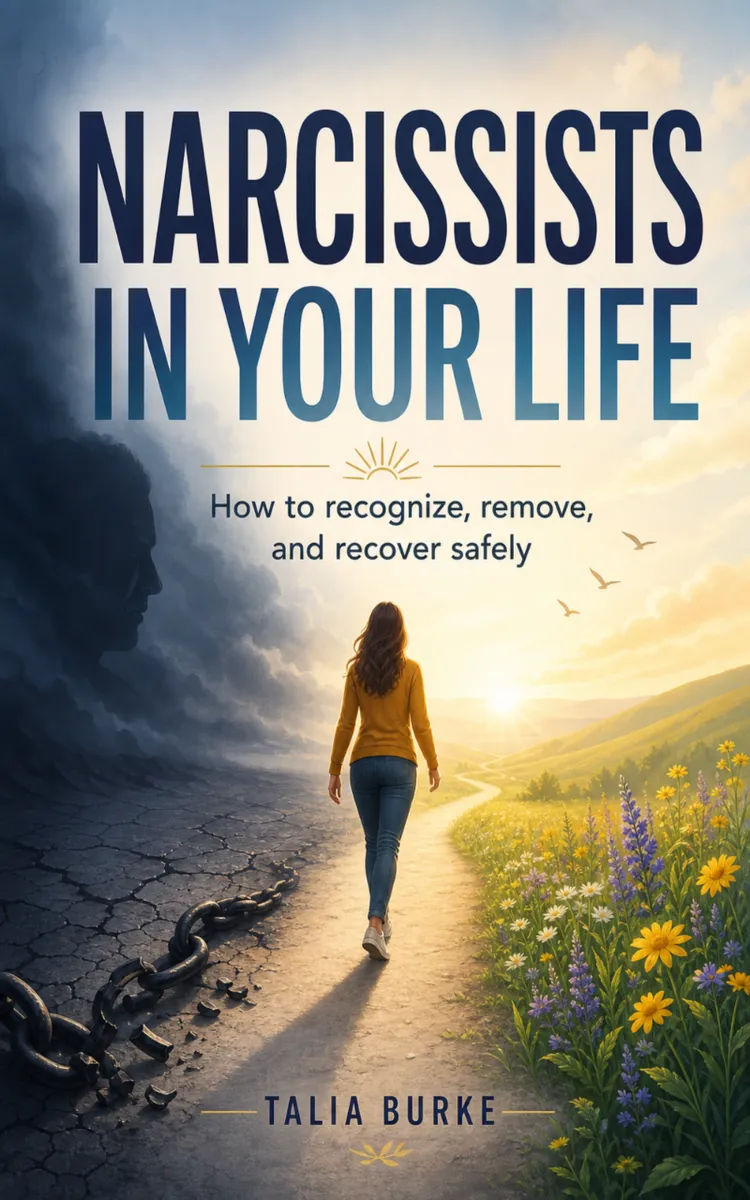
Narcissists In Your Life
Created with Inkfluence AI
Recognizing narcissistic behavior, ending harmful relationships, and recovering
Table of Contents
- 1. Spotting Narcissistic Patterns Fast
- 2. Decoding Gaslighting Tells
- 3. Recognizing Love-Bombing Cycles
- 4. Understanding Supply and Control
- 5. Breaking the Perfectionism Trap
- 6. Reclaiming Your Identity After Devaluation
- 7. Challenging Core Beliefs They Target
- 8. Setting Boundaries Without Guilt
- 9. Using the Gray-Rock Response
- 10. Mastering Boundary Consequences
- 11. Communicating With the BIFF Method
- 12. Preparing for No-Contact Safely
- 13. Documenting Reality Without Escalation
- 14. Handling Hoovering and Return Attempts
- 15. Dealing With Flying Monkeys
- 16. Rebuilding Trust in Yourself
- 17. Healing Trauma Responses and Triggers
- 18. Rewriting Your Inner Narrator
- 19. Building a Support System That Holds
- 20. Designing a Future Free of Narcissists
Preview: Spotting Narcissistic Patterns Fast
A short excerpt from “Spotting Narcissistic Patterns Fast”. The full book contains 20 chapters and 29,773 words.
When the Apology Never Ends the FightNina, 34, had learned to rehearse simple conversations before having them. She was an HR manager, so she knew how to speak carefully, document concerns, and stay calm under pressure. Still, every time she asked her partner to stop making jokes about her in front of friends, the conversation somehow became an argument about her flaws.
He’d say she was “too sensitive.” Then he’d remind her of the one time she snapped after hours of being provoked. By the end, Talia was apologizing for her tone, her timing, and even bringing up the issue. The original problem had vanished. Again.
Normal conflict can be uncomfortable, but it usually leaves room for repair. Both people can look at what happened, take some responsibility, and change their behavior. A narcissistic pattern feels different: the disagreement keeps circling back to your character while the other person escapes accountability.
The question isn’t whether someone ever behaves badly; it’s whether the same pattern keeps making you doubt yourself.The Shift From Isolated Incident to Repeating PatternOld Belief: If I can explain myself clearly enough, the conflict will finally make sense and get resolved.
New Reality: The pattern matters more than the explanation. When someone repeatedly twists reasonable concerns into attacks on you, the problem may not be your communication.
This shift matters because narcissistic dynamics often hide inside ordinary-looking disagreements. One rude comment can be thoughtlessness. One defensive reaction can come from stress. But when every concern becomes proof that you’re difficult, disloyal, jealous, or unstable, you’re no longer dealing with a single bad moment.
You’re watching a system protect one person from accountability.
Talia noticed this when she began keeping a private note after arguments. She wrote down the starting point, what she said, how her partner responded, and how the conversation ended. The entries looked different on the surface - money, social plans, household chores - but the shape was nearly identical. She raised a concern. He denied or minimized it. He brought up an old mistake. She defended herself. He became the injured party. She apologized.
The Pattern-Spotter Checklist isn’t about diagnosing anyone. It’s a way to check whether your relationship is asking you to abandon your own memory and judgment. You don’t need a perfect case or a dramatic label to take repeated harm seriously.
How the Pattern Takes Over Your Daily LifeA narcissistic pattern gains power through repetition. It teaches you to spend more energy managing the other person’s reaction than understanding your own experience. You may start editing ordinary words, delaying necessary conversations, or accepting a false version of events simply to get peace.
That doesn’t mean every tense relationship is narcissistic. Healthy people can be defensive, distracted, or wrong. The key difference is what happens after the tension. Is there curiosity, repair, and changed behavior? Or does the same person keep demanding understanding while offering none?
Signs this pattern is running your lifeYou prepare a legal brief for basic needs.
You collect dates, screenshots, and explanations before saying, “That hurt me.” This happens because past conversations taught you that your feelings will be cross-examined instead of heard.
The subject changes whenever accountability appears.
You ask about a broken promise, and suddenly you’re discussing your childhood, your tone, or a mistake from three years ago. The distraction works because you end up defending yourself rather than addressing the original behavior.
You feel relief when they’re merely neutral.
A quiet evening feels like a reward. You monitor facial expressions, footsteps, texts, or pauses because your nervous system has learned that small signals may predict the next blowup.
Their apology creates more work for you.
“I’m sorry you felt that way” is followed by an explanation of why you caused it. You leave the conversation responsible for their feelings, their behavior, and the repair.
A healthy disagreement may hurt, but it doesn’t require you to disappear in order for peace to return.Talia’s checklist helped her separate conflict from control. Her partner could disagree with her request. What stood out was the repeated refusal to stay with the request itself. He didn’t say, “I see why that embarrassed you, and I’ll stop.” He argued that she was the kind of person who embarrassed him.
That distinction is small in wording and enormous in effect. A disagreement focuses on an action. A narcissistic pattern often turns the action into a verdict about your identity.
Questions That Reveal What You’ve Been NormalizingWhen you bring up one specific behavior, does the conversation stay on that behavior?
Write down the last three examples....
About this book
"Narcissists In Your Life" is a self-help book by Anonymous with 20 chapters and approximately 29,773 words. Recognizing narcissistic behavior, ending harmful relationships, and recovering.
This book was created using Inkfluence AI, an AI-powered book generation platform that helps authors write, design, and publish complete books. It was made with the AI Self-Help Book Writer.
Frequently Asked Questions
What is "Narcissists In Your Life" about?
Recognizing narcissistic behavior, ending harmful relationships, and recovering
How many chapters are in "Narcissists In Your Life"?
The book contains 20 chapters and approximately 29,773 words. Topics covered include Spotting Narcissistic Patterns Fast, Decoding Gaslighting Tells, Recognizing Love-Bombing Cycles, Understanding Supply and Control, and more.
Who wrote "Narcissists In Your Life"?
This book was written by Anonymous and created using Inkfluence AI, an AI book generation platform that helps authors write, design, and publish books.
How can I create a similar self-help book?
You can create your own self-help book using Inkfluence AI. Describe your idea, choose your style, and the AI writes the full book for you. It's free to start.
Write your own self-help book with AI
Describe your idea and Inkfluence writes the whole thing. Free to start.
Start writingCreated with Inkfluence AI


