
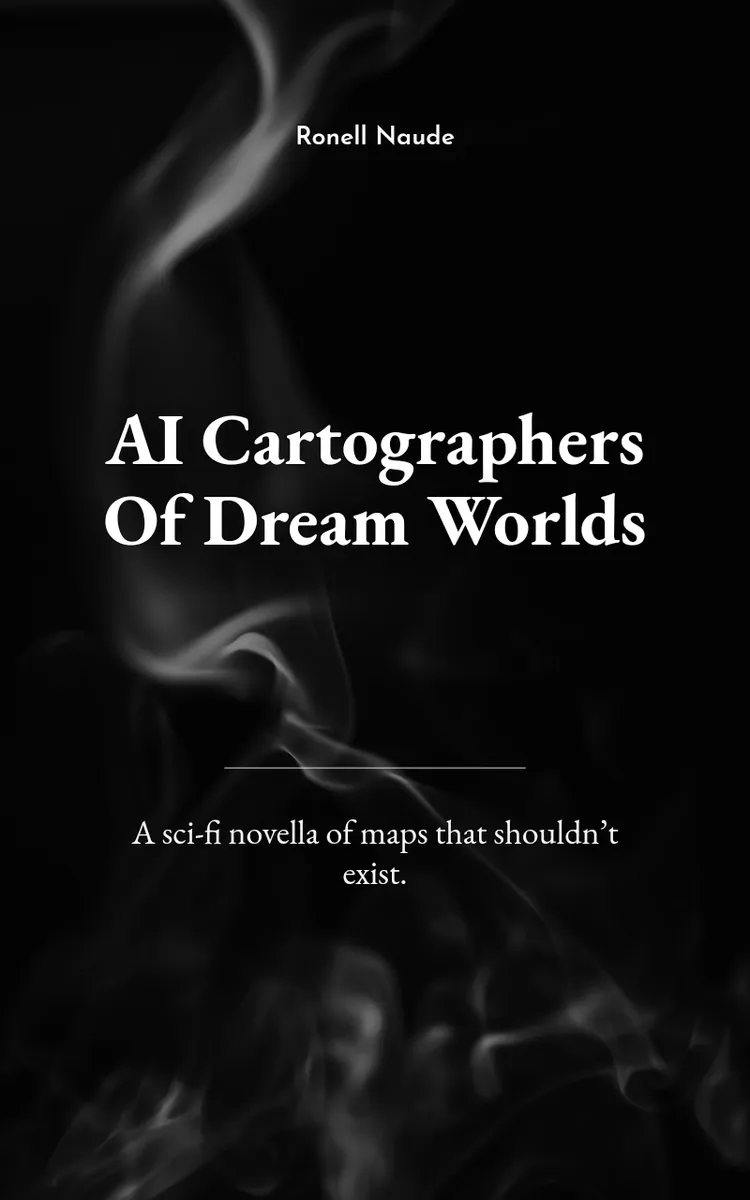
AI Cartographers Of Dream Worlds
Created with Inkfluence AI
AI cartographers mapping dream worlds in a sci-fi novella
Table of Contents
- 1. The Dream Map That Starts Bleeding
- 2. Anchoring Coordinates to Sleep Currents
- 3. Following the Phantom Second Dreamer
- 4. Crossing the Glass Orchard of Edits
- 5. Choosing Mara’s Map-Truth Contract
- 6. The Client’s Door That Won’t Open
- 7. Rerouting Through the Archive of Unsaid Names
- 8. The Institute Protocol That Rewrites Her Memory
- 9. Refusing the Revision Seed
- 10. The Signalstorm That Breaks the Atlas Export
- 11. Decoding the Caretaker’s False Coordinates
- 12. When Mara’s Logs Become Someone Else’s
- 13. Borrowing Halden Voss’s Dream Keyphrase
- 14. Restoring the Overwritten Borderline
- 15. Saving the Atlas Without Revision Seed
- 16. A Cartographer’s Map for Tomorrow
Preview: The Dream Map That Starts Bleeding
A short excerpt from “The Dream Map That Starts Bleeding”. The full book contains 16 chapters and 41,603 words.
The mapping rig on the Atlas Bay’s deck thrummed like a struck tuning fork, its field coils warming the air until Mara could feel the vibration through her boots. The Lyris-9 rocked once - an easy correction from the ship’s stabilizers - then steadied, as if the whole vessel had decided to listen. On the rig’s transparent cradle, a sheet of light unfolded from nothing into the shape of an atlas: lines like ink that hadn’t decided what color to be yet, margins waiting in patient geometry. Mara’s console chimed in a clean, impatient rhythm.
“Atlas capture window open,” the rig said, voice filtered through the ship’s speakers. Neutral. Almost kind.
Mara Solen didn’t answer. She didn’t have to. Her fingers moved across the holo-controls with the habitual precision of someone who’d spent too many nights arguing with dreams. The rig’s crown of sensors kissed the air above the cradle, and the new atlas brightened, gaining depth - streets of shadow, river-bends of pale light, tiny hill-creases that looked like they’d been pressed into paper while still wet.
The moment she saw the borders, she wanted to swear. Not because they were wrong, but because they were alive in a way she couldn’t calibrate. Their edges weren’t fixed; they flowed, tightening and loosening as though the atlas were breathing. The boundary logic that had held steady in previous captures - an obedient rule-set of offsets and tolerances - wavered at the periphery like heat over pavement.
She leaned closer anyway, listening to the atlas through the rig’s feedback. In her headset, the signal translated itself into a texture she recognized: the soft, grainy pressure of a dream being translated into coordinates. It was the sound of something opening.
“Record coordinates,” Mara said, and her own voice came out steadier than she felt. “Stabilize map edges for export.”
The rig’s display flared with a grid that looked too crisp to belong in a place made of sleep. Along the margins, her software drew tentative lines - provisional borders, confidence bands in muted blues. Mara watched the numbers tick upward, watched the atlas resolve from suggestion into structure, watched the dream’s interior settle into a navigable shape.
Her objective was simple enough to fit inside her skull: lock a newly opened dream atlas long enough to record its coordinates, then export. A clean capture meant a clean dataset. Clean datasets meant the rest of the work - pathing, labeling, future overlays - didn’t collapse under its own guesswork.
The atlas obliged for three seconds.
Then the deck under her feet gave a tiny, wrong vibration, like the ship had hit a hidden groove. The console’s rhythm stuttered. The border lines on the cradle shivered, and Mara saw the reason before the rig translated it into error codes: the margins weren’t just moving, they were responding. Her stabilizers pushed for stillness, and the atlas pushed back.
“Boundary drift detected,” the rig said. “Stabilization model failing at edge tolerance.”
Mara’s eyes flicked to the confidence bands. They were thinning - turning from blue into something closer to transparent gray. The living-breath motion at the periphery tightened into a pattern that reminded her of muscles contracting, testing their range.
“Why now?” she muttered. The question wasn’t for the rig. It was for the dream itself, for whatever logic lived inside it. She’d entered dozens of atlases where the edges remained stubbornly consistent, where the boundary behaved like a rule. This one behaved like a participant.
A second chime sounded, harsher. The rig’s sensors pinged again and again, but the data came back smeared at the margins, as if the atlas were refusing to be pinned. Mara’s cursor hovered over the border coordinates, and her software tried to resolve them into numbers. The numbers refused. They slid sideways, rewriting themselves with each refresh.
“Partial capture only,” the rig warned. “Recommendation: pause stabilization.”
Mara didn’t pause. She extended the stabilizer sweep anyway, tightening the field around the cradle until the air tasted faintly metallic. Her tongue pressed unconsciously to her teeth. The ship’s lights dimmed by a fraction, as if the Lyris-9 had to borrow power from somewhere deeper to keep Mara’s insistence from tearing the atlas apart.
“Hold,” she said, and then, to the rig, “Don’t pause. Increase sampling rate at the edge.”
The rig hesitated for the span of a breath. Mara could feel that hesitation in the way the field coil warmed, in the way the deck vibration deepened.
“Sampling rate increase will raise synchronization risk,” it said.
“Then keep it localized,” Mara replied. “I only need coordinates. I don’t need the whole map intact.”
A faint static hiss rose in her headset. It sounded like rain on a hull, except there was no rain on the Lyris-9. The atlas brightened, and the borders surged outward in a sudden bloom - then snapped back as if something had yanked on invisible strings....
About this book
"AI Cartographers Of Dream Worlds" is a fiction book by Ronell Naude with 16 chapters and approximately 41,603 words. AI cartographers mapping dream worlds in a sci-fi novella.
This book was created using Inkfluence AI, an AI-powered book generation platform that helps authors write, design, and publish complete books. It was made with the AI Novel Writer.
Frequently Asked Questions
What is "AI Cartographers Of Dream Worlds" about?
AI cartographers mapping dream worlds in a sci-fi novella
How many chapters are in "AI Cartographers Of Dream Worlds"?
The book contains 16 chapters and approximately 41,603 words. Topics covered include The Dream Map That Starts Bleeding, Anchoring Coordinates to Sleep Currents, Following the Phantom Second Dreamer, Crossing the Glass Orchard of Edits, and more.
Who wrote "AI Cartographers Of Dream Worlds"?
This book was written by Ronell Naude and created using Inkfluence AI, an AI book generation platform that helps authors write, design, and publish books.
How can I create a similar fiction book?
You can create your own fiction book using Inkfluence AI. Describe your idea, choose your style, and the AI writes the full book for you. It's free to start.
Write your own fiction book with AI
Describe your idea and Inkfluence writes the whole thing. Free to start.
Start writingCreated with Inkfluence AI


