
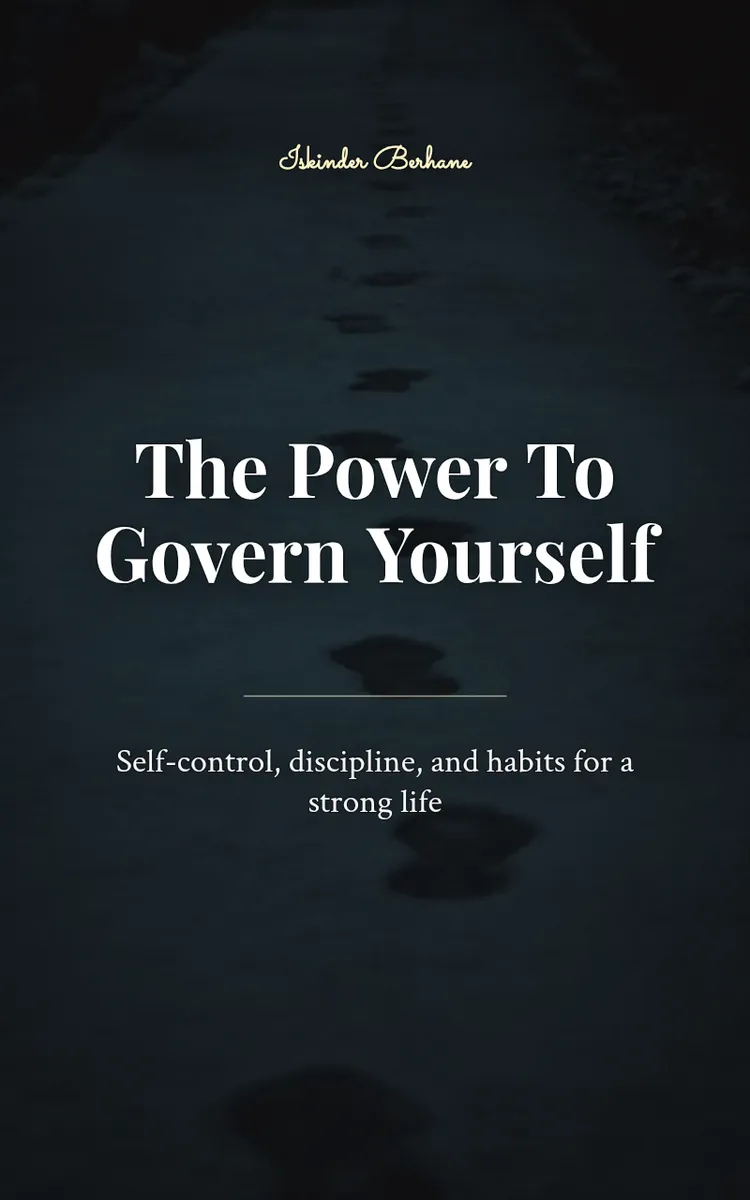
The Power To Govern Yourself
Created with Inkfluence AI
Building self-control and discipline through habit formation
Table of Contents
- 1. Claim Your Self-Governor Identity
- 2. Break the Urge-Behavior Chain
- 3. Build Habits with the Two-Trigger Plan
- 4. Say No Without Losing Relationships
- 5. Recover Fast with the 24-Hour Reset
Preview: Claim Your Self-Governor Identity
A short excerpt from “Claim Your Self-Governor Identity”. The full book contains 5 chapters and 7,179 words.
When Your Good Intentions Keep Expiring
What do you call yourself after promising, for the fourth Monday in a row, that you’ll get your mornings under control? You set the alarm, lay out your clothes, and picture yourself walking into the day calm and prepared. Then the alarm rings. Your hand reaches for snooze before your brain has finished forming a sentence.
By lunchtime, the plan has slipped. The workout didn’t happen. The important task is still waiting. You tell yourself you’ll restart tomorrow, as if tomorrow is a fresh version of you instead of the same person carrying the same patterns.
The problem may not be a lack of discipline. You may be trying to perform habits that don’t yet belong to the way you see yourself.
Will your habits remain a temporary performance, or will they become evidence of who you choose to be?
From Performing Discipline to Becoming Your Governor
Old Belief: I need to force myself to do disciplined things until I finally become disciplined.
New Reality: I build discipline by repeatedly acting as the person who governs himself.
That shift matters because behavior follows the story you believe about yourself. If you think, “I’m trying to become organized,” skipping one planning session feels like proof that you’re not organized. The habit becomes a test. Every missed day threatens your identity, and that pressure often leads to quitting altogether.
A chosen identity gives the habit a steadier foundation. Instead of saying, “I’m attempting to wake early,” you begin saying, “I’m a person who protects the first hour of the day.” The alarm is no longer a battle between comfort and willpower. It becomes a small decision that confirms your chosen role.
Take a self-employed plumber who wants to stop losing evenings to unfinished paperwork. He could treat job notes as an annoying task he must force himself to complete. Or he could choose the identity of a professional who closes the day properly. That identity makes the next action clearer: before leaving the van, he records the job, checks tomorrow’s schedule, and sends the needed invoice. It isn’t glamorous. It’s governance in work boots.
The habit doesn’t need to feel natural at first. Identity isn’t a costume you put on and instantly believe. It’s a direction you reinforce through evidence. Each completed action says, “This is how I operate.” Over time, the action feels less like a performance and more like a normal expression of you.
The Identity-to-Action Loop
The Identity-to-Action Loop is simple: choose who you are becoming, let that identity guide one visible action, then use the action as evidence for the identity. The loop strengthens through repetition.
You don’t need to declare that you’re a perfectly disciplined person. That claim may feel false, and your mind will argue with it. Choose something believable and specific: “I’m someone who keeps promises to myself,” or “I’m someone who handles important tasks before distractions.” Then give that identity a small job today.
When the loop is running in the wrong direction, your old labels guide your choices. “I’m terrible with money” makes another careless purchase feel expected. “I never stick with anything” makes a missed workout seem like the end of the story. The label lowers the standard before the decision even arrives.
Signs this pattern is running your life:
1. You wait to feel motivated before acting, then use the lack of motivation as evidence that you can’t change.
2. One missed habit turns into a week of avoidance because you treat the slip as an identity verdict.
3. You make plans based on your ideal self, but your daily choices still follow the identity of someone who is always rushed.
4. You talk about discipline as something you either have or don’t have, rather than something you practice through small proof.
The fix isn’t to argue with every negative thought. It’s to create better evidence. A person who governs himself still gets tired, distracted, and irritated. The difference is that he doesn’t let those states make every decision.
Your identity becomes believable when your daily actions give it proof.
Questions That Put Your Identity on the Line
1. What kind of person do you want your daily habits to prove you are?
Choose a quality that matters in real life, not a polished slogan. “Reliable,” “steady,” or “prepared” may be more useful than “successful.”
2. Where are you asking discipline to rescue a vague identity?
If you keep saying you need more self-control, name the role underneath it. Perhaps you want to be a parent who is present after work, a business owner who follows through, or a person who can trust his own word.
3. What is one action that would make that identity visible today?
Keep it small enough to complete without a dramatic mood change. If your identity is “I handle important things,” send the overdue email before checking social media.
4....
About this book
"The Power To Govern Yourself" is a self-help book by Iskinder Berhane with 5 chapters and approximately 7,179 words. Building self-control and discipline through habit formation.
This book was created using Inkfluence AI, an AI-powered book generation platform that helps authors write, design, and publish complete books. It was made with the AI Self-Help Book Writer.
Frequently Asked Questions
What is "The Power To Govern Yourself" about?
Building self-control and discipline through habit formation
How many chapters are in "The Power To Govern Yourself"?
The book contains 5 chapters and approximately 7,179 words. Topics covered include Claim Your Self-Governor Identity, Break the Urge-Behavior Chain, Build Habits with the Two-Trigger Plan, Say No Without Losing Relationships, and more.
Who wrote "The Power To Govern Yourself"?
This book was written by Iskinder Berhane and created using Inkfluence AI, an AI book generation platform that helps authors write, design, and publish books.
How can I create a similar self-help book?
You can create your own self-help book using Inkfluence AI. Describe your idea, choose your style, and the AI writes the full book for you. It's free to start.
Write your own self-help book with AI
Describe your idea and Inkfluence writes the whole thing. Free to start.
Start writingCreated with Inkfluence AI


