
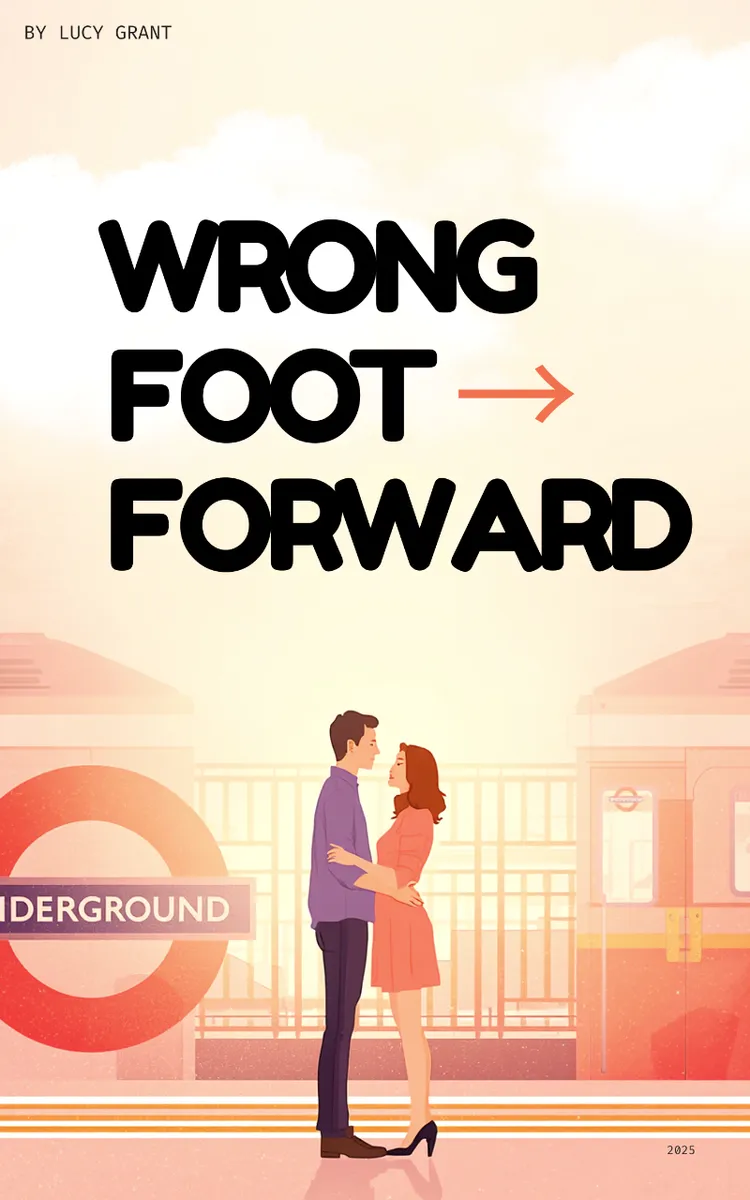
Read the first chapter
The whole of chapter one, free. About 12 min. Turn the pages with the arrows, your keyboard, or a swipe.
Chapter 1
The Lift Lie That Wasn’t
The lift doors of 42 Holborn sighed shut with the sort of theatrical patience that made you want to apologise to them. Ollie stood just inside, one hand still half-raised as if he could catch the closing gap, and the other gripping his phone like it might offer an escape hatch if he stared at it hard enough.
He’d missed the reception queue by seconds. He’d missed the last train by minutes. He’d missed - well, everything that mattered this morning - by the exact amount that turned an ordinary commute into a minor personal tragedy. The foyer air smelt faintly of lemon polish and hot paper, and the lift’s carpet was that weird, expensive grey that soaked up footsteps without ever actually forgiving them. Above, a small panel glowed with floor numbers. Ahead, the button for his floor - sixteen - looked like it was judging him.
He pressed it.
Nothing.
He pressed it again, more firmly, as if force could coax electricity into obedience. The button gave a quiet click, then the lift gave a quiet lurch, like it was deciding whether to acknowledge him at all. Ollie’s stomach did that unpleasant flip it always did when his body started writing its own scripts.
Someone stepped into the lift behind him. The doors shivered, then held. A woman - smooth hair, sharp coat, sensible shoes that somehow looked stylish without trying - took in the scene in one glance and didn’t blink. She held her phone at her side, screen dark, and carried a folder under one arm like it belonged there. Her expression had the calm competence of someone who’d never spent a whole morning rehearsing apologies in the mirror.
Ollie tried to smile. It came out as a grimace that sounded, in his head, like a file being dragged across a desk.
“Sorry,” he said automatically, because words were easier than thinking.
The lift pinged. The floor numbers flickered. Then - of course - his phone buzzed. A calendar alert. An email. Something that made him look down, just for a second, just long enough for panic to sprint ahead of him.
When he looked up again, he saw her eyes shift to his hand.
To the way it was hovering awkwardly near the lift handrail, fingers curled like he was bracing for something that wasn’t happening.
To the fact that he’d somehow - how? - managed to position himself at an angle that made it look as if he was waiting to be helped.
Not waiting, exactly. More… frozen. Like a performance. Like he was trying to be seen.
His brain offered up a single, useless thought: Oh no. Oh no, no, no - The lift made a sound that could only be described as smug. The doors began to close again, this time with less patience. Ollie lunged without thinking, shoulder grazing the brushed steel wall, and his hand shot out in a reflexive grab at the handrail. The movement was clumsy, the kind that in any other context might have been called “awkward.” In this context, in her gaze, it landed like a story.
Her face tightened, not with anger, but with that sharp, controlled judgement people reserve for catching someone at something they shouldn’t be doing.
The doors finished closing.
And Ollie, in the split-second before the lift started to move, managed to think one sentence - one sentence perfectly formed and completely useless - before the moment swallowed it whole.
He was pretending.
He was pretending to be disabled.
He had not corrected it.
He hadn’t even had time to breathe properly.
The lift began its ascent with a smooth hum that made everything feel too quiet, too intimate. The air was cool and faintly metallic. Ollie could feel the heat of his own cheeks under his collar, could hear his pulse thudding in his ears louder than the lift’s motor.
Beside him, the woman didn’t look away, but she also didn’t look at him. She stared at the floor display as if it might offer evidence. Her folder sat against her ribs, steady. Her jaw was set.
Ollie could have tried to explain. He could have said, I’m not - It was a button - No, I - anything. But his instinct, when social pressure hit, was not to speak. It was to dig deeper. To make the situation make sense by force of explanation. And the problem with explanations was that they required time. And time, in that lift, was already gone.
He swallowed. “It’s - ” he began, then the lift chimed as the doors opened.
The foyer outside was brighter, with that office smell of printer toner and someone’s breakfast sandwich lingering in the carpet. People moved in a steady flow, coats swinging, cases thumping lightly against knees. The woman stepped out first, smooth as a blade.
Ollie followed, too fast, bumping the edge of his shoulder on the door frame. He reached into his mind for the right words and came up with the same sentence again, but this time with a different ending: It’s not what you think, I promise.
He caught up to her just before the corridor turned.
“Sorry,” he said, because “sorry” was the only safe currency his mouth knew how to spend. “I didn’t - I wasn’t - I just - ”
She stopped. Not abruptly. Just enough that the air around them changed. The corridor’s hum seemed to quiet.
Her eyes flicked to him, sharp and bright. “You missed the button,” she said.
Ollie blinked. “What?”
“That’s what you did,” she continued, as if she were reading something on a form. “You pressed it too many times, panicked, and then acted like you needed… assistance.” She said the last word as if it were a specific kind of lie.
He stared at her, the words scrambling in his head. She wasn’t guessing. She was naming.
“I didn’t act,” he said, and then immediately regretted how defensive it sounded. “I froze. That’s not the same. I was - my phone - I looked down and then the doors - ”
The sentence broke apart. He could feel himself spiralling into the sort of explanation that only made things worse.
Her lips pressed together. She shifted her folder slightly, angling it closer to her chest like armour. “Look,” she said, and her tone was professional enough to qualify as polite but not gentle. “I haven’t got time for - this.”
He took a breath. “It wasn’t - I swear it wasn’t - ”
She cut in again, because apparently she was determined to win against him on speed. “You can swear all you like. People do.” Her eyes held his for one beat too long. “But I saw it.”
Ollie’s ears went hot. The corridor had turned into a stage, and he was still standing in the wrong spot, still dressed for the wrong part of the play.
He tried to laugh, because sometimes humour could buy time. It came out thin. “Right. Yes. You saw it. Obviously.” He gestured vaguely at the air, as if the lift itself could explain. “But I’m not - ”
“Not what?” she asked. Her voice stayed even. That was the worst part. Evenness meant she’d already decided where the conversation would end.
He opened his mouth. Closed it. Looked, helplessly, at the building number plaque bolted to the wall like it might tell him how to behave.
“I’m Ollie,” he blurted, because names were meant to create a bridge, and he was too flustered to know whether it was a bridge or a trap. “I’m - sorry. I’m new.”
Her gaze flicked down, then back up, like she was placing him on a mental chart. The folder shifted again. “Right.”
He waited for her to say something else. Instead she turned her head slightly, listening to something he couldn’t hear. A coworker passed behind her, glanced at Ollie, then kept going without slowing, as if he’d become one of those office rumours that didn’t deserve attention.
The woman looked back at him. “I’m on reception until eleven,” she said briskly. “If you need to apologise properly, do it then.”
Ollie stared. “Properly?”
She gave him a tiny, humourless smile, the kind that suggested she’d never been short on “properly” in her life. “Yes. Properly.” She started walking, her shoes clicking on the polished floor. “In the meantime, please don’t - ” She paused at the corridor corner, just long enough to let the thought land. “Don’t do it again.”
And then she was gone, swallowed by the flow of people and fluorescent lighting.
Ollie stood there with his mouth half-open, his phone buzzing again in his hand like it was mocking him for making him look down at the exact wrong time. He could still feel the lift’s cool air on his face, could still hear the smug little chime as the lift decided it was done with him.
He wasn’t sure what hurt more: that she thought he’d faked it, or that she’d said it out loud like it was an answer key.
He walked towards his desk with the stubborn determination of a man who could not afford to be embarrassed in his own life. The trouble was, embarrassment was a creature with legs. It followed you. It waited for you to turn a corner and then trotted right after.
At his workstation, his colleague - someone Ollie had met once at a drinks thing and immediately forgotten the name of - looked up and smiled in that friendly way people used when they wanted you to feel normal.
“Morning,” they said.
Ollie managed to return the smile. “Morning.”
The colleague’s eyes flicked, briefly, towards the corridor where the woman had gone. “Reception’s got a new face,” they said, in the tone of someone sharing a bit of gossip as if it were weather.
Ollie swallowed. “Is she… new?”
“Not exactly.” A pause. “She’s sharp, though. Don’t mess about.”
Ollie sat down, slowly, as if sudden movement might summon the lift again and trap him inside it with his own humiliation. “I wouldn’t dream of it,” he said, which was technically true. He wouldn’t dream of pretending to be disabled, because he didn’t even dream of being that kind of person.
But his stomach didn’t believe him.
He opened his laptop. The keys felt too smooth under his fingers. He tried to type a document, tried to focus on a spreadsheet, tried to do the kind of work that didn’t care what you’d done in a lift.
Every time his mind wandered, it returned to the moment in the steel box: her eyes on his hand, her calm certainty, the way she’d cut him off as if he were already guilty.
At ten past nine, his manager called him over. At ten thirty, someone asked for a quick review. At eleven, the day shifted into that office rhythm where you could either keep spinning in your own head or get dragged along by tasks.
Ollie chose tasks. Tasks were at least honest about being boring.
He finally caught sight of her again at eleven fifteen, when she stepped out from reception with a coffee in hand and a stack of papers tucked under her arm. She moved like she owned the corridor. Her competence made the world feel slightly less chaotic, which was annoying considering she’d just accused him of being the chaos.
He stood when she approached, then sat back down again as if his body had vetoed his courage.
She paused by his desk. The coffee smelled faintly of vanilla and something stronger beneath it - espresso, maybe. She looked at him with the same careful control as before, like she was holding a pen over his file and deciding whether to mark him “resolved” or “problem.”
Ollie straightened. “Hi,” he said, because his brain had decided that if it couldn’t un-happen the lift, it could at least behave.
“Hi,” she replied. One syllable. No warmth, but not cruelty either. Just… assessment.
He lifted his hands slightly, palms up, a gesture that meant nothing and everything. “I wanted to apologise properly,” he said. “I know you asked for it.”
Her eyes narrowed a fraction. “Good.”
He took a breath. “I wasn’t pretending. I panicked. I pressed the button wrong. My phone buzzed and I looked down.” He could hear how flimsy it sounded, like a child’s excuse, but he kept going because the truth had to be bigger than his embarrassment. “When I looked up, the doors had started closing and I - I grabbed the handrail and my body did that thing where it freezes. It wasn’t… a choice.”
He watched her face as he spoke. She didn’t soften. She didn’t do the little “oh, I see” smile people offered when you’d redeemed yourself.
Instead, her gaze held steady, and something in it shifted - just slightly - as if she was mapping his panic to a pattern she recognised. Not sympathy, exactly. More like understanding.
When he finished, the corridor noise returned in a rush. Someone laughed somewhere down the hall. A printer started up with a whirr that sounded like a complaint.
The woman’s coffee cup made a soft click against the edge of her folder when she adjusted her grip. “You froze,” she said.
“Yes,” Ollie admitted, because hiding it felt worse than saying it. “I froze.”
A beat passed. It was the sort of beat that could have become awkward forever, but she didn’t let it. She took a sip of her coffee and then - almost reluctantly - she looked at him properly.
“And you didn’t correct it,” she added.
He let out a breath that shook a fraction. “I couldn’t. The window closed before I could form a sentence.”
Her expression flickered - something like disbelief, then something like amusement at how ridiculous that was. “That’s… inconvenient,” she said.
Ollie blinked. “Inconvenient?”
She gave him a small, dry look. “Yes. In case you were wondering, the universe doesn’t like continuity.”
He stared at her. “What?”
She stepped back half a pace, as if she’d decided she’d said enough. “Nothing.” She shifted her papers again. “Just - don’t do it again.”
Ollie wanted to protest. Wanted to say, I can’t promise anything if I keep freezing at the exact moment it matters. But he didn’t know how to ask for reassurance without sounding like he needed it. So he nodded instead, like a man agreeing to terms and conditions.
She turned to go.
Ollie’s voice cut after her, too quick. “Wait.”
She paused.
He hesitated, then forced the question out. “Do we… work together?”
She looked over her shoulder. “We’re in the same building,” she said.
“Right,” Ollie said, because he was clever enough to realise that wasn’t an answer. “But - like - same team?”
A flicker of something passed over her face. Not quite annoyance. Not quite amusement. Something more complicated. “You’ll find out,” she said.
Then she walked away, leaving Ollie with his apology hanging in the air like an unfinished sentence.
He sat back down, stared at the blank document on his screen, and tried to make the day behave. Outside, London carried on with its relentless enthusiasm for traffic lights and late buses. Inside, the lift hummed somewhere behind the walls, indifferent to the fact that it had just turned him into a rumour.
Ollie looked at the corridor again, as if he might catch her watching him from a distance, as if he might see the exact moment her perception had shifted.
He didn’t.
Instead, his inbox pinged - another calendar reminder. Another task. Another day that would require him to be a person among other people, even when his face still felt too hot for his own skin.
And the cost of his split-second panic sat there with him, stubborn as a stain: not the misunderstanding itself - she’d cleared that up quickly, truth in, verdict out - but the ghost of it, wandering through his thoughts like a second presence.
Ollie had wanted control back from the moment it slipped away.
What he had instead was a new kind of problem.
A woman in the same building who now knew exactly how he froze - who’d decided his incompetence was, at best, inconvenient - and who, judging by her careful calm, would be impossible to avoid even if he tried.
End of chapter one. 39 more chapters in the full book.
Swipe or use the arrows to turn the page
What's inside: 40 chapters
- 1. The Lift Lie That Wasn’t
- 2. A Proper Hello, Interrupted
- 3. Her Competence Feels Like a Wall
- 4. The First Shared Deadline
- 5. Ollie Learns to Apologise Twice
- 6. The Pitch That Blows Up
- 7. The Pub Where They Keep Colliding
- 8. A Friend’s Flat, No Exit Routes
- 9. When He Notices What She Hides
- 10. The Spreadsheet War
- 11. Following the Ghost’s Footsteps
- 12. The Morning After the Roast
- 13. Ollie’s Honest Retelling
- 14. A Contract Signed in Cold Air
- 15. The Clue in the Deleted Email
- 16. The Museum Date That Isn’t
- 17. Her Proper Laugh, Finally
- 18. The Pitch Deck Goes Missing
- 19. The Competing Storyline
- 20. The Door Opens at Midday
- 21. A Kiss Almost Happens, Then Doesn’t
- 22. The Workplace Rumour Turns Hostile
- 23. Tracking the Saboteur’s Trail
- 24. Amelia’s Competence Breaks at Home
- 25. Ollie Chooses Transparency
- 26. The Evidence Swap
- 27. The Conference Room Confrontation
- 28. When He Blames Himself
- 29. A Shared Walk Through London Rain
- 30. The Night She Files Him Away
- 31. Asking the Unfinished Question
- 32. The Gala Seating Disaster
- 33. Ollie Doesn’t Evaporate
- 34. Who Told the Toast?
- 35. The Public Apology That Wins
- 36. Letting It Be Messy
- 37. Café Truths Over Cold Coffee
- 38. The Project That Forces Choice
- 39. The Almost-Accident That Teaches
- 40. A Date That Isn’t Work
About this book
"Wrong Foot Forward" is a romance book by Alejandra with 40 chapters and approximately 110,238 words. Workplace romantic comedy built on a lingering meet-cute misunderstanding.
This book was created using Inkfluence AI, an AI-powered book generation platform that helps authors write, design, and publish complete books. It was made with the AI Romance Novel Writer.
Frequently Asked Questions
What is "Wrong Foot Forward" about?
Workplace romantic comedy built on a lingering meet-cute misunderstanding
How many chapters are in "Wrong Foot Forward"?
The book contains 40 chapters and approximately 110,238 words. Topics covered include The Lift Lie That Wasn’t, A Proper Hello, Interrupted, Her Competence Feels Like a Wall, The First Shared Deadline, and more.
Who wrote "Wrong Foot Forward"?
This book was written by Alejandra and created using Inkfluence AI, an AI book generation platform that helps authors write, design, and publish books.
How can I create a similar romance book?
You can create your own romance book using Inkfluence AI. Describe your idea, choose your style, and the AI writes the full book for you. It's free to start.
Write your own romance book with AI
Describe your idea and Inkfluence writes the whole thing. Free to start.
Start writingCreated with Inkfluence AI


