
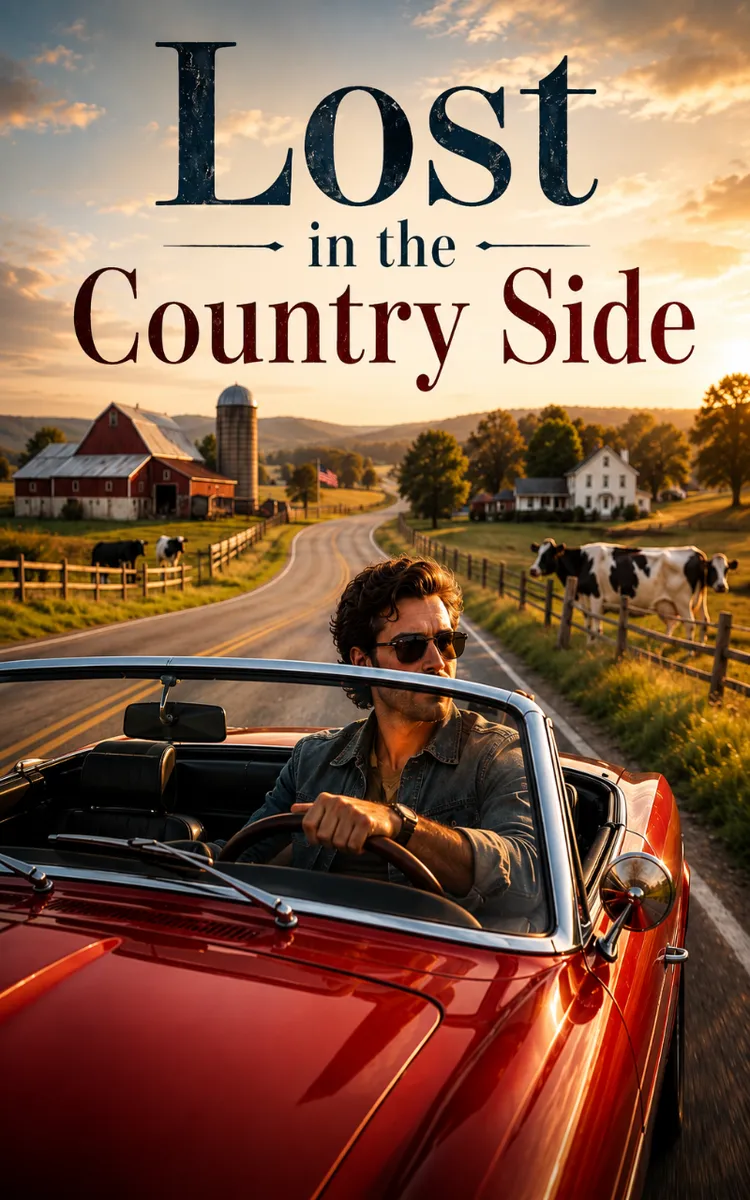
Read the first chapter
The whole of chapter one, free. About 15 min. Turn the pages with the arrows, your keyboard, or a swipe.
Chapter 1
The Flat-Tire Panic on Gravel
The red convertible rolled over the gravel like it had somewhere important to be, which was a bold lie told by the sound of small rocks pinging the wheel wells. Calvin Mercer had one hand on the steering wheel, the other tapping the dashboard in a rhythm that suggested confidence, and the windows were down just enough to let in the smell of warm dust and cut grass from fields that didn’t care about his schedule.
The country road stretched ahead in that slow, empty way that made you feel like the world was holding its breath. No passing cars. No distant farm lights. Just a line of fence posts and sky, and the occasional gust that fluttered his shirt collar against his neck like it wanted to join the conversation.
Then the car made a noise that was less “road trip” and more “someone dropped a toolbox into a blender.” The steering wheel jerked, the engine hiccuped, and the convertible lurched to the shoulder with a final, offended shudder.
Calvin coasted to a stop, the tires crunching to silence. He stared through the windshield at the gravel slowly settling back into place, as if the road might apologize for what it had done.
“Okay,” he said to nobody, because he was the kind of man who talked to machines and expected them to behave. “Okay. A minor situation.”
He got out, the air hitting him cool and dry, carrying that faint, earthy smell of manure that always seemed to show up on rural days like a surprise guest. The spare tire well was right there in his mind - he could picture it. He could feel the victory already forming.
Except when he looked at the front tire, the reality was a shredded, dusty donut of defeat. The rubber looked like it had been chewed by something with strong opinions. The rim was clean enough to be insulting, and the sidewall was gone in a way that made Calvin’s stomach sink faster than the car had.
He crouched, ran his fingers over the torn edge, and flinched at the grit. “Great,” he muttered. “So we’re doing this.”
He stood and opened the trunk, and the trunk responded with a loud, metallic complaint as if it had also been waiting for an excuse to stop working. Tools clattered. The smell of old rubber and gasoline fumes drifted out, warm and sharp.
He popped the jack up and shoved it into place, grunting with the dramatic seriousness of a man who definitely owned a torque wrench somewhere. The gravel shifted beneath the jack wheels, and for a second he thought he had everything under control.
Then the convertible’s body gave a tiny, suspicious creak, and the jack settled a fraction lower with a soft, awful sigh.
Calvin froze, staring at the car like it might start talking back.
“Don’t you dare,” he told it, because apparently he was now negotiating with physics. He adjusted the jack, checked the ground, and tightened things down again with extra force. The tire stayed flat. The world stayed quiet. The only sound was insects and the distant hum of nothing.
Calvin tried his phone.
No service. Of course. The signal bar area might as well have been decorative. He waved his screen at the sky like the sky owed him a favor.
He thumbed the call button anyway, because pride is a stubborn animal. The phone made a brief, hopeful chirp and then gave him the blank, unfriendly silence of a dead connection.
He tried again. And again. Each time he got the same result, the air felt a degree colder, as if the road itself disapproved of his denial.
By the time he stood with his hands on his hips, dust on his forearms and frustration in his throat, his earlier confident rhythm had turned into a tight, angry tapping. Gravel crunched under his shoes when he paced a few steps along the shoulder.
“Alright,” he said, forcing cheer into his voice like it could trick the universe. “Roadside help. That’s the plan. People drive by. Someone sees me. Someone stops.”
He held his thumb out and walked to the edge of the road, lifting both arms like he was auditioning for a role titled “Man Who Is Definitely Not Trapped.” He angled his body toward the direction cars might come from, squinting at the empty horizon.
Minutes passed the way rural time does - slow enough to feel personal. A bird landed on a fence post and stared at him with the calm judgment of an animal that had never had to change a tire.
Calvin waved anyway, because surrender didn’t look good on him. A passing tractor was just a rumor on the far bend. The road stayed empty.
He went back to the convertible, knelt beside the flat tire, and pulled at the lug nuts with a wrench that had never been properly appreciated. The metal scraped, the bolt stubbornly resisted, and his arm started to burn.
“Come on,” he hissed, twisting harder. The wrench slipped a millimeter on the grit and smacked his knuckles, sending a sharp sting up his hand. He shook his fingers, glaring at the lug nuts like they were personally responsible for his injury.
He tried again, more carefully this time, because pain makes you smarter for about five seconds. The lug nuts loosened with a gritty, reluctant sound. One by one, they came free, and he exhaled like he’d just survived something heroic.
Then the spare tire rolled into view in the trunk, and Calvin’s relief lasted exactly until he saw it.
The spare was there, yes. But it looked… dusty. Like it had been parked in a shed for a decade. The tread was flattened in spots, and the sidewall had a faint crack that made Calvin’s heart do an uncoordinated hop.
He stared at it, then at the road, then at the sky.
“Seriously?” he said. “The universe can’t even give me a spare with confidence?”
He set the spare aside and checked the tire well and tools again, because if he couldn’t trust the spare, he could at least trust his own thoroughness. He found a small patch kit tucked behind a bag of emergency flares he hadn’t used since some landscaping job gone wrong, and he considered, very briefly, the idea of patching the destroyed tire like it was a leaky garden hose.
Then he remembered the tire was shredded in a way that suggested patching would be like frosting a break in a bone.
Calvin went back to the road and flagged again, this time with extra intensity, his posture stiff with “I’m fine” even though his knuckles were throbbing.
A sound came from the distance: an engine, low and uneven, like it was trying to decide whether it wanted to exist. Gravel crunched somewhere far off, and Calvin turned his head so fast his neck popped.
A pickup appeared around the bend.
Not a sleek modern truck. This one looked like it had a personality. The paint was faded, the hood slightly dented, and the tires threw dust like it was a hobby. It rolled slowly, then pulled over with a gravelly squeal and a final thunk.
Calvin’s relief surged so hard it made him temporarily stupid.
He walked toward the passenger-side window with his arms still half-raised, as if the truck might not recognize he was a human in distress unless he performed. He was ready with his thanks, his explanation, his “I’ve got it, but…” speech.
The window rolled down, and a woman leaned out, her hair pulled back in a way that meant she’d stopped caring about flyaway hairs years ago. She looked about Calvin’s age - thirty, maybe - wearing work boots and a faded denim jacket that had clearly seen more dirt than he ever would by accident.
“Hey,” she said, voice steady, like she’d already decided the day would be interesting. “You’re the one with the red car?”
Calvin blinked. “Yes,” he said quickly, then slowed down, because he realized he was about to sound desperate. “I mean - yeah. Flat tire. I’m just trying to - ”
“Trying to get it to behave?” She lifted one brow. “That thing does not look like it’s interested in negotiation.”
Calvin glanced back at the shredded rubber and tried to laugh like he hadn’t already been betrayed by his own spare. “It’s fine. I’ve got it.”
The woman looked at him for a second - at his dusty shirt, his sore knuckles, the jack planted on gravel like a stubborn monument. Then she gestured toward the pickup’s bed with her chin.
“I can help,” she said.
Calvin’s pride flared up like a match in dry grass. “I’m okay. Really. I just needed someone to - ” He waved at the road, as if his earlier lack of luck could be fixed with manners. “You know. To pass by. For a tow or something.”
She leaned back slightly, and the truck’s interior smelled faintly of coffee and something metallic, like tools. “A tow out here is… how do people say it?” She paused, thinking like she was searching for the right word in a drawer. “Not fast.”
Calvin swallowed. “I can fix it. I’m almost done.”
He said it with the kind of confidence that comes from having no idea how long “almost” can stretch out in the countryside. The woman didn’t argue. She just watched him like he was a puzzle with missing pieces.
Calvin held up the wrench, then remembered his knuckles were hurting and lowered it. “Just - if you want to do something, you can - uh - keep an eye out. In case someone else comes.”
She smiled, small and knowing, the way people smile when they’ve seen stubborn men try to wrestle machines. “Calvin,” she said, like she’d read it on a sticker, even though he hadn’t told her his name.
Calvin stared. “How did you - ”
“My cousin’s friend lives down the road,” she said, shrugging. “He told me a guy with a red convertible was stranded. Said he looked like he was trying to win a fight with a tire.”
Calvin’s ears heated. “That’s… not - ”
“Not accurate?” she offered.
“It’s accurate,” he admitted, then immediately tried to regain control of his dignity. “But I’m not losing.”
The woman nodded toward the road, where the gravel road disappeared into silence again. “I’m Diane Holloway,” she said. “I’m heading back to my place. It’s close enough that I don’t mind stopping. You can ride with me and we can sort out your car from there.”
Calvin opened his mouth to refuse.
Then his phone buzzed in his pocket with a sudden, teasing burst of life - one bar, like a cruel joke. He looked down at the screen and saw it had found service just long enough to show him a missed call from his mechanic, dated yesterday. The universe had impeccable timing and zero mercy.
He looked back at Diane and the pickup and the road, and his refusal crawled back into his throat.
“Sort it out how?” he asked, trying to make it sound casual.
Diane smiled wider. “Like grown-ups,” she said.
Calvin tightened his jaw. “I’m a grown-up.”
“Then hop in,” she replied, like that settled it.
He didn’t want to. He wanted to stay by his car, to prove something to himself and the empty road and the tire that had clearly chosen chaos. But the gravel under the jack felt suddenly less stable, and his knuckles throbbed with every beat of his pulse.
He walked to the driver’s door, slid in, and shut it with a heavy, defeated thud. The convertible smelled like sun-warmed upholstery and dust. He looked at Diane through the open pickup window as she climbed into the driver’s seat.
“You’ll come back for it, right?” he asked quickly, because now he was worried she’d leave him with the wreckage and a story he’d tell with a laugh later.
Diane started the pickup. “Sure,” she said. “Unless it tries to run away.”
Calvin glanced at the flat tire again, then at the wrench in the gravel. “It won’t,” he said, even though the tire had already proven it had no loyalty.
Diane pulled onto the road, and the pickup’s tires kicked up a ribbon of dust behind them. Calvin stared at his convertible in the rearview mirror and felt, irrationally, like he was abandoning it at a party.
He tried to focus on the motion, on the steady rumble of the truck, on the fact that at least he wasn’t standing alone in the middle of nowhere anymore.
Then Diane turned her head and called over the engine noise, “You got a name?”
Calvin opened his mouth, then remembered he’d already given it away. “Calvin,” he said.
“I thought so,” she replied, and the way she said it made him feel like the road had been gossiping.
He leaned back, trying not to let the irritation show. “I’ll still fix it,” he insisted, mostly to keep his pride from collapsing entirely.
Diane laughed - one quick bark of sound that didn’t mean she was mocking him, just that she found the situation entertaining. “You can fix it,” she agreed. “After we get you out of the gravel.”
The truck bounced along the road, and Calvin watched the countryside slide past: fields mottled with dry grass, fence lines, and patches of wildflowers that looked too cheerful for the trouble he’d already collected. He shifted in his seat as the pickup rattled and hit every uneven seam in the gravel.
Minutes later, the road narrowed, the trees thickened, and the air changed - less dusty, more damp with the smell of leaves and soil. Then Diane’s place appeared like a secret that had decided to stop hiding.
A farmhouse sat back from the road with a porch light that wasn’t on, but didn’t need to be. Barns and outbuildings clustered around it, and the whole place looked like it ran on chores and stubbornness. Calvin could hear chickens before he saw them, a sharp, chaotic chorus that made him think of a referee blowing a whistle in the middle of a mess.
Diane pulled into the drive and parked with practiced ease. Calvin climbed out, wincing as his sore knuckles reminded him they were still part of the world.
He followed Diane toward the house area while she walked like she’d been doing this her whole life. Her boots made steady sounds on the dirt path - thud, scuff, thud - while the air filled with hay and something sweet and rotting in the best possible way.
As they approached the garage space, Calvin started talking again, because when he got nervous he filled silence with plans. “Okay. So. We go back, we get the car, then I - ”
Diane held up a hand. “Slow down,” she said, not unkindly. “You can help, but you’re not the only person on this farm.”
Calvin blinked. “Help? I thought I’d be fixing the car.”
“You’ll help with whatever’s happening,” she corrected. “The car can wait a minute.”
Calvin stared at the garage door, which looked like it weighed a thousand pounds, and at the shelves inside that were lined with tools and parts and things that definitely didn’t belong in a man’s idea of a simple roadside rescue.
He swallowed his protest. “Fine,” he said. “I’ll help. But I’m still fixing it.”
Diane grinned, and it was the kind of grin that promised trouble without admitting it. “Sure, Calvin.”
He stepped toward the open area where a gate stood half-hung, one hinge sagging like it was tired. A wheelbarrow sat nearby, tipped slightly, and a pile of something - hay bales, maybe, or feed sacks - looked like it had taken offense to gravity.
Calvin picked up the gate latch to straighten it.
The gate moved.
Not in a controlled way, either. It swung wider than he expected, caught on a fence post, and then - because the world loved timing - someone’s chicken chose that exact moment to sprint across the yard like it had a deadline.
Calvin yelped, jerked the gate back, and in doing so hooked his shirt on a nail. The gate snapped back into place with a loud metallic clack that echoed across the yard. The wheelbarrow tipped further. A puff of dust rose like the farm itself was offended by his involvement.
Diane appeared beside him instantly, like she’d been waiting for the exact moment disaster would become her problem. “What did you do?” she asked, eyes bright, voice calm.
Calvin looked down at his shirt snagged on the nail, at the crooked wheelbarrow, at the gate now swinging perfectly again but only because it had decided to. A few feathers floated in the air from the chicken’s dramatic exit.
“I… fixed the gate,” he said, tugging his shirt free. It didn’t come free. The nail held on stubbornly, like it had been promoted.
Diane’s laugh burst out of her. Not mean. Just delighted. “You fixed it so hard the whole yard got rearranged.”
Calvin tried to untangle himself with his free hand, knuckles screaming again. “I didn’t rearrange anything. The farm is rearranging itself around me.”
Diane bent down and, with one quick motion, freed his shirt from the nail. The way she did it was efficient, almost casual - like she’d saved stubborn men from their own enthusiasm before.
Calvin stared at her hands, then at the mess, then at the direction of the road. “Okay,” he said, voice tightening with determination. “We go get the car.”
Diane wiped dust off her jeans and nodded toward the garage. “We’ll get to the car,” she promised. “But first - ”
A loud clunk sounded from somewhere behind them, followed by the unmistakable sound of something heavy settling in the wrong place. Calvin turned.
The gate, the wheelbarrow, the chicken, the dust - all of it would have been funny enough, but the new sound came from a stack of feed sacks near a corner of the barn. One sack had shifted, bulged, and then slowly slid, as if it were trying to find a comfortable position.
It chose the most inconvenient one possible.
A sack plopped to the dirt with a wet thud, and a thin trail of feed spilled out like a beige betrayal.
Diane looked at it, then at Calvin, then sighed like a person who loved her farm and also loved the chaos it attracted.
“Well,” she said, in the tone of someone accepting that the universe had arrived with a red convertible and a stubborn man. “I guess you’re helping.”
Calvin stared at the spilled feed, then at Diane’s face, and decided - against every sensible instinct - that pride was a renewable resource.
“I can handle it,” he said.
Diane’s smile turned into something slightly dangerous. “Good,” she replied. “Because the car’s going to need help later.”
As Calvin reached for the feed sack with his sore knuckles, he heard, faintly, the rumble of a passing pickup on the road - someone coming down the gravel path, tires crunching, engine humming. Calvin’s hope flared for half a second, then died when he remembered he’d refused Diane’s first offer back at the road.
The passing pickup didn’t stop. It just rolled by, the sound fading into the countryside.
Calvin kept his hand on the sack anyway, jaw set, and told himself he could fix this - gate, feed, tire, everything.
Diane watched him struggle for a moment and then leaned closer, voice low enough to cut through the barn sounds. “Just so you know,” she said, “the farm gate doesn’t like being pushed.”
Calvin looked at her, then at the sack, then at the messy yard he’d helped create.
“Neither do I,” he said, and lifted the sack with the optimism of a man who’d never met gravity personally.
End of chapter one. 9 more chapters and about 28,521 words in the full book.
Swipe or use the arrows to turn the page
What's inside: 10 chapters
- 1. The Flat-Tire Panic on Gravel
- 2. Diane’s Pickup, Calvin’s Pride
- 3. The Farm Gate That Won’t Open
- 4. Hay Bales and the Wrong Ladder
- 5. The Tractor That Keeps Rolling
- 6. Calvin’s Apology That Backfires
- 7. The Pump Hose Flood Surprise
- 8. The Storm That Exposes Everything
- 9. Fixing the Convertible with Farm Tools
- 10. Love, Laughter, and One Last Mishap
About this book
"Lost In The Countryside" is a comedy book by Anonymous with 10 chapters and approximately 28,521 words. Romantic comedy about a stranded man and farm chaos.
This book was created using Inkfluence AI, an AI-powered book generation platform that helps authors write, design, and publish complete books. It was made with the AI Novel Writer.
Frequently Asked Questions
What is "Lost In The Countryside" about?
Romantic comedy about a stranded man and farm chaos
How many chapters are in "Lost In The Countryside"?
The book contains 10 chapters and approximately 28,521 words. Topics covered include The Flat-Tire Panic on Gravel, Diane’s Pickup, Calvin’s Pride, The Farm Gate That Won’t Open, Hay Bales and the Wrong Ladder, and more.
Who wrote "Lost In The Countryside"?
This book was written by Anonymous and created using Inkfluence AI, an AI book generation platform that helps authors write, design, and publish books.
How can I create a similar general book?
You can create your own general book using Inkfluence AI. Describe your idea, choose your style, and the AI writes the full book for you. It's free to start.
Write your own comedy book with AI
Describe your idea and Inkfluence writes the whole thing. Free to start.
Start writingCreated with Inkfluence AI


