
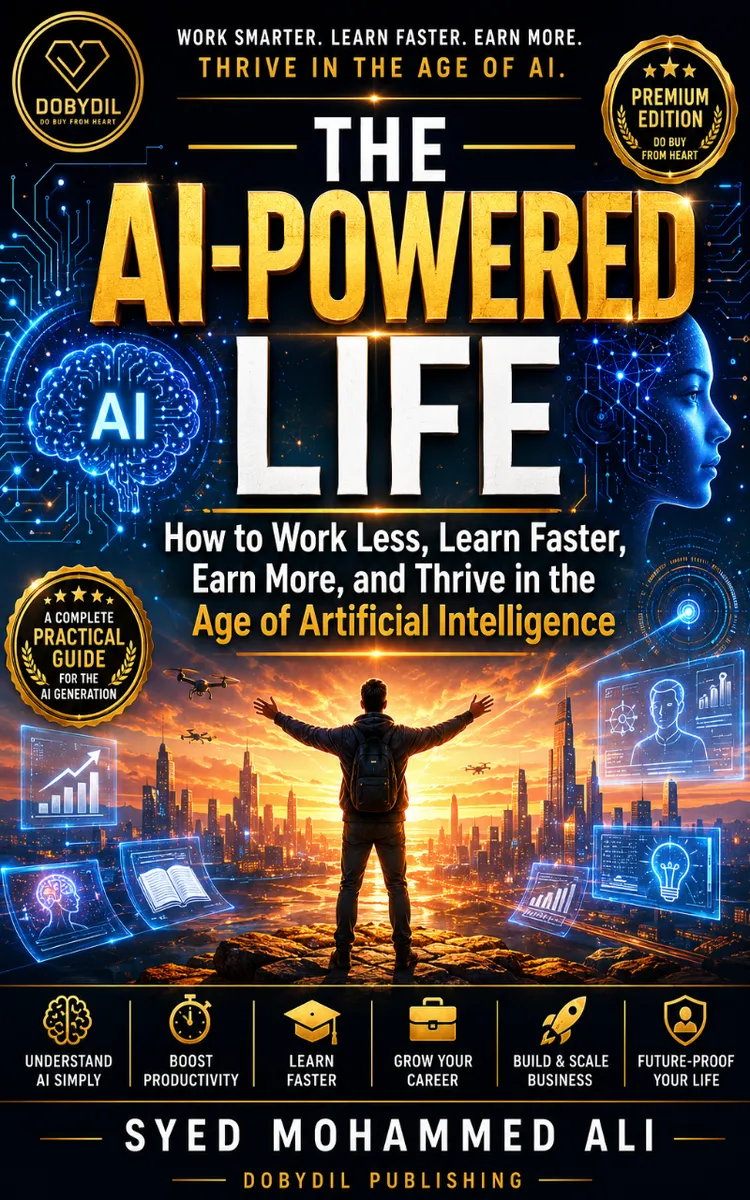
The AI-Powered Life
Created with Inkfluence AI
Using AI for productivity, learning, career, and business growth
Table of Contents
- 1. The Internet-Scale AI Moment
- 2. AI in Plain English
- 3. AI’s Industry Playbooks
- 4. The New Rules of Success
- 5. The Future of Work Map
- 6. Build Your AI Personal Assistant
- 7. AI for Better Decisions
- 8. Time Blocking with AI
- 9. Personal Productivity Systems
- 10. AI-Powered Goal Setting
- 11. Learn Any Skill Faster
- 12. AI Tutors for Personalized Practice
- 13. AI for Reading and Research
- 14. AI for Writing That Sounds Like You
- 15. Build a Personal Knowledge System
- 16. Future-Proof Skills Portfolio
- 17. Find Better Jobs with AI
- 18. Personal Brand Engine
- 19. Interview Prep with AI Scripts
- 20. Career Planning for AI Decades
- 21. AI-Powered Marketing Campaigns
- 22. AI Sales Outreach That Converts
- 23. Customer Service Automation with Guardrails
- 24. AI for Business Operations
- 25. Create New Revenue Streams
- 26. Creativity with AI Co-Design
- 27. Critical Thinking in the AI Era
- 28. Leadership with AI-Augmented Teams
- 29. Emotional Intelligence Under Automation
- 30. What Humans Will Always Do Better
- 31. Your AI Strategy for Life
- 32. Your AI Strategy for Career
- 33. Your AI Strategy for Business
- 34. Avoiding AI Pitfalls
- 35. Thrive in the Next Decade
Preview: The Internet-Scale AI Moment
A short excerpt from “The Internet-Scale AI Moment”. The full book contains 35 chapters and 85,251 words.
The Internet-Scale AI Moment: How to Spot the Signals and Act
The biggest risk in the AI shift isn’t “falling behind.” It’s moving on the wrong signals - buying tools, changing workflows, or training people based on hype instead of impact. That mistake wastes time and money, and it slows your learning curve right when you need speed.
Artificial intelligence now spreads like the internet once did: fast, cheap to copy, and hard to ignore. When AI gets embedded into everyday software - email, search, docs, spreadsheets, customer tools - your competitors don’t need a research lab to gain an advantage. They just need a workflow that turns AI output into real work.
In this chapter, you’ll learn why this moment matters as much as the internet shift, and you’ll use a practical tool - The Shift-Impact Radar - to identify what to do next. You’ll leave with a repeatable way to scan your work and market, spot high-leverage AI opportunities, test them safely, and decide what to watch for so you don’t get blindsided.
---
The Shift-Impact Radar: Learn Why This Shift Changes Everything
AI feels confusing because it doesn’t arrive as one product. It shows up as features inside products you already use, and it changes how information turns into action. The internet shifted how people distribute information; AI shifts how people produce and apply information.
Here’s the key idea: the internet scaled distribution. AI scales execution. When AI can draft, summarize, classify, translate, extract, and reason across messy inputs, it compresses the time between “I have a question” and “I have an answer I can use.” That time compression changes operations, customer expectations, and decision speed - fast.
So how do you avoid guessing? You need signals you can act on, not opinions you have to debate. Use The Shift-Impact Radar to sort the noise from the opportunities by asking two questions for each signal you notice:
1. How likely is this to reach my day-to-day work soon?
2. If it reaches my work, how big is the effect on time, quality, cost, or revenue?
The practical part comes next: you apply the radar repeatedly, then run small tests to validate impact before you commit.
Core definitions for this radar (so you can use it correctly):
- Signal: A concrete change you can observe - new AI features inside tools you already use, a customer behavior shift, a competitor workflow update, or a new internal bottleneck that AI can reduce.
- Impact: The measurable change you expect in your work - faster turnaround, fewer errors, lower rework, more consistent output, higher conversion, or reduced support load.
- Radar score: A simple priority score you assign so you can rank signals and pick the next test.
The Shift-Impact Radar scoring rule (keep it simple and fast):
- Score Likelihood from 1 to 5 (1 = far away, 5 = already affecting your work).
- Score Impact from 1 to 5 (1 = minor improvement, 5 = major workflow change).
- Multiply to get Priority (Likelihood × Impact). This gives you an immediate ranking without pretending you can predict the future perfectly.
Ask yourself this check after you score a signal: If I’m right, what changes in my week next month? If you can’t name that change, you don’t yet have a useful signal - go gather more evidence.
---
How It Works: Turn AI Signals Into a Ranked Action Plan
The Shift-Impact Radar works because you stop treating AI adoption like a yes/no decision and start treating it like a portfolio: you scan, you rank, you test, and you learn.
Use this sequence with real inputs from your job and market. Don’t start with “What should I do with AI?” Start with “What changed around me that creates an opportunity or threat?”
1. Capture signals from your real workflow (not your feed).
Look for changes in the tools you already touch (docs, email, support tickets, proposals), plus customer-facing friction (slow responses, inconsistent messaging, repetitive questions). Write each signal in one sentence: “AI feature X could reduce Y in my process Z.”
2. Score each signal with Likelihood × Impact.
Give Likelihood a 1-5 rating based on timing and access - if your team already uses the tool, Likelihood starts higher. Give Impact a 1-5 rating based on where the work cost lives: time-to-first-draft, rework from errors, or cycle time from request to delivery.
3. Pick one “testable slice” for the top 1-3 signals.
Slice the workflow into one thin part you can change quickly - drafting an email response, summarizing customer notes, generating a first-pass spec, classifying incoming requests. You reduce risk because you don’t overhaul everything at once.
4....
About this book
"The AI-Powered Life" is a how-to guide book by Syed Mohammed Ali with 35 chapters and approximately 85,251 words. Using AI for productivity, learning, career, and business growth.
This book was created using Inkfluence AI, an AI-powered book generation platform that helps authors write, design, and publish complete books. It was made with the AI Ebook Generator.
Frequently Asked Questions
What is "The AI-Powered Life" about?
Using AI for productivity, learning, career, and business growth
How many chapters are in "The AI-Powered Life"?
The book contains 35 chapters and approximately 85,251 words. Topics covered include The Internet-Scale AI Moment, AI in Plain English, AI’s Industry Playbooks, The New Rules of Success, and more.
Who wrote "The AI-Powered Life"?
This book was written by Syed Mohammed Ali and created using Inkfluence AI, an AI book generation platform that helps authors write, design, and publish books.
How can I create a similar how-to guide book?
You can create your own how-to guide book using Inkfluence AI. Describe your idea, choose your style, and the AI writes the full book for you. It's free to start.
Write your own how-to guide book with AI
Describe your idea and Inkfluence writes the whole thing. Free to start.
Start writingCreated with Inkfluence AI


