
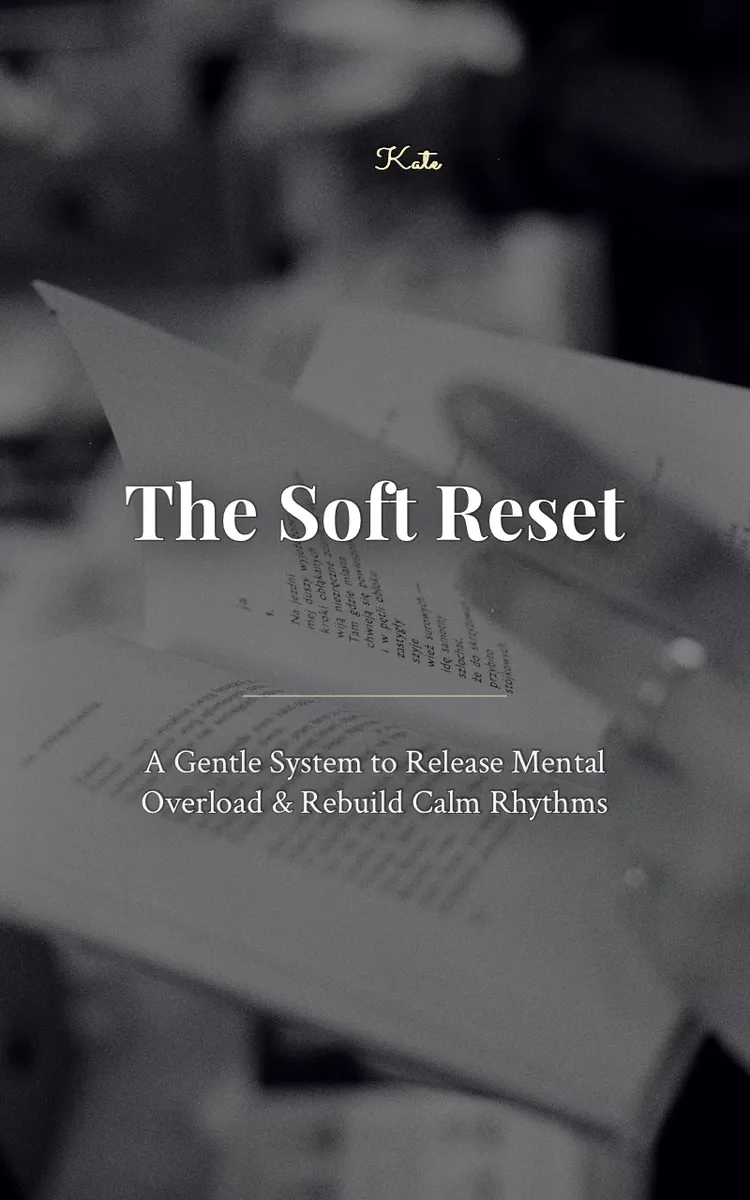
Quiet Intentional Days For Mothers
Created with Inkfluence AI
Gentle planning and mindset support for overwhelmed mothers
Table of Contents
- 1. Uncluttering Your Mind for Quiet Days
- 2. Breaking the Perfectionism Trap Gently
- 3. Designing a Gentle Daily Plan
- 4. Setting Boundaries Without Guilt
- 5. Turning Chaos Into Purposeful Resilience
Preview: Uncluttering Your Mind for Quiet Days
A short excerpt from “Uncluttering Your Mind for Quiet Days”. The full book contains 5 chapters and 7,379 words.
Picture This
Have you ever caught yourself staring at the fridge, toothbrush in one hand, and suddenly realized you don’t know what you’re doing next-like your brain just… tapped out? Your mind starts flipping through everything that needs to happen today, but instead of helping, it turns into a loop: If I forget something, everything will fall apart. If I don’t do it perfectly, it won’t count. If I start something else, I’ll fall behind. And then you feel guilty for being stuck. Fun.
Lena, 34-part-time nurse and mom of two-knows this exact brand of mental chaos. Between shifts, lunches, laundry that multiplies like it’s got its own team, and the constant “Mom?” from the other room, her brain collects thoughts the way her kids collect toys. She’ll sit down for five minutes, think she’ll “figure it out,” and end up with a head full of tabs that never load. What’s worse? The spiral doesn’t always start with something big. Sometimes it starts with a small question like, “What’s for dinner?” and somehow turns into, “I’m failing at everything.”
What if the spiral isn’t a personality flaw-but a signal that your mind needs a quick Soft Reset Loop before you drown in decisions?
The Mindset Shift
Old Belief: “If I can’t handle all these thoughts, something is wrong with me.”
New Reality: “If my mind is spiraling, it’s doing what brains do-collecting. My job is to gently unload it, then choose one next step.”
That shift matters because it changes the target from you to the process. When you treat the spiral as a personal failure, you try harder, push more, and end up more exhausted. But when you treat it like a busy brain that needs organizing, you stop fighting your own mind and start helping it.
Here’s a concrete example. Lena used to wait until she felt “calm enough” to plan. That never came. Her planning attempts were basically her brain arguing with itself. So instead, she tried a tiny routine: when she noticed the spiral starting-usually around that “blank” moment in the day-she did a quick brain dump on paper. Not a perfect list. Just whatever was rattling around in her head: “bath towels? permission slip? call daycare? dinner decision?” Then she closed the page and took one reset breath (more on that in a second). The difference wasn’t that life got easier. The difference was that her mind stopped treating every thought like an emergency.
And the best part? The Soft Reset Loop doesn’t ask you to become a productivity person. It’s not about doing more. It’s about clearing the mental runway so you can take off with less fear.
Going Deeper
A spiral usually starts when your brain is trying to protect you but doesn’t have the right container for all the “important” things. In real life, you’re juggling responsibilities, deadlines, emotions, and tiny logistics-your mind keeps trying to hold it all at once. That’s why it feels heavy. It’s not just thoughts. It’s thoughts plus the tension of “I should remember this.”
The Soft Reset Loop is your gentle container. It gives your brain a place to put the noise so you can stop carrying it around like a backpack full of rocks. You’re not forcing calm. You’re creating enough clarity that calm becomes possible.
When you do a brain dump + reset, you’re telling your nervous system: I’m aware. I’m not ignoring you. I’m handling this. That matters because spirals thrive on uncertainty. Once you can “see” what’s in your head, your brain doesn’t have to keep scanning for threats. It can finally downshift.
Signs this pattern is running your life
1. You keep re-checking the same worry (like “Did I send that form?”) even after you’ve already looked once. Your brain wants reassurance, but it can’t settle because the full list of worries isn’t out in the open.
2. You feel busy, but nothing feels finished. You’re mentally moving through tasks without actually choosing what matters next, so everything stays equally urgent.
3. Small decisions feel huge-what to cook, what to pack, what to respond to-because each choice feels like it could tip the whole day.
4. You “plan” when you’re already fried. Your brain dumps happen only after you crash, which means they’re messy, late, and tied to guilt instead of clarity.
En résumé: When your mind spirals, it usually needs unloading and a reset-not more willpower.
The Soft Reset Loop (the “why” behind it)
The brain dump tells your mind, “I’ll hold this for you.” The reset tells your body, “We’re safe enough to choose.” Together, they interrupt the spiral early, before it turns into a full-blown day-ruiner.
You don’t need a fancy system. You need a repeatable moment of relief.
Reflection & Self-Assessment
1. Where do your spirals usually start-what’s the first trigger you notice?
Is it mornings, afternoons, bedtime, or that “dead pause” in the day? An honest answer might sound like, “It starts when I’m waiting for my kids and I can’t remember what’s next.”
2....
About this book
"Quiet Intentional Days For Mothers" is a self-help book by Kate with 5 chapters and approximately 7,379 words. Gentle planning and mindset support for overwhelmed mothers.
This book was created using Inkfluence AI, an AI-powered book generation platform that helps authors write, design, and publish complete books. It was made with the AI Self-Help Book Writer.
Frequently Asked Questions
What is "Quiet Intentional Days For Mothers" about?
Gentle planning and mindset support for overwhelmed mothers
How many chapters are in "Quiet Intentional Days For Mothers"?
The book contains 5 chapters and approximately 7,379 words. Topics covered include Uncluttering Your Mind for Quiet Days, Breaking the Perfectionism Trap Gently, Designing a Gentle Daily Plan, Setting Boundaries Without Guilt, and more.
Who wrote "Quiet Intentional Days For Mothers"?
This book was written by Kate and created using Inkfluence AI, an AI book generation platform that helps authors write, design, and publish books.
How can I create a similar self-help book?
You can create your own self-help book using Inkfluence AI. Describe your idea, choose your style, and the AI writes the full book for you. It's free to start.
Write your own self-help book with AI
Describe your idea and Inkfluence writes the whole thing. Free to start.
Start writingCreated with Inkfluence AI


