
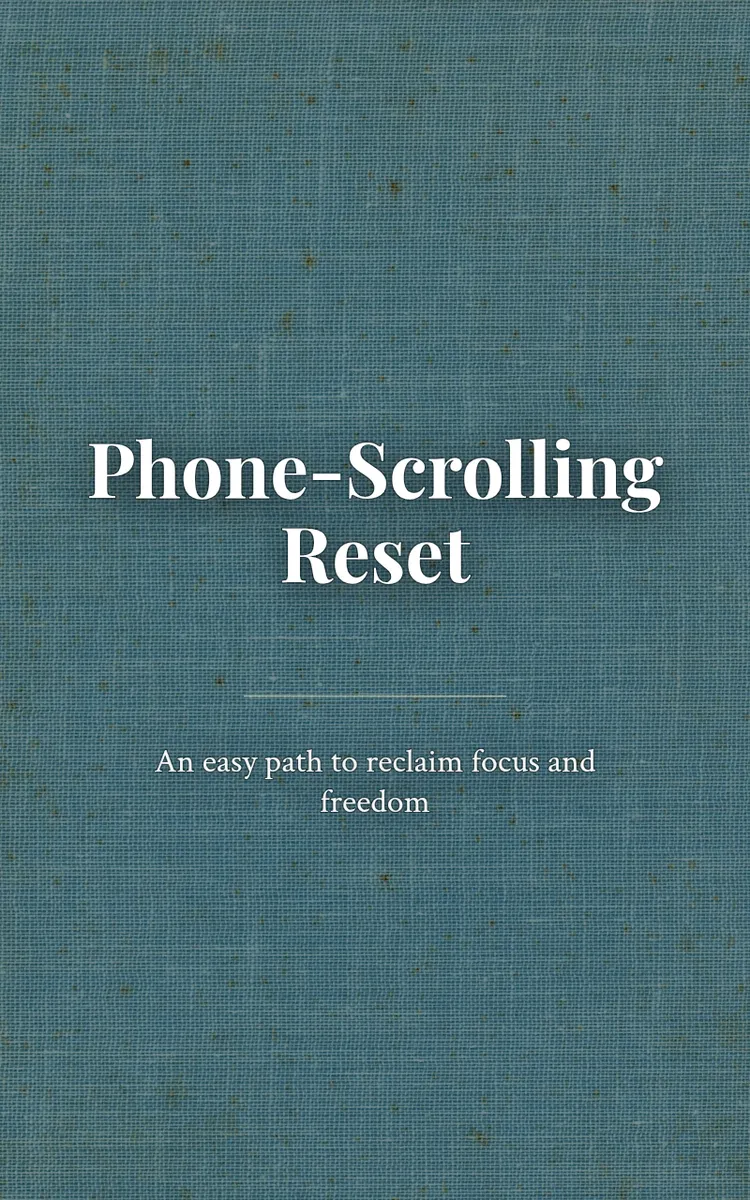
Breaking mindless phone scrolling through self-growth
Table of Contents
- 1. Rewriting Your Scrolling Identity
- 2. Breaking the Reward Loop Beliefs
- 3. Designing Friction Without Losing Joy
- 4. Replacing Scrolls With Real-Life Rituals
- 5. Staying Reset Through Relapse
Preview: Rewriting Your Scrolling Identity
A short excerpt from “Rewriting Your Scrolling Identity”. The full book contains 5 chapters and 7,764 words.
The Moment “Just Checking” Takes Over
At 9:14 p.m., you pick up your phone to check one message. You’re tired, but not ready for sleep. The screen lights your face as you answer the message, then glance at a notification, then open a video someone sent earlier.
A few minutes later, you’re watching strangers organize their kitchens, arguing in comments, and reviewing a product you’ll never buy. You look at the clock. Forty minutes have disappeared. Your thumb is still moving, almost on its own.
You tell yourself the same thing you’ve said before: “I was just checking.”
What if “I’m just checking” isn’t a description of your behavior, but the identity keeping it in place?
The Story You Repeat and the Person You Become
Old Belief: I’m just checking my phone. It’s no big deal, and I can stop whenever I want.
New Reality: Each “quick check” rehearses a story about who I am. I can replace that story with one that supports attention, choice, and phone freedom.
The old belief sounds harmless because “checking” feels small. It makes the phone use seem temporary and reasonable. You weren’t planning to scroll for an hour. You only wanted to see whether someone replied, check the weather, or look up one detail.
But the reason you picked up the phone matters less than the story that follows. “I’m just checking” quietly removes responsibility from the moment. It suggests that the scrolling simply happened to you. You’re not someone who chooses to lose time. You’re someone who happened to look.
That story can keep repeating even when your experience says otherwise.
Picture a morning when you reach for your phone before getting out of bed. You check the time, then a message, then a short video. You’re still under the blanket twenty minutes later, feeling rushed before the day has begun. If you call that “just checking,” you miss the real pattern: you’ve started treating your attention as something the phone can claim whenever it asks.
The Identity Switch Protocol begins with a different sentence. Not “I’m bad at self-control.” Not “I need to become a completely different person.” Try this instead: “I’m a person who notices the pull and chooses what happens next.”
That identity gives you room to act. You might still open the phone sometimes. You might still scroll longer than planned. The difference is that the behavior no longer gets to define you. A slip becomes information, not proof that you’re powerless.
How “Just Checking” Becomes a Scrolling Identity
Your phone doesn’t need to convince you to make a huge decision. It only needs to win a tiny moment. The phrase “just checking” helps because it lowers the emotional cost of picking up the device. There’s no clear boundary around it. No beginning, no end, no reason to pause.
Over time, your brain starts connecting ordinary feelings with automatic checking. Bored? Check. Uncomfortable? Check. Waiting for water to boil? Check. Avoiding a difficult task? Check. The phone becomes less like a tool and more like your default answer to any feeling that asks for attention.
Signs this pattern is running your life:
1. You pick up your phone without being able to name what you came to do.
You unlock it first and decide what you want afterward. The action comes before the intention.
2. You use “just checking” to describe sessions that last much longer than planned.
The phrase stays the same whether you looked for ten seconds or lost an entire evening.
3. You feel irritated when something interrupts your scrolling.
A conversation, a meal, or even your own tiredness starts to feel like an obstacle between you and the screen.
4. You judge yourself after scrolling, then reach for the phone again to escape that feeling.
Shame becomes part of the loop. The phone creates discomfort, then offers itself as the quickest way to avoid it.
The Identity Switch Protocol: Stop asking, “How do I control my phone?” Start asking, “What would a person who protects their attention do next?”
This question works because identity shapes small choices. If you think of yourself as someone who has no discipline, a missed boundary feels predictable. If you think of yourself as someone learning to protect attention, the same moment becomes practice.
That doesn’t mean pretending you never want to scroll. You do. The goal isn’t to become a person who feels no pull toward the phone. It’s to become a person who can feel the pull without automatically obeying it.
Questions That Expose the Old Story
1. When you say “I’m just checking,” what are you usually trying not to feel?
Look beyond boredom. Maybe you’re avoiding the awkwardness of starting work, the quiet after an argument, or the tiredness you don’t want to admit. An honest answer might be, “I’m checking because I don’t want to think about the email waiting for me.”
2....
About this book
"Phone-Scrolling Reset" is a self-help book by Anonymous with 5 chapters and approximately 7,764 words. Breaking mindless phone scrolling through self-growth.
This book was created using Inkfluence AI, an AI-powered book generation platform that helps authors write, design, and publish complete books. It was made with the AI Self-Help Book Writer.
Frequently Asked Questions
What is "Phone-Scrolling Reset" about?
Breaking mindless phone scrolling through self-growth
How many chapters are in "Phone-Scrolling Reset"?
The book contains 5 chapters and approximately 7,764 words. Topics covered include Rewriting Your Scrolling Identity, Breaking the Reward Loop Beliefs, Designing Friction Without Losing Joy, Replacing Scrolls With Real-Life Rituals, and more.
Who wrote "Phone-Scrolling Reset"?
This book was written by Anonymous and created using Inkfluence AI, an AI book generation platform that helps authors write, design, and publish books.
How can I create a similar self-help book?
You can create your own self-help book using Inkfluence AI. Describe your idea, choose your style, and the AI writes the full book for you. It's free to start.
Write your own self-help book with AI
Describe your idea and Inkfluence writes the whole thing. Free to start.
Start writingCreated with Inkfluence AI


