
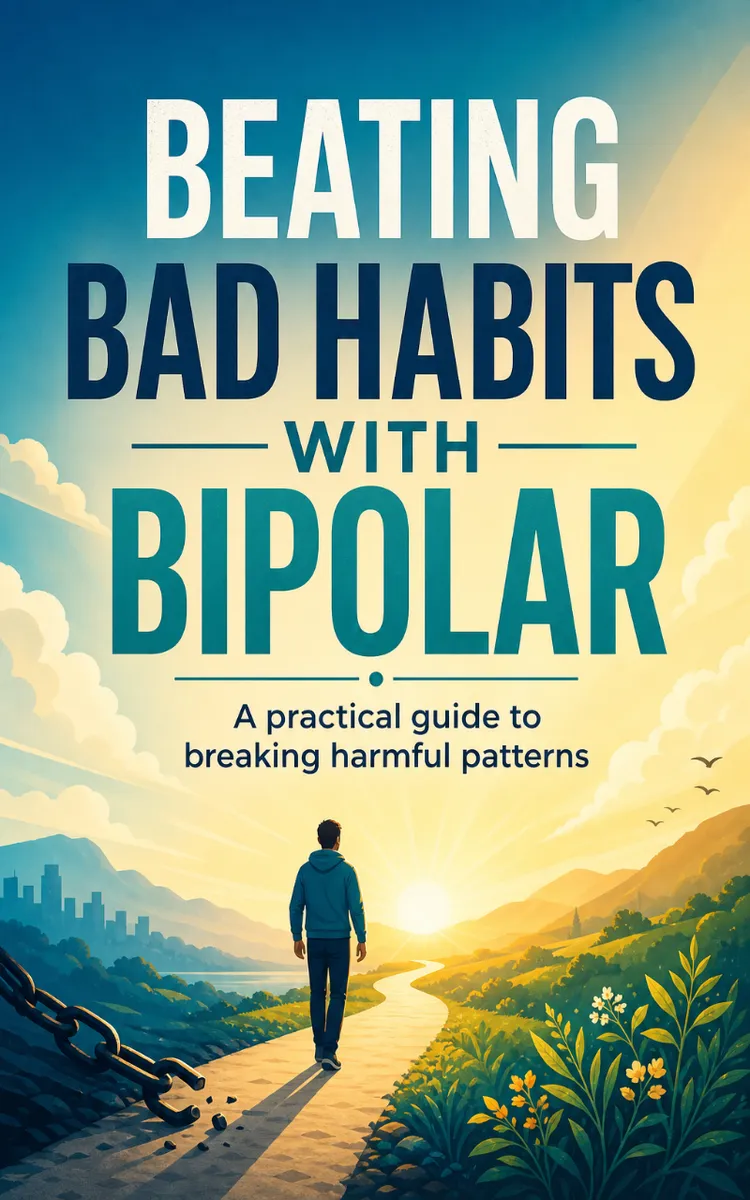
Beating Bad Habits With Bipolar
Created with Inkfluence AI
Breaking bad habits while managing bipolar disorder
Table of Contents
- 1. Identifying Your Habit Triggers
- 2. Separating Mood From Choice
- 3. Building a Stable Habit Baseline
- 4. Choosing One Habit to Beat
- 5. Replacing, Not Just Removing
- 6. Designing Your Urge Surf Plan
- 7. Using HALT to Catch Early Escalation
- 8. Creating a Bipolar-Friendly Environment
- 9. Setting Boundaries Without Guilt
- 10. Managing Sleep to Stabilize Behavior
- 11. Tracking Without Obsessing
- 12. Rewriting Beliefs That Fuel Relapse
- 13. Strengthening Identity Through Small Wins
- 14. Building a “When-Then” Action Plan
- 15. Practicing Self-Compassion Over Shame
- 16. Communicating Needs During Highs
- 17. Staying Gentle During Lows
- 18. Handling Mixed States With Grounding
- 19. Using Medication Support as a Habit Tool
- 20. Creating a Relapse-Response Protocol
- 21. Rebuilding After a Slip Without Starting Over
- 22. Strengthening Willpower With Implementation Intentions
- 23. Building a Support Team That Actually Helps
- 24. Turning Progress Into Purpose
- 25. Your 30-Day Bipolar Habit Victory Plan
Preview: Identifying Your Habit Triggers
A short excerpt from “Identifying Your Habit Triggers”. The full book contains 25 chapters and 42,532 words.
Picture This: The same urge, different weather
Rosa, 34, nurse manager, could feel it before it showed up. Not the full meltdown or the big crash - just the shape of it. On days when her mood ran high, she’d get this sharp, fast confidence that made her want to “fix everything” right now. She’d start projects at midnight, reply to coworkers like she had double the hours in the day, and somehow end up buying random stuff she didn’t need because it “felt like momentum.”
Then there were the other days. The lows. The kind where getting out of bed felt like carrying a wet blanket everywhere you went. Her phone would light up with messages she still cared about, but replying felt impossible. She’d scroll until her brain felt numb. And the worst part? The “bad habit” would look the same on the surface - same escape, same avoidance - but the trigger underneath was totally different. High mood, low mood, mixed mood… the urge always showed up like it owned the place.
So she started asking herself a question that didn’t let her off the hook: What sets me off, exactly - when I’m high, when I’m low, and when I’m mixed? Because if you don’t map the weather, you keep blaming the storm on your character.
If the urge is the symptom, what’s the weather that keeps producing it?
Before vs After: Stop treating triggers like mystery meat
Old Belief: “My bad habit just happens. I’m either strong enough to resist or I’m not.”
New Reality: “My bad habit shows up when certain triggers line up with my bipolar ‘weather,’ and I can map that pattern.”
That shift matters because it changes what you’re trying to control. When you think the habit is random, you end up relying on willpower in the moment. And with bipolar highs, lows, and mixed states, willpower is basically a phone battery with no charger - sometimes it lasts, sometimes it dies fast. You don’t need a stronger version of yourself. You need a clearer picture of what’s already happening inside and around you.
Rosa noticed that her “urge to escape” wasn’t one trigger. It was a set of conditions. During a high, her trigger-weather combo looked like: extra caffeine + a messy schedule + feeling “behind” + people moving slower than her brain. The habit was scrolling or impulsive spending - anything to keep the engine revving. During a low, the combo was different: missed sleep window + loneliness + quiet house + a task she couldn’t “start right.” The habit became numbness - phone scrolling, staying in bed longer, avoiding calls. Same behavior category. Different signal underneath.
When you map triggers to mood weather, you stop asking, “What’s wrong with me?” and start asking, “What’s going on right now, and what do I need?” That’s how you get your confidence back. Not by pretending it won’t happen - but by recognizing the setup earlier than the habit can take the wheel.
Going Deeper: The Trigger-Weather Map (and what your pattern hides)
Here’s the core idea behind the Trigger-Weather Map: your bad habit doesn’t just get triggered. It gets invited - by specific inputs (triggers) that hit differently depending on your bipolar state (weather). “Weather” isn’t just mood; it’s the whole internal climate - sleep pressure, energy level, focus, irritability, speed of thoughts, and how safe or trapped your brain feels. When the weather is off, the same trigger can hit like gasoline instead of a match.
So instead of writing “I was stressed” and calling it a day, you start getting precise. You track what happened right before the urge, then you label the bipolar weather you were in: high, low, or mixed (or “leaning high,” “leaning low,” “restless/amped,” whatever words you actually use). Over time, you stop guessing. You start predicting.
You don’t need perfection. You need enough detail to spot the repeat offenders.
Signs this pattern is running your life
1. You only notice the habit after it’s already loud. Like, you realize you’re doing it - but you can’t name what set it in motion.
2. Your “triggers” don’t make sense across moods. The same situation leads to different outcomes depending on whether you’re high, low, or mixed.
3. You feel surprised by your own choices. Not because you don’t know yourself, but because you’re responding to conditions you haven’t mapped.
4. Your restraint strategy changes depending on the state - but you don’t connect the dots. Example: in a low you try to “push through” (and crash), but in a high you try to “be productive” (and spiral into impulse).
Trigger-Weather Mapping means you’re not fighting your habit - you’re spotting the setup before it shows up.
Reflection & Self-Assessment: Find your exact “setup” (not just your label)
Now grab a notebook (or the notes app you actually use) and answer questions that are specific enough to be useful. Not dramatic. Just honest.
1....
About this book
"Beating Bad Habits With Bipolar" is a self-help book by Anonymous with 25 chapters and approximately 42,532 words. Breaking bad habits while managing bipolar disorder.
This book was created using Inkfluence AI, an AI-powered book generation platform that helps authors write, design, and publish complete books. It was made with the AI Self-Help Book Writer.
Frequently Asked Questions
What is "Beating Bad Habits With Bipolar" about?
Breaking bad habits while managing bipolar disorder
How many chapters are in "Beating Bad Habits With Bipolar"?
The book contains 25 chapters and approximately 42,532 words. Topics covered include Identifying Your Habit Triggers, Separating Mood From Choice, Building a Stable Habit Baseline, Choosing One Habit to Beat, and more.
Who wrote "Beating Bad Habits With Bipolar"?
This book was written by Anonymous and created using Inkfluence AI, an AI book generation platform that helps authors write, design, and publish books.
How can I create a similar self-help book?
You can create your own self-help book using Inkfluence AI. Describe your idea, choose your style, and the AI writes the full book for you. It's free to start.
Write your own self-help book with AI
Describe your idea and Inkfluence writes the whole thing. Free to start.
Start writingCreated with Inkfluence AI


