
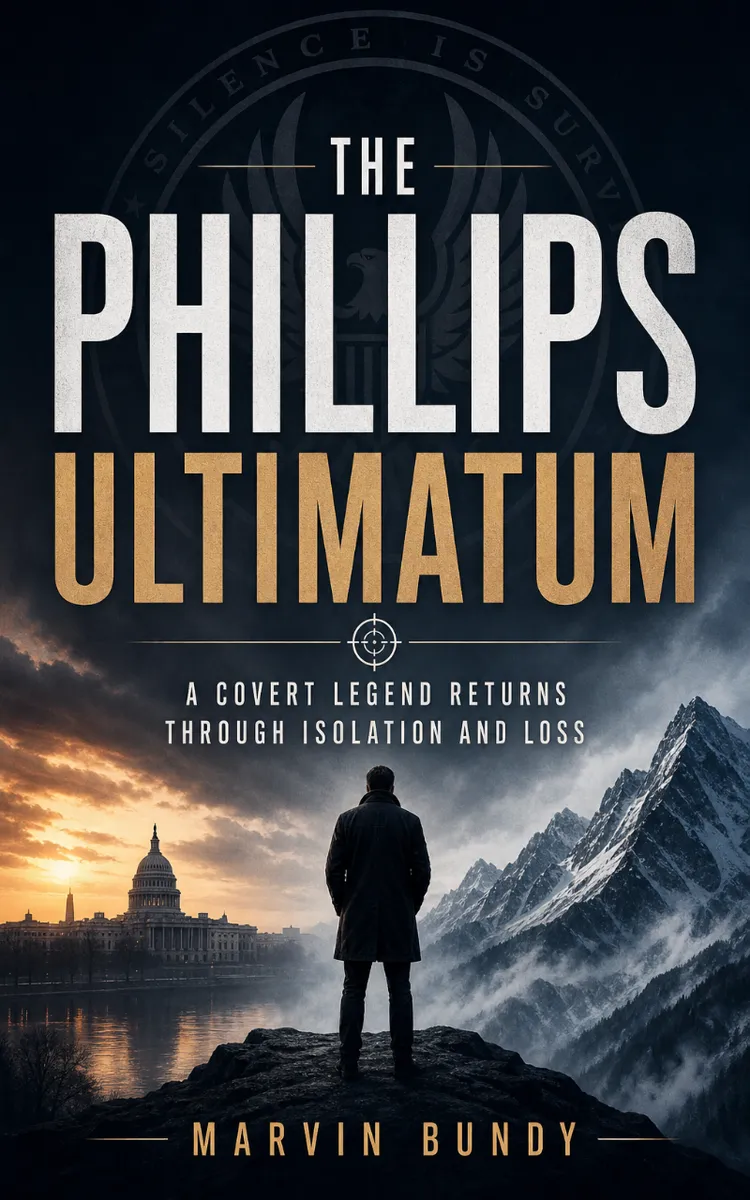
Read the first chapter
The whole of chapter one, free. About 21 min. Turn the pages with the arrows, your keyboard, or a swipe.
Chapter 1
The Silent One Under False Stillness
A thin winter light slid across the corrugated vent above Arthur Richter’s rented attic room, turning the dust into something almost visible. The machine shop below was closed for the night, but the building never truly went quiet—pipes clicked as metal cooled, the radiator gave a tired knock, and the wind worried at the loose seam of the window frame. Arthur sat with his back straight on the narrow bed, a sheet of paper balanced on his knee like a patient, ordinary man doing an ordinary job. Pencil marks climbed in tight, economical angles across the page: measurements of distances from street to alley, from alley to side door, and from side door to the fire escape that ran down the brick like a vein.
He wasn’t mapping for pleasure. He was mapping for absence—his own, the way a watchful eye could mistake stillness for safety and step too close. The paper smelled faintly of eraser dust. His fingers were warm despite the room’s chill, a small anomaly he’d learned to live with. Under the assumed identity, he kept his routines plain: tea brewed too weak to be memorable, laundry done at odd hours, the same patch of floor scrubbed until it looked untouched. The extraordinary parts of him were folded into the ordinary like contraband in a toolbox.
Outside, a freight truck rolled through the industrial town with a low, distant growl. Its headlights swept once across the attic window, and Arthur didn’t flinch. He adjusted the pencil instead, letting the graphite catch the light at a different angle, as if he were merely correcting a mistake. If anyone looked up from the street, they would see a man alone in an attic, turning time into something manageable.
A knock came then—soft, careful, wrong for the hour. Not loud enough to belong to a neighbor who wanted something simple like a package. Not hard enough to be a threat. It was the kind of knock that asked permission from the building itself.
Arthur set the pencil down. The paper didn’t slide. His fingers moved with the same calm, already deciding how much to reveal and how much to bury. He listened again, letting the sounds sort themselves: the knock, the distant truck, the radiator’s metallic throat. A car door shut somewhere below, muffled by floors and insulation. Footsteps crept toward the stairs that led to the attic rooms.
He had been alone long enough to forget how quickly “alone” could become a target.
When he opened the door a crack, the hallway light spilled in a thin blade. A man stood there in a dark coat that didn’t fit the town’s late winter uniform. His hair was neatly cut, his hands empty, his posture too deliberate. He smiled like he’d rehearsed it in a mirror. “Evening,” he said, voice low and local enough to pass. “I’m looking for room twelve. Wrong address on the slip.”
Arthur stared at him without inviting the story. “No one’s in twelve,” he said.
The man’s eyes flicked to Arthur’s face, then past it, searching the attic doorway as if the room might betray secrets by the shape of its clutter. “Landlord says you’re the one who keeps the place steady.”
Arthur didn’t react to the mention of a landlord. He’d already checked the building’s rhythm, already learned where the landlord’s habits ended. “I keep myself steady.”
The man’s smile tightened. “That’s not what I—"
Arthur closed the door another inch, letting the light thin. He kept his voice flat. “If you’re lost, take the stairs down and ask again. I don’t help strangers.”
The man hesitated. His gaze sharpened, and Arthur felt it the way he felt drafts—an extra pressure in the air, subtle but undeniable. The man shifted his weight, and his coat brushed something at his waistband. Not a gun, not yet. A phone, maybe. A recorder. A transmitter. The kind of tools people used when they didn’t want to be seen doing the asking.
Arthur’s enhancements didn’t make him invincible. They made him precise. He could read micro-delays in a breath, the tiny imbalance of a body deciding whether to lunge or retreat. He could feel the radiator’s tick and the hallway’s hum, separating them like instruments in an orchestra. It was never magic. It was training and years of classified work and the kind of capability that still had to choose what to spend.
He chose stillness.
The man stepped closer, lowering his voice into something meant for confession. “I don’t want trouble,” he said. “I just need to speak to the Silent One.”
Arthur didn’t move. The name landed like a paper cut—small, irritating, impossible to ignore. The town’s cold seemed to sharpen around him. He felt the hallway light flicker against the edge of his vision.
“Wrong door,” Arthur said.
The man’s eyes didn’t leave his. “Everyone keeps saying that.” He swallowed. “But there are people who believe you’re real.”
Arthur’s throat tightened, not from fear but from the familiar irritation of being mythologized. For years, people had talked about The Silent One the way men talked about storms: with awe and distance, as if he existed only when you needed him and only in the part of the world that didn’t require details. Arthur had learned to let that doubt protect him. If they couldn’t decide whether he existed, they hesitated. Hesitation kept them away.
But the man in the coat wasn’t hesitating anymore. He reached into his pocket, slow enough to look polite, and produced a phone held low, screen dark. “Ross sent me.”
The name was a knife sliding under a bandage. Arthur’s body reacted before his mind could find a polite response. He didn’t freeze the way he did for Clair—he didn’t have that luxury—but something inside him tightened, a reflex built for sudden contact and sudden betrayal.
Arthur’s voice stayed controlled. “Ross doesn’t send people to my door.”
The man’s thumb tapped the phone once. The screen didn’t light, but Arthur heard the faint vibration of a connection attempt, the soft click of a system trying to make itself known through walls. “Ross says he’s tried everything,” the man said. “He says you’ll pick up if he— ”
Arthur’s hand moved, not toward the phone, not toward a weapon. He simply blocked the man’s view into the hallway with his shoulder, a quiet command. “He can try again somewhere else.”
The man’s expression shifted, a crack in the rehearsed smile. “He’s not supposed to contact you directly.”
Arthur could taste the metallic edge of anger on his tongue, like old pennies. “Then he shouldn’t.”
The man exhaled through his nose, as if deciding whether to press or retreat. “Ross says it’s urgent.”
Arthur leaned slightly closer, just enough to let the man understand that proximity meant surveillance. “Urgent for whom?”
The man hesitated again. “For all of them.”
Arthur didn’t ask who “them” were. He didn’t need to. There were always “all of them” in the stories people told about him, stories where he was a lever someone else pulled. Arthur had spent years making sure no one knew where the lever ended and where he began.
He waited, letting silence do the work his hands couldn’t explain.
Finally, the man lifted the phone a fraction and pressed a button. A voice crackled through the dark screen’s speaker—not on speaker, not meant for the hallway, but close enough that Arthur could hear it when the transmission found a gap in the building’s insulation.
“Arthur,” Ross said.
There was no mistaking his cadence. Ross spoke like every word was a door he’d tested before opening. Calm in the way of a man who had learned the hard limits of panic. Arthur felt his name in his own bones, familiar and hated.
Arthur didn’t answer.
Ross continued anyway, low and firm. “You’re hard to reach.”
Arthur’s jaw worked once. “You shouldn’t be reaching.”
A pause. Then Ross said, “I didn’t come to argue.”
Arthur finally allowed the tiniest shift of his weight, enough to show the man in the coat that the door would close again if the conversation didn’t move. “Then state what you want.”
The man in the coat watched Arthur like a person watching a locked safe. He didn’t speak. He didn’t interrupt. He waited for Ross’s voice to decide his own next step.
Ross’s voice stayed steady. “I have information. It touches Clair.”
Arthur felt the world narrow so violently it was almost physical. The radiator’s tick seemed to stop. The distant truck’s growl became a muffled memory. His breath stayed shallow without his permission. He didn’t look at the man in the hallway; he couldn’t afford to. He kept his eyes on the crack of darkness between door and frame, as if he could anchor himself to the wood.
Clair.
The name wasn’t a trigger because it was loud. It was a trigger because it was precise—because it belonged to a time when his life had been something other than maintenance and assessment and survival.
His hand tightened on the door edge until the skin across his knuckles went pale. He could feel his heart’s rhythm like a second heartbeat under his ribs. It didn’t race. It didn’t turn into drama. It simply didn’t agree with what he’d been doing for years.
Ross’s voice came again, careful now. “Arthur?”
Arthur’s throat burned. He forced sound through it anyway. “Don’t say it.”
“I didn’t know if you’d still—" Ross stopped himself, the way men stop when they realize they’re about to step on a mine they didn’t plant.
Arthur’s voice turned colder. “You shouldn’t be talking about her.”
The man in the coat swallowed audibly. He shifted his phone-holding hand, and Arthur saw the faint tremor now—fear, not for himself, but for the consequences of being the bridge between Ross and whatever Arthur was.
Ross spoke softly, as if volume could make the past less sharp. “Clair asked me to make sure you didn’t get dragged back.”
Arthur’s mind tried to reject the statement. Clair had disappeared years ago, and the world had agreed to treat that as the kind of tragedy that lived in paperwork. She’d been filed away as a missing person. A set of rumors. A blank space.
But Ross’s voice made the blank space breathe.
Arthur’s fingers loosened for a fraction of a second. A memory rose without permission: hands at a kitchen sink, warm water running over knuckles; Clair’s laugh when he tried to mimic something normal and failed in an awkward, endearing way. Not because she pitied him. Because she believed he deserved the attempt. She’d looked at him like he was still capable of being human, not just useful.
The enhancement experiments had made him beyond conventional limits, but Clair had made him beyond a certain kind of loneliness. She’d given his silence a meaning that wasn’t fear.
Arthur swallowed hard. “I told you not to contact me.”
Ross didn’t argue. “You’re alive.”
Arthur’s mouth tightened. Alive was an insult disguised as fact. Alive meant he’d failed to stay gone. "Alive" meant someone else had decided his existence was negotiable.
“Then you know what it costs,” Arthur said.
Ross’s silence stretched just long enough for Arthur to feel the weight of the room’s cold. Then Ross said, “Someone’s moving again. They’re trying to test whether you’re real.”
Arthur let out a quiet breath. That was the part that made him laugh without humor. People always wanted proof. They wanted to see the legendary destroyer not as myth but as footage, as a body, as a conclusion.
Arthur had spent years giving them uncertainty. He’d learned to live so quietly even his neighbors forgot to ask questions. He’d built a life that looked like neglect and boredom from the outside.
But legends had gravity. Other players smelled it. They circled.
Ross’s voice sharpened. “I need you to listen. The name Clair is what cracks you open, Arthur. That’s why I’m using it. If I tell you the details without that anchor, you’ll shut down and walk away.”
Arthur’s anger flared, then steadied into something more dangerous. Ross wasn’t wrong. The name had already cracked something open. He could feel the old grief moving under the skin like a slow tide.
He forced his voice to stay even. “I’m not coming to you.”
Ross took a breath. “Then I’ll come to you.”
Arthur’s eyes flicked to the man in the coat. The man looked like he’d been told to stand in a doorway and wait for disaster. Arthur could end this conversation with a door closing. He could walk back into his attic and return to his routines, letting the legend stay unproven.
But Clair’s name had already done something to his peace. It had turned his stillness from choice into reaction. The quiet he’d been maintaining felt less like shelter and more like a lid.
Arthur said, “No.”
Ross didn’t push. “Okay,” he said, and the word was calm enough to be a lie. “Then tell me this. Are you alone?”
Arthur hesitated. He didn’t like answering that question. It implied a vulnerability he’d spent years hiding. Still, Ross needed something. Ross always needed something.
Arthur looked past the hallway man, through the dim gap of the stairwell. He could hear the building’s settling, the whisper of wind around the window frame. No footsteps beyond the ones in the hallway. No voices. No other presence.
“Yes,” Arthur said.
Ross’s voice lowered. “Good. Stay where you are. Don’t open doors.”
Arthur almost laughed again. Ross had no authority in his life. Ross was just another voice trying to move pieces on a board Arthur refused to admit existed.
Arthur said, “You sent someone to my door anyway.”
Ross didn’t deny it. “I didn’t send him to threaten you. I sent him to reach you without drawing attention. It’s already drawn attention, Arthur.”
Arthur’s gaze went to the man in the coat. The man met his eyes and looked away first, like a guilty witness.
Arthur felt the cost of this moment settle into his chest. Every contact had ripples. Every ripple could become a wave. If someone was watching the building, the phone’s transmission attempt could have logged signals. If the man in the coat carried gear, it could have been fingerprinted by proximity. If Ross had sent him, Ross had made a calculation about Arthur’s existence—and that meant Arthur’s assumed identity might not be as safe as he’d believed.
Arthur spoke quietly. “I won’t be your proof.”
Ross’s voice came back, measured. “I’m not asking for proof. I’m asking you to stop them from using Clair as bait.”
Arthur’s skin prickled. The idea was too clean, too cruel. Clair wasn’t a name you used like an email subject line. She was the person who’d made him believe he deserved a normal life—made him accept the possibility of mornings that weren’t evaluated like targets. Someone using her name would be trying to reach inside him and pull out the version of Arthur they needed.
Arthur’s mind moved in tight, private circuits. If the world had learned Clair’s significance, then they might also know where his weakness lived. If they knew where his weakness lived, they could find his location through it.
He said, “You used her name.”
Ross didn’t deny it. “I had to.”
Arthur’s voice went flat. “Then listen carefully. If you’re trying to drag me back into your war, you’re too late.”
Ross’s pause was long enough to feel like pressure. “I’m not dragging you,” he said. “I’m warning you. There’s an asset under a church. Someone planted it years ago, waiting for the right moment.”
Arthur’s muscles went still in a way that wasn’t calm. Years ago. Waiting. The phrase turned his stomach. He’d hidden his own things with the care of a man sealing a wound. He’d also learned, over time, that other people could seal theirs too—and that sometimes they sealed them with his fingerprints.
Arthur said nothing.
Ross continued, softer. “Arthur. You disappeared because someone manipulated events. You believed that staying together would destroy her future. That’s what they wanted you to believe. But they didn’t count on you keeping a piece of your old life somewhere safe.”
Arthur’s throat tightened at the precision of the words. Ross was speaking around facts he shouldn’t have had, facts that belonged to Clair’s orbit and to the months Arthur had spent rebuilding his mind into a shape that could survive the lie.
He realized, with a strange clarity, that Ross wasn’t only contacting him. Ross was checking whether Arthur would break.
Arthur forced himself to breathe. He forced the hallway air into his lungs and let it cool his anger. “I said no.”
Ross’s voice steadied. “Then I’ll leave you alone.”
The man in the coat shifted again, relief flickering across his face as if he’d just escaped a blow. Arthur didn’t trust relief. Relief was a cover for what came next.
Ross’s voice returned, one last time. “Tell me you heard me.”
Arthur stared at the attic door as if he could see through it to the church Ross mentioned, to the hidden gear beneath stone and dust. He could already feel the outlines of his own equipment in the way his body remembered weight and texture.
He said, “I heard you.”
Ross exhaled. “Good.”
The line went dead. Silence slammed into the hallway like a door closing from the other side. The man in the coat stood there with his phone still in hand, not moving, as though he expected Ross’s voice to return with instructions.
Arthur didn’t allow it. He opened the door wider, letting the hallway light fully spill over him and the man. Then he stepped forward just enough to make the man uncomfortable, just enough to show he wasn’t afraid of proximity.
“Go back down,” Arthur said.
The man blinked. "You—"
“Go.” Arthur’s tone didn’t rise, but it carried authority built from years of being the kind of person who could end conversations without raising his voice. Even without combat, his presence had that weight.
The man hesitated one last time, then lowered his gaze and backed away. His shoes scuffed softly on the hallway carpet. He didn’t run. Running would look like guilt. He walked out the way people walked when they believed they’d gotten away with something.
Arthur waited until the building’s sounds swallowed the final footsteps. Only then did he close the door and lock it with a quiet click.
He stood in his small room, listening to the radiator tick and the wind worry the windowpane. He tried to return to normal. He tried to pick up his pencil and finish the measurements he’d started. His hand moved, but the graphite didn’t touch paper.
His enhancements made him quick, and his senses made him sharp, but they couldn’t blunt the emotional fracture Clair’s name had opened. That was the cost Ross had tried to leverage. That was the cost Arthur had always carried under the skin: the part of him that still believed in her.
He crossed to the window and looked down at the street. A few cars sat idle, their engines off. A streetlamp buzzed faintly. No one stood watching his building.
For now.
He forced himself to think like a man who had survived manipulation before. Years earlier, someone had manipulated events to convince both him and Clair that staying together would destroy her future. Arthur had lived with that lie like a punishment. He’d allowed himself to disappear so she could move forward, so she could have a future that didn’t end in headlines or graves.
But Clair’s name had been a crack in that foundation. If Ross was right—if there was an asset under a church—then the manipulation wasn’t done. Someone had kept the bait alive.
Arthur went to the small dresser beneath the window and slid open the top drawer. Ordinary tools sat inside—a sewing kit, spare buttons, and a cheap shaving blade. He kept them because ordinary tools made ordinary men. He kept them because he knew how predators thought: they looked for weapons first. They rarely looked for the absence of them.
His fingers found the false bottom, a panel that lifted with a soft resistance. Beneath it sat a folded cloth-wrapped case, edges rubbed smooth from handling. He didn’t take it out. Not yet.
He needed to confirm the room hadn’t been compromised. He needed to feel the air for any lingering electronic chatter, for the kind of signal his equipment could detect. His hearing teased at the silence, searching for a hidden transmitter’s faint hum. Nothing. The attic remained as it had been: cold, still, quiet enough to be mistaken for peace.
He moved through his routines with more precision than usual. He checked the window latch twice. He listened at the door. He turned off the radiator and felt the temperature shift across his skin, letting his body register the change as if it were a map. The mind behind the enhancements didn’t merely react—it processed.
Then he reached for his coat. Under the assumed identity, he had no reason to carry anything heavy. But he had learned how to hide the weight of his past in pockets that looked empty.
His fingers brushed a small object in the inner lining—metal, cold even through cloth. He didn’t draw it out. He only felt it, like a reminder to himself that he still had options.
When he left the attic room, he did it like a man going to pay a bill. He took the stairs down slowly, letting the building creak in familiar places. He stepped into the street with the late winter air biting his lungs and the town’s industrial smell—oil, wet concrete, old metal—filling his senses. He walked with the steady rhythm of someone with nowhere to be.
He passed a dim storefront with a hand-painted sign that had lost most of its letters. Across the road, a closed diner glowed with a single flickering bulb behind blinds. He kept his eyes forward, his attention spread like a net: the reflection in windows, the angle of parked cars, the spacing between shadows.
The town was small enough that he could feel its surveillance in the way the quiet shifted when he moved. People weren’t watching him directly, not yet. But something about the night had changed since Ross’s voice came through the phone. A new layer had been added to the air, invisible but present.
Arthur didn’t try to locate it. He simply adjusted. He took a longer route than necessary, cut through an alley where the ground was packed with old snow, and headed toward the church at the edge of town.
It wasn’t far. That was part of the cruelty. The church sat abandoned, its windows boarded, its steeple leaning like a tired arm. It had been a place Arthur used to hide what he couldn’t afford to carry. A place where no one looked because no one believed in anything worth stealing.
He reached the church after an interval long enough for his heartbeat to settle into its controlled baseline. He didn’t rush. Rushing invited attention. He approached from the side, where the stone wall was slick with damp and the grass grew thin and stubborn through cracks.
The smell of wet earth rose when he stepped close. The door was sealed with boards and rusted nails. He didn’t touch it. He went to the rear, where a collapsed section of foundation had exposed a patch of earth beneath the church’s bones.
He knelt and pressed his palm against the stone. Cold seeped into his skin. His other hand moved to a hidden seam in the wall—something he’d once carved into it and then covered with a layer of mortar that looked like it had always been there.
His fingers found the edge of a concealed panel. It shifted under pressure with a quiet scrape. He lifted it and revealed the space he’d prepared. Time had weathered the mortar, but the cavity remained intact.
Inside, wrapped in cloth and protected with layers of oil-slicked paper, were the pieces he needed. Not a dramatic arsenal. Not a sci-fi miracle. Just equipment built for a specific kind of work, designed to be carried, hidden, and used by a person whose body could keep up with the demands.
He pulled out a compact case first. The weight settled into his palm like a familiar truth. He unwrapped it in the damp air, letting his senses take inventory: the texture of fabric insulation, the cool metal of components, the precise arrangement of parts that fit together without fuss.
He didn’t inventory every item. He didn’t have to. His body remembered. He could feel the shape of the tools even before he assembled them, like his enhancements had stored not only capability but familiarity.
He moved methodically, but the method wasn’t calm anymore. It was controlled urgency. Clair had cracked him open. Ross had confirmed that someone else cared enough to probe. The legend might exist, or it might be a story with teeth. Either way, the place where his life hid under ordinary routines had become vulnerable to other people’s curiosity.
He pulled a smaller compartment open and checked a set of components. The metal’s surface was clean, untouched by rust. Whoever had planted an asset under a church years ago hadn’t found it—or had believed it would be found by someone else. Arthur had never liked the idea that his careful hiding could be overwritten.
He closed the case with a soft click and slid it into a hidden recess inside his coat. Next came a second item—something that looked like harmless folded cloth until you unfolded it and saw the engineered precision of it. He held it for a moment, feeling the coolness, the promise of it.
His thoughts flickered back to Clair again. Not the manipulated version Ross implied, not the version of a future destroyed by staying together. The real one—the one who had made his silence feel like safety instead of absence.
Arthur’s jaw tightened. The manipulation had convinced him to disappear. It had also convinced Clair that he was choosing her future over their present. He’d done it because he believed that was love. He’d done it because she had asked him to trust her future, even if it cost him his own.
But if someone had kept bait alive under a church, then the manipulation wasn’t only about separation. It was about control. It was about making sure Arthur never fully belonged to his own life again.
He stood and brushed damp from his knees. He looked out over the abandoned church grounds, the boarded windows reflecting a pale strip of sky. He listened. The wind dragged itself across the stone. Somewhere far off, a car door shut and the echo died quickly.
Arthur didn’t wait for the mission to start. He’d already begun hunting before anyone officially gave him permission.
He turned his head slightly, not toward any visible receiver, but toward the idea of Ross’s voice still hanging in the air. His mouth moved with the words he’d refused to speak earlier, the ones that cost him more than refusal ever could.
He spoke quietly, the sound swallowed by the church’s quiet. “Tell Ross I’m coming.”
Then he stepped back into the damp night, moving with the same ordinary restraint that kept his assumed identity intact—except now his stillness had changed. It wasn’t peace anymore. It was preparation, held so tight it threatened to break.
End of chapter one. 7 more chapters and about 42,223 words in the full book.
Swipe or use the arrows to turn the page


What's inside: 8 chapters
- 1. The Silent One Under False Stillness
- 2. Refusal That Breaks Into Memory
- 3. The Enhancement That Never Sounds Like Magic
- 4. Ross’s Question Finds the Missing Year
- 5. The Church Cache That Shouldn’t Exist
- 6. Clair’s Voice Inside His Control
- 7. The Phillips Ultimatum Begins Unseen
- 8. Tell Ross I’m Coming
About this book
"The Phillips Ultimatum" is a fiction book by Marvin Bundy with 8 chapters and approximately 42,223 words. Covert intelligence thriller featuring a hidden enhanced assassin.
This book was created using Inkfluence AI, an AI-powered book generation platform that helps authors write, design, and publish complete books. It was made with the AI Novel Writer.
Frequently Asked Questions
What is "The Phillips Ultimatum" about?
Covert intelligence thriller featuring a hidden enhanced assassin
How many chapters are in "The Phillips Ultimatum"?
The book contains 8 chapters and approximately 42,223 words. Topics covered include The Silent One Under False Stillness, Refusal That Breaks Into Memory, The Enhancement That Never Sounds Like Magic, Ross’s Question Finds the Missing Year, and more.
Who wrote "The Phillips Ultimatum"?
This book was written by Marvin Bundy and created using Inkfluence AI, an AI book generation platform that helps authors write, design, and publish books.
How can I create a similar fiction book?
You can create your own fiction book using Inkfluence AI. Describe your idea, choose your style, and the AI writes the full book for you. It's free to start.
Write your own fiction book with AI
Describe your idea and Inkfluence writes the whole thing. Free to start.
Start writingCreated with Inkfluence AI


