
Read the first chapter
The whole of chapter one, free. About 12 min. Turn the pages with the arrows, your keyboard, or a swipe.
Chapter 1
Retirement Ends at Precinct 12
The brass on the precinct door looked newer than the building had any right to be, but the sound of it closing behind me was the same old thunk—heavy and final, like it wanted to remind me who owned the space. My badge was clipped to my coat out of habit, even though the paper ID in my wallet said RETIRED in block letters. I kept my hands steady anyway, the way I used to when a traffic stop turned sideways and everybody pretended they weren’t nervous.
Precinct 12 smelled like floor wax and old coffee, warm in the hall and sharp near the records room, where air-conditioning fought the heat like it had something personal against humidity. I walked past two young officers with eyes too clean for this place, past a bulletin board of community notices, and into the Records Room.
The fluorescent lights were brutal enough to make the filing cabinets look sick. Metal drawers lined the walls like coffins, each one labeled in neat black type. The room was quiet except for the printer’s lazy whir and the muted scratch of someone’s pen. A thin man behind the counter looked up as I approached, his chair squeaking like it resented him.
“Lieutenant Washer?” he asked, like the title was a question.
I held my retired badge between two fingers so he could see it, then let it fall back into my pocket. “Dale. I’m here about Juggs.”
His gaze flickered—just once—to the nameplate on my file folder, the one someone had prepared ahead of time. The paper looked too new, too official. “Sgt. Madsen’s expecting you.”
“Then he better be waiting,” I said, keeping my voice low. “I need access to the one-million-dollar campaign theft file and the witness list tied to it.”
That landed. The man’s pen stopped moving. He glanced toward the back office door, then back at me. “Those records… they’re restricted.”
“I’m not asking for the whole universe,” I said. “I’m asking for the Juggs case file. The original. The witness list. The stuff that got swallowed when he—" I stopped myself before I said "died" like it was a fact and not a wound.
His mouth tightened. “The mayor's death records are tied up with internal review. They don’t release them to retirees.”
“I’m not a retiree,” I said. “I’m a man they dragged back out of retirement to fix a mess they made.”
Silence stretched long enough for the printer to finish whatever it was printing and start the next job. I could hear the paper sliding through the machine, that dry rasp, like sand in a lock.
The man leaned forward, his voice dropping. “Sgt. Madsen’s in with leadership. If you want to wait— ”
“I don’t do waiting,” I said, and I meant it. Not the way a hothead means it. The way a cop means it when he’s watched time turn evidence into rumors.
I started for the back office door before he could stop me. The handle was cold and slick under my palm. Before I could turn it, it opened from the inside, and Sgt. Theo Madsen stepped out, filling the doorway with broad shoulders and a face that never looked like it slept enough.
“Madsen,” I said.
He stared at me for a beat too long. Then his eyes settled on my coat, on the badge, and on my posture. “Dale. You made it.”
“Don’t sound surprised,” I said.
He looked past me toward the counter, then back at my face. “Come on.” His tone softened just enough to be practiced. “We’ll get you what you need.”
That promise was a thin blanket. I could feel the cold underneath it.
He led me into a small office where the air was warmer and the shadows were thicker. A wall clock ticked louder than it had any right to, and a desk fan pushed stale air around, never quite cooling it. A second man sat behind the desk—Raymond Voss, if memory didn’t fail me, the kind of administrator who always looked as if he’d just come from a meeting about meetings.
Voss didn’t stand. He didn’t offer his hand. He watched me like I was an inconvenience he’d been assigned.
“Sgt. Madsen says you’re requesting the Juggs matter,” Voss said.
“I’m requesting the file,” I replied. “And the witness list. I’m here to reopen the one-million-dollar theft and the death that followed.”
Voss’s expression stayed polite, but his eyes sharpened. “Mayor Arnold Juggs’s death isn’t a reopen. It’s classified under a different administrative category.”
“Different category,” I repeated, letting the words sit between us like a warning.
Madsen cleared his throat. “There’s been a reclassification for legal reasons.”
“Legal reasons don’t erase a ledger,” I said.
That made Voss blink once. “What ledger are you referring to?”
My hands tightened at my sides. I’d come in with questions I didn’t say out loud because I’d learned the hard way that people hear what they want to hear and ignore what doesn’t flatter them. “The one that’s missing,” I said. “The one that’s tied to the campaign funds. The one that’s supposed to show where the money went.”
Voss leaned back slightly, the chair creaking. “The department has determined the investigation into those funds is concluded.”
“That’s funny,” I said. “I’ve been retired for years, and the only thing that’s concluded is the city’s ability to lie with a straight face.”
Madsen shifted, and I caught the smallest tell—the way his jaw worked like he was chewing something bitter. “Dale,” he said, “we can’t release the full file. Not to you. Not officially.”
I stared at him. “You brought me in here.”
“I brought you in because you insisted,” he said. He didn’t look at Voss when he said it. He looked at me. “And because leadership knows you’ll keep pressing until you find a way around them.”
That wasn’t comfort. It was a threat wrapped in honesty.
Voss tapped the folder in front of him, a thick stack with a label that read JUGGS - ADMIN REVIEW. The paper was clean and crisp, like it had been printed yesterday to replace something older.
“You can receive a partial packet,” Voss said. “Redacted. With witness summaries that comply with current restrictions.”
“A partial packet won’t tell me who kept the ledger and who used it to kill,” I said.
Voss’s smile was thin. “The witness list you want has been sealed for safety. There are ongoing concerns.”
I felt my old anger rise like bile. “You mean there’s someone still alive who remembers how Miles Branson got blamed.”
Madsen’s eyes snapped up at the name. For a second, the office went quiet in a way that wasn’t just the room—it was the air bracing itself. Then Voss spoke, calm and smooth.
“Miles Branson is not part of this administrative matter,” he said.
I looked at Madsen again. “So that’s the obstacle. Not the law. Not the classification.” I leaned forward. “The obstacle is you’re still protecting the story you needed back then.”
Madsen’s voice went harder. “Dale. Don’t.”
I exhaled through my nose, slowly. The fan pushed warm air across my face, carrying the faint smell of old paper and toner. I could hear my own pulse in my ears, that steady drum that used to sync with my breathing when the city was lying and I was the only one hearing it.
“Let me see what you’re willing to give me,” I said.
Voss nodded once, like he’d expected me to fold. “We’ll print what’s permitted and provide it through records. You’ll review it on-site.”
“I’m not leaving without the witness list,” I said.
“You can review summaries,” Voss corrected.
“Summaries are for people who don’t need the truth,” I said.
Madsen reached into a drawer and pulled out a slim manila folder. He held it toward me with two fingers, like it might burn. “Here.”
I took it. The folder was heavier than it looked, the paper thick enough to hold weight. I didn’t open it yet. I let the label and the seal speak first. The official stamp sat on the cover—RESTRICTED—RECATEGORIZED—AUTHORIZED STAFF ONLY.
“This is what you call access?” I asked.
“It’s what I can do,” Madsen said.
“Then do it,” I replied.
I opened the folder and scanned the first pages. The case summary was there, condensed and sanitized, dates smoothed out like someone had run a blade over evidence to remove the sharp edges. But tucked between the pages—almost hidden by how clean the rest of it was—was a small note tucked into the margin. Not stamped. Not printed.
Handwritten, with ink that looked like it had been added later.
LEDGER FRAGMENT: STORAGE BOX 7B, RECORDS ANNEX.
My throat tightened. I’d been chasing that kind of clue for years, the kind that didn’t belong in redacted paperwork because it wasn’t meant to be shared. I flipped the page fast, hoping for more.
There was a second note—this one in the same handwriting—covering half a line as if whoever wrote it had been interrupted.
RECLASSIFIED QUIETLY. DON’T ASK VOSS. ASK KELLER.
I didn’t recognize the name, but my mind was already sprinting down alleys I hadn’t walked in years. Storage Box 7B. Records Annex. If it was real, then the missing ledger wasn’t gone. It was moved. Quietly.
I looked up at Madsen. “This is new.”
Madsen’s face tightened, and for the first time he looked like a man who’d been holding his breath. “It’s not supposed to be in there.”
“That’s your obstacle?” I asked. “A note someone slipped into your redacted folder?”
Voss stood now, slow and deliberate. “Dale, you’re reading outside the intended bounds.”
“I’m reading what’s in my hands,” I said, and my voice came out colder than I meant.
Voss’s eyes flicked to the handwritten lines. “You shouldn’t have noticed those.”
“Or someone wanted me to,” I said.
Madsen’s gaze darted, too quick. "Dale, don’t make this worse.”
I turned the folder over, checking for more. Nothing else jumped out—until I reached the back page and saw the witness list… not the full list, not names in ink, but a set of coded references. Next to them, a line: WITNESS STATUS: TRANSFERRED UNDER SAFETY PROTOCOLS.
I stared at that until the words blurred. Transferred. Safety protocol. The phrase sounded clean, like a legal term. It didn’t feel clean.
“Who’s Keller?” I demanded.
Madsen swallowed. “A records tech. In the annex.”
“Then we go to the annex,” I said.
Voss’s posture stiffened. “You will not access the annex without approval.”
I met his eyes. “You already gave me a trap disguised as a packet.”
“That’s an accusation,” Voss said.
“It’s an observation,” I replied.
The printer in the other room suddenly screamed as if something had jammed. The sound cut through the office, sharp and sudden. Then came a second noise—metal clacking, fast footsteps in the hall.
Madsen’s face changed first. His eyes went to the door.
Voss’s voice dropped. “Close the folder.”
“I’m not closing anything,” I said.
But the door to the office swung open before I could argue. A uniform I didn’t recognize rushed in, breathless, eyes wide. “Sgt. Madsen, there’s been a disturbance in the Records Annex. We’ve got a report of unauthorized access.”
My pulse kicked. Unauthorized access. Storage Box 7B.
Madsen stood very still. “Who reported it?”
The union shook his head, swallowing hard. “Not sure. But they said there was a—"
His gaze landed on me, and his tone shifted into something careful. “They said there was a retired detective looking for Juggs materials.”
Voss’s mouth tightened. “That’s you.”
I felt the room tilt, just slightly. The notes in the folder hadn’t been a gift. They’d been bait. Someone had set the board and was waiting for me to move.
Madsen grabbed the edge of my folder, trying to pull it away. I jerked it back, my heart punching against my ribs. “What did you do?” I asked him, and the question wasn’t for the uniform or Voss. It was for the man who’d brought me here and then looked like he regretted it.
Madsen’s hand stayed half-extended. He didn’t answer right away. When he finally spoke, his voice was low enough that it didn’t reach the uniform’s ears.
“I tried to keep it from you,” he said.
“Keep what from me?”
“The ledger,” he whispered. “The missing piece isn’t missing. It’s… it’s controlled now.”
Controlled. The word tasted like iron.
Voss stepped in, regaining his authority. “Sgt. Madsen will escort you back to Records for permitted review. You will not go to the annex.”
“Or what?” I asked.
Voss looked at the uniform, then back at me. “Or you’ll be detained.”
The decision hit me like a shove. I had the partial file in my hands, just enough to confirm the case wasn’t dead and just enough to prove someone wanted me to chase the wrong door. The notes were pointing to Storage Box 7B, but the timing—right after the folder landed in my lap—felt engineered.
If I backed down, I’d lose the chance to see what was in that box before whoever planted the disturbance erased it. If I pushed, I might get locked out and marked as a threat, exactly what they needed to shut everything down for good.
I looked at Madsen. “You knew about Box 7B.”
His eyes didn’t move. “I knew there was a fragment.”
“And you thought I wouldn’t get killed for chasing it.”
Madsen flinched at that, just a fraction. That was the closest thing to an admission I’d ever get from him.
I made my choice fast, because hesitation gets you killed in Precinct 12. I snapped the folder shut and held it against my chest. “Fine,” I said to Voss, my voice steady. “Escort me back to Records. I’ll review what you let me review.”
Voss relaxed a hair, pleased with the obedience he hadn’t earned.
Then I added, “But I’m going to need the annex access logs. The ones that show who opened Storage Box 7B and who filed the disturbance report.”
Voss’s smile died. “That’s not permitted.”
“It is if you want to prove I’m the unauthorized one,” I said. “Otherwise you’re admitting someone inside your chain framed the whole thing.”
The uniform shifted, uncomfortable. Madsen’s jaw tightened again, and I knew he was calculating whether he could save himself by sacrificing me.
Voss stared at me for a long moment. The office clock ticked loud enough to feel like a countdown.
“Records will print what it can,” Voss said finally. “On-site only.”
I nodded like I’d won something. I hadn’t. Not yet.
But as they guided me out of the office and back toward the records room, I kept the file tucked under my arm. The handwritten notes burned against my shirt like a brand. I could already see the next problem forming—because the witness list I’d been promised was only summaries, transferred under safety protocol, and the missing ledger fragment was the heart of the case.
I’d secured a partial packet. I’d found a path to Storage Box 7B.
And I’d walked straight into a complication that smelled like betrayal—one that meant the ledger wasn’t just missing.
It was being guarded.
End of chapter one. 23 more chapters and about 66,277 words in the full book.
Swipe or use the arrows to turn the page


What's inside: 24 chapters
- 1. Retirement Ends at Precinct 12
- 2. The Missing Ledger Appears
- 3. Juggs’s Death Timeline Rebuilt
- 4. A Patrol Car Mirrors Old Betrayal
- 5. Miles Branson’s Name Won’t Stay Quiet
- 6. The Treasurer’s Office Burns Clean
- 7. Storage Unit Seven Holds a Trap
- 8. The Courier Van Disappears Again
- 9. Dale Chooses to Trust a Stranger
- 10. Keira’s Map Points to a Dead End
- 11. The Brass Insignia Names a Unit
- 12. A Witness Vanishes Before Talking
- 13. The Silencing at Larkspur Plaza
- 14. The Torn Photo Points to Miles
- 15. Dale Faces the Scapegoat Truth
- 16. Cray’s Men Burn Dale’s Car
- 17. The Organized Crime Ledger Breaks Open
- 18. Miles’s Shadow Turns Dale Against Himself
- 19. The Betrayal Begins in the Interview Room
- 20. Trapped Without a Way Out
- 21. Dale Brings the Old Players Together
- 22. Miles Was Innocent, Set Up
- 23. Cray and Vellum Turn on Each Other
- 24. New Detective Work After the Ghosts
About this book
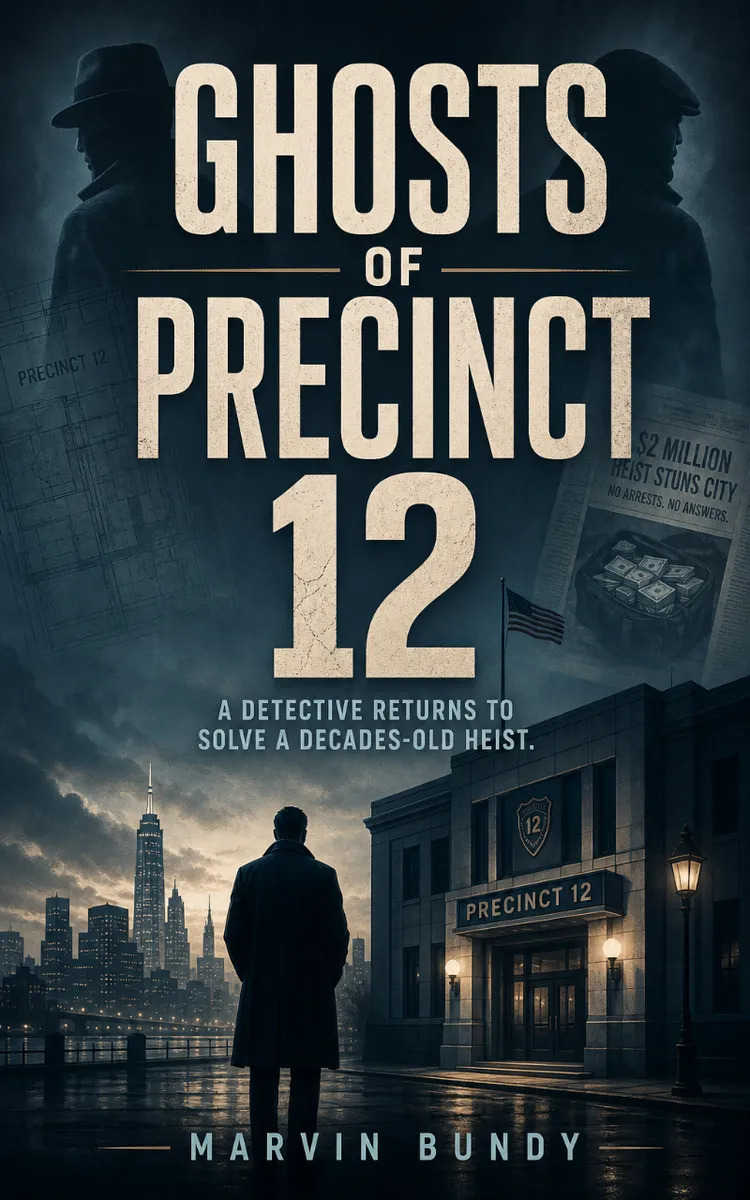
"Ghosts Of Precinct 12" is a fiction book by Marvin Bundy with 24 chapters and approximately 66,277 words. A retired detective reopens a cold case involving corruption and murder..
This book was created using Inkfluence AI, an AI-powered book generation platform that helps authors write, design, and publish complete books. It was made with the AI Novel Writer.
Frequently Asked Questions
What is "Ghosts Of Precinct 12" about?
A retired detective reopens a cold case involving corruption and murder.
How many chapters are in "Ghosts Of Precinct 12"?
The book contains 24 chapters and approximately 66,277 words. Topics covered include Retirement Ends at Precinct 12, The Missing Ledger Appears, Juggs’s Death Timeline Rebuilt, A Patrol Car Mirrors Old Betrayal, and more.
Who wrote "Ghosts Of Precinct 12"?
This book was written by Marvin Bundy and created using Inkfluence AI, an AI book generation platform that helps authors write, design, and publish books.
How can I create a similar fiction book?
You can create your own fiction book using Inkfluence AI. Describe your idea, choose your style, and the AI writes the full book for you. It's free to start.
Write your own fiction book with AI
Describe your idea and Inkfluence writes the whole thing. Free to start.
Start writingCreated with Inkfluence AI


