
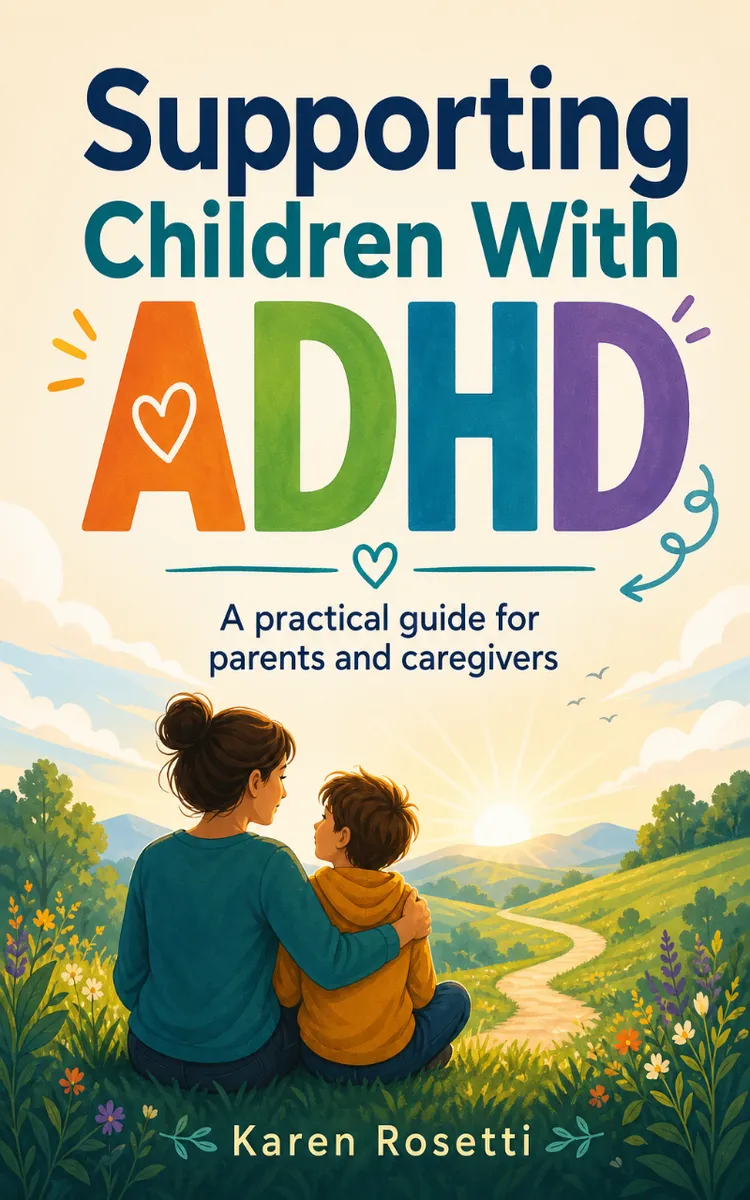
Supporting Children With ADHD
Created with Inkfluence AI
Parent guidance for supporting children with ADHD
Table of Contents
- 1. Rewriting the ADHD Story
- 2. Building Boundaries Without Guilt
- 3. Turning Meltdowns Into Signals
- 4. Coaching Focus With Micro-Habits
- 5. Strengthening Resilience and Purpose
Preview: Rewriting the ADHD Story
A short excerpt from “Rewriting the ADHD Story”. The full book contains 5 chapters and 7,788 words.
When a Hard Morning Becomes a Story About Who Your Child IsTalia, a 34-year-old early-childhood teacher and parent of two, knows how quickly an ordinary morning can turn into a courtroom. Her child can’t find one shoe, forgets the lunch bag, and starts bouncing from room to room while the clock keeps moving. Talia hears herself say, “Why can’t you just get it together?” Then comes the look on her child’s face: not defiance, but defeat.
By breakfast, the lost shoe has become evidence. The unfinished homework means “lazy.” The forgotten permission slip means “careless.” A burst of energy at the wrong moment becomes “disrespectful.” Soon, a child is carrying more than a backpack. They’re carrying a story about themselves - and so are you.
What if the problem isn’t your child’s character, but the story being attached to their struggles?From Blame to Possibility: The ADHD Identity ReframeOld Belief: My child’s ADHD behaviors show that they’re careless, unmotivated, difficult, or not trying hard enough.
New Reality: My child’s ADHD behaviors show where support, practice, and a better fit are needed - not who my child is.
This shift doesn’t mean pretending hard moments are easy. It doesn’t excuse hurtful behavior or remove expectations. It changes what you do with the behavior. Instead of asking, “What’s wrong with you?” you begin asking, “What got in the way, and what could help next time?”
That question leaves room for growth. It also protects your child from turning a repeated struggle into a permanent identity. A child who forgets homework may need a visible packing routine, a reminder before transition, or help breaking the task into smaller pieces. Calling that child “irresponsible” adds shame, but no useful support.
Talia began noticing the difference in her own language. When her child left a reading folder at school, she wanted to say, “You never remember anything.” Instead, she paused and said, “The folder didn’t make it into your bag. Let’s work out where the packing step breaks down.” The problem stayed real. Her child stayed capable.
That’s the heart of the ADHD Identity Reframe: separate the behavior from the identity, then build expectations around skills that can be taught.
Why the Identity Reframe Changes What Your Child Believes Is PossibleChildren build their self-image from repeated messages, especially the messages delivered during stressful moments. If a child often hears “lazy,” they may stop seeing effort as worthwhile. If they hear “you’re always causing problems,” they may expect rejection before anyone has spoken. Shame can make a child hide mistakes, avoid difficult tasks, or give up quickly to escape another painful reminder.
A more accurate identity gives the brain somewhere better to go. “You’re learning how to manage your attention” is different from “You’re bad at paying attention.” The first describes a skill in progress. The second sounds like a verdict.
Look for these signs that the old story is running your home:
You describe your child with fixed words.
Words such as “always,” “never,” “lazy,” or “careless” appear more often than descriptions of what actually happened.
Your child predicts failure before trying.
They say, “I’m going to mess this up,” refuse to start, or joke about being “the bad kid.”
You lower expectations completely - or raise them angrily.
Some days you do everything for your child because it feels easier. Other days, frustration pushes you to demand independence they haven’t yet learned.
Strengths disappear from the conversation.
You can list missing assignments and forgotten items instantly, but you struggle to name where your child shows curiosity, courage, humor, persistence, or care.
The ADHD Identity Reframe means holding high belief and practical support at the same time.Talia’s child might be expected to pack a school bag, but not expected to remember every item without help. The expectation is responsibility. The support is a checklist taped beside the door, with three boxes: folder, lunch bag, water bottle. Responsibility grows through a structure that makes success easier to repeat.
Questions That Help You See the Child Beneath the StruggleWhat label do I use when I’m exhausted, and what specific behavior is underneath it?
If “careless” is your word, name the exact moment instead: “The permission slip stayed on the counter after we discussed it.” Specific language points toward a solution.
What does my child do well that becomes invisible when problems pile up?
Talia noticed that her child could spend twenty minutes carefully building an elaborate train track. That didn’t erase difficulty with homework, but it revealed patience, focus, and design thinking under the right conditions.
Am I expecting a mature skill without teaching the steps?
“Be responsible” is too broad for a child who needs to learn how to check a planner, gather materials, and place them by the door....
About this book
"Supporting Children With ADHD" is a self-help book by Anonymous with 5 chapters and approximately 7,788 words. Parent guidance for supporting children with ADHD.
This book was created using Inkfluence AI, an AI-powered book generation platform that helps authors write, design, and publish complete books. It was made with the AI Self-Help Book Writer.
Frequently Asked Questions
What is "Supporting Children With ADHD" about?
Parent guidance for supporting children with ADHD
How many chapters are in "Supporting Children With ADHD"?
The book contains 5 chapters and approximately 7,788 words. Topics covered include Rewriting the ADHD Story, Building Boundaries Without Guilt, Turning Meltdowns Into Signals, Coaching Focus With Micro-Habits, and more.
Who wrote "Supporting Children With ADHD"?
This book was written by Anonymous and created using Inkfluence AI, an AI book generation platform that helps authors write, design, and publish books.
How can I create a similar self-help book?
You can create your own self-help book using Inkfluence AI. Describe your idea, choose your style, and the AI writes the full book for you. It's free to start.
Write your own self-help book with AI
Describe your idea and Inkfluence writes the whole thing. Free to start.
Start writingCreated with Inkfluence AI


