
Read the first chapter
The whole of chapter one, free. About 9 min. Turn the pages with the arrows, your keyboard, or a swipe.
Chapter 1
Why Your Brain Predicts Everything
Your Brain’s Shortcut: Why Perception Feels Like Certainty
Have you ever watched a magician pull a coin from behind someone’s ear and felt, for a split second, that your eyes were simply “wrong”? Then - almost immediately - your brain edits the scene so smoothly that the trick starts to feel inevitable. The paradox is that the brain is always predicting, yet we experience the world as if it’s being delivered to us in real time.
That’s the core mystery behind why your brain predicts everything: perception isn’t a passive recording. It’s more like a constant draft that gets revised as new information arrives. In this chapter, we’ll follow that draft across brain physiology, look at where the idea came from historically, and use one everyday setting - an active, attention-hungry workplace - to show how prediction turns ordinary moments into something you can almost test.
If you’ve ever wondered why the same street looks different when you’re alert versus relaxed, or why a familiar sound can “fill in” missing parts, you’re already standing near the answer. If your brain is predicting, what exactly are you seeing - reality, or the smartest guess your body can make fast enough to function?
The Predict-Verify Loop in Everyday Perception
Let’s name the idea we’ll keep returning to: the Predict-Verify Loop. Your brain doesn’t wait for the world to arrive and then build a picture. Instead, it runs a prediction based on context - what you’ve seen before, what usually happens next, what your body expects to need - and then it verifies that prediction against incoming sensory signals.
You can feel this loop in places where timing matters. When you’re crossing a busy street, your brain doesn’t just wait for “cars” to appear; it anticipates motion, judges speed, and updates your next move before the full evidence is even in. When you’re driving, the same thing happens with a quieter intensity: your brain is constantly guessing where other cars will be, how far they’ll be, and whether that brake light change means “slow” or “danger.” Vision, hearing, and even touch are threaded through prediction because prediction is how the nervous system stays ahead of the world.
Physiologically, this isn’t just a metaphor. The brain is built from networks that send signals both upward and downward through layers. Higher-level areas use context to influence lower-level processing, shaping what gets amplified and what gets ignored. When incoming sensory input conflicts with the brain’s guess, you get a “prediction error” - a kind of surprise signal that tells the brain it needs to revise its story.
Now here’s why this becomes so testable in daily life: prediction doesn’t just change what you perceive; it changes what you notice. Two people can look at the same scene and come away with different details, not because one of them “sees less,” but because each person’s brain is verifying a different predicted version of the world.
If prediction is always running, then perception becomes less like a camera and more like a continuous negotiation between expectation and evidence. And that negotiation leaves fingerprints - sometimes obvious, sometimes sneaky - across the brain’s physiology.
From Phrenology to Prediction: How the Idea Took Shape
Long before neuroscientists used the language of prediction, they were wrestling with a similar question: how does the mind turn sensory information into experience? In the 1800s, one influential but misguided approach tried to localize mental functions by mapping bumps and grooves on the skull - phrenology. It was wrong in its details, but it captured a real instinct: that perception depends on specific brain machinery rather than a single, all-purpose “mind-stuff.”
As physiology improved, a different picture emerged. Researchers began to understand that the brain contains pathways that process sensory inputs and pathways that coordinate them with memory, attention, and action. In the early 20th century, experiments on perception made it hard to believe that the brain is merely receiving signals. Optical illusions, for example, demonstrated that perception can be systematically distorted even when the physical stimulus stays the same.
Then came the modern convergence: computational ideas about how systems cope with uncertainty. The brain faces a problem that every mechanic knows: you can’t inspect every possible part every time. You need expectations to narrow the search. Prediction models - sometimes described in terms of Bayesian inference - offer one way to describe how the brain could weigh prior experience against current sensory data.
This doesn’t mean your brain is a calculator, or that you can write down its math on a napkin. It means the architecture of perception makes sense if the brain is trying to be efficient under noise and delay. Your senses arrive late. Your brain compensates by projecting forward.
A useful way to see the historical shift is to notice what changed in the questions scientists asked. Instead of only asking “What part of the brain responds when we see something?” researchers began to ask “What part of the brain anticipates what we’ll see next?” Once you ask that, the Predict-Verify Loop becomes a natural candidate for how perception stays stable in a world that is constantly changing.
And stability is the point. The world doesn’t hold still long enough for raw sensory data to be turned into a full picture. Prediction is the technique that makes perception feel continuous.
Nina’s Night Shift: Prediction at the Wheel
Nina is 34 and drives for a rideshare service in a busy city. Her workday is built from short bursts of attention: picking up passengers, navigating crowded streets, scanning mirrors, reading brake lights, and listening for changes in traffic patterns. It’s not a lab, but it’s close to one in an important sense - she’s constantly updating her internal model of the next moment.
Consider what her job demands. A rideshare driver doesn’t just “see the road.” She has to infer intention: whether a cyclist is about to shift lanes, whether a pedestrian is stepping off the curb, whether a car’s creeping forward means it’s turning or just stuck in traffic. Those cues are often partial. A blink of motion, a slight change in spacing, a brake light that flickers rather than fully illuminates - enough for prediction, not enough for certainty.
That’s where the Predict-Verify Loop becomes vivid. Nina’s brain makes a guess about what’s likely happening, and then it verifies that guess through continued sensory input. When the guess matches reality, everything feels smooth. When it doesn’t - when a pedestrian suddenly steps out, or a car that seemed to be waiting suddenly moves - the mismatch creates a moment of heightened attention, as if the mind had to “catch up.”
Even sound participates. City traffic is a layered orchestra of engines, tire hiss, distant horns, and intermittent sirens. People often assume they’re hearing the environment directly, but in practice the brain groups sounds into patterns based on expectation. A familiar engine note can become meaningful before the full acoustic picture arrives, because the brain is already using context - time of night, street type, typical traffic flow - to predict which sound category belongs where.
Nina’s workplace also highlights another physiological reality: attention is limited. Prediction helps the brain decide what’s worth processing in detail. When she’s navigating a dense area, her brain can’t fully analyze every stimulus. So it prioritizes what fits the most likely scenario - then it flags surprises when the evidence doesn’t line up.
This is why everyday perception can feel like a set of repeatable experiments. Nina will encounter similar routes, similar vehicle behaviors, and similar street layouts. Each trip becomes a new test of the same internal model, with small variations that determine whether prediction holds steady or needs correction. Over time, her brain doesn’t just store memories of places; it learns the predictive structure of how those places behave.
In a way, her job trains the Predict-Verify Loop to run quickly and to treat the world as a pattern-generating machine. The result isn’t just efficient driving. It’s a particular style of perception - one that can be accurate, but also occasionally overconfident when the world behaves in a way she didn’t expect.
When Surprise Becomes Perception: The Counterintuitive Twist
Here’s the counterintuitive finding that changes how you think about perception: the brain can experience a scene as “fully real” even when key parts of the sensory input are missing, because prediction fills the gaps. The surprise isn’t that the brain can guess - it’s that the guess can become the experience itself.
This matters because it flips the usual intuition. We tend to assume perception is the brain reporting what the senses measured. In the Predict-Verify Loop, perception is closer to the brain’s best explanation of what the senses should be measuring, given context. Incoming signals don’t just correct the brain; they can also confirm it so strongly that the predicted version feels like the direct version.
You can see this in everyday phenomena like visual illusions that depend on context, or in how the brain “completes” degraded information. If your expectation is strong enough, the brain may not treat missing details as missing. It treats them as already handled. The verification step becomes a stamp of approval rather than a careful audit.
For Nina, this can show up in subtle ways. A street that typically has a certain flow - cars pulling out one way, pedestrians behaving in another - creates strong priors. When something breaks the pattern, her prediction error would be larger and more noticeable. When nothing breaks, the scene feels stable and coherent, even though much of what she experiences is reconstructed.
So the world you perceive is not a raw stream. It’s a negotiated product between what you expect and what you can verify. That negotiation is fast, and it often succeeds. But it also means that perception is not merely a window - it’s a collaboration.
And once you see that, the next time you notice a “mistake” in your senses, the question changes. You stop asking only why your eyes or ears failed. You start asking why your brain predicted that success was likely.
What This Tells Us About Being Human in Motion
Prediction isn’t a glitch in human perception; it’s a feature that makes life possible. Without it, your nervous system would have to rebuild the world from scratch at every moment, and the delays alone would make coordination nearly impossible. The Predict-Verify Loop turns the brain into a forward-looking organ, not because it’s trying to be clever, but because it has to be timely.
At the same time, prediction reveals something uncomfortable about social life and personal experience: what feels obvious often comes from the expectations you carry. Nina’s expectations aren’t “wrong” when they’re accurate - but they can steer attention in ways that make some details feel invisible until they become urgent. That’s not just neuroscience. It’s how humans move through crowded spaces, interpret each other, and form quick judgments.
The fascinating part is that this system is both resilient and fallible. It can handle chaos with grace, then stumble when the world shifts just enough to break the pattern. The mind doesn’t just process reality; it interprets it through a living model that’s always one step ahead - and occasionally, that step lands on the wrong tile.
If your perception is your brain’s best guess in motion, then every “I saw it” is also an “I expected it” - so what else in your life might be happening the same way?
End of chapter one. 4 more chapters in the full book.
Swipe or use the arrows to turn the page

What's inside: 5 chapters
- 1. Why Your Brain Predicts Everything
- 2. The Dopamine Chase Behind Motivation
- 3. Memory’s Remix: Why You Recall Wrong
- 4. Attention, Not Intelligence, Runs Your Life
- 5. Your Body Teaches Your Mind Fear First
About this book
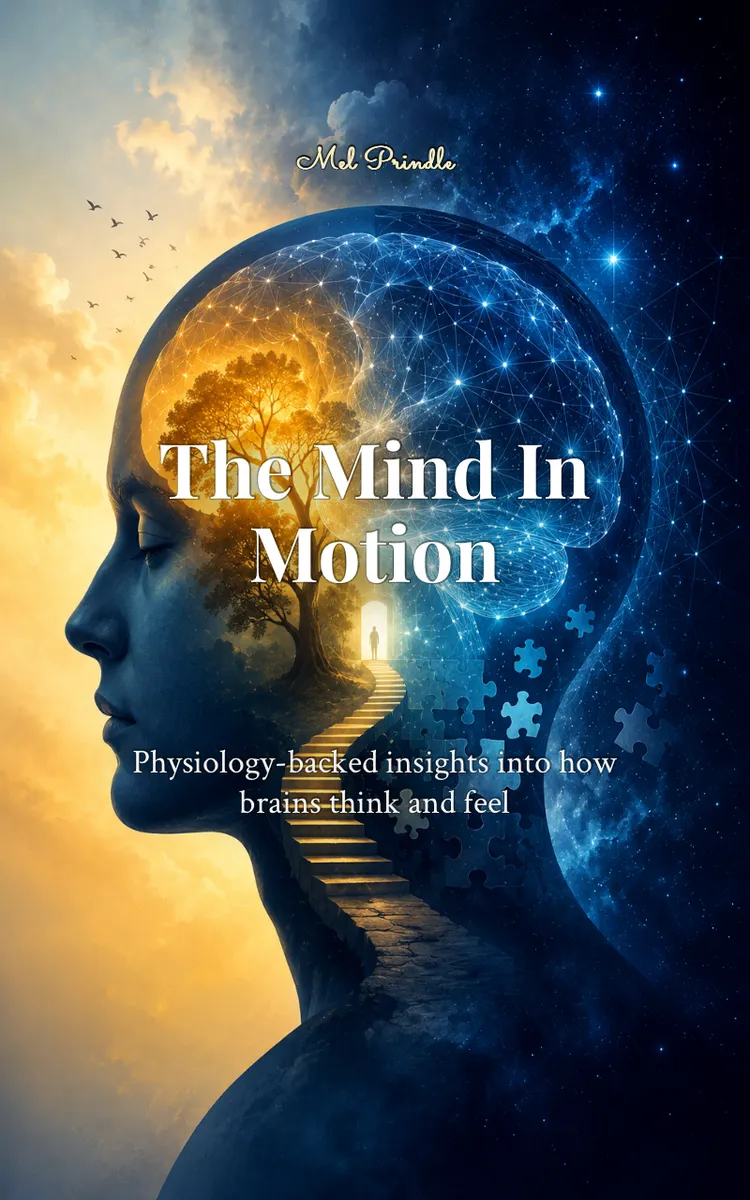
"The Mind In Motion" is a curiosity book by Mel Prindle with 5 chapters and approximately 8,463 words. Understanding the human mind using physiological facts and research.
This book was created using Inkfluence AI, an AI-powered book generation platform that helps authors write, design, and publish complete books.
Frequently Asked Questions
What is "The Mind In Motion" about?
Understanding the human mind using physiological facts and research
How many chapters are in "The Mind In Motion"?
The book contains 5 chapters and approximately 8,463 words. Topics covered include Why Your Brain Predicts Everything, The Dopamine Chase Behind Motivation, Memory’s Remix: Why You Recall Wrong, Attention, Not Intelligence, Runs Your Life, and more.
Who wrote "The Mind In Motion"?
This book was written by Mel Prindle and created using Inkfluence AI, an AI book generation platform that helps authors write, design, and publish books.
Write your own curiosity book with AI
Describe your idea and Inkfluence writes the whole thing. Free to start.
Start writingCreated with Inkfluence AI


