
Read the first chapter
The whole of chapter one, free. About 9 min. Turn the pages with the arrows, your keyboard, or a swipe.
Chapter 1
The TDEE Frictionless Approach
The TDEE Frictionless Approach: How Belly Fat Gets Stored - and How to Prove Exercise Isn’t Doing the Heavy Lifting
A typical “I’ll just work out harder” plan ignores a hard truth: your body doesn’t run on willpower - it runs on math. The TDEE (Total Daily Energy Expenditure) is the total energy you burn in a day from everything you do, including breathing, digestion, temperature control, and moving around. Formal exercise is only a slice of that pie for most people, and even when it’s helpful, it’s rarely the main driver of belly fat changes.
Tanya, 34, works customer support and loves one thing more than she loves food: not sweating. She’s the kind of person who can’t stand the idea of “finding time,” and she’s tired of being told that results require suffering. So we’re going to do something different - learn how belly fat is stored and mobilized, then use the Frictionless TDEE Proof Model to show you (with your own numbers) why exercise usually lands under 10% of total calorie burn for real, everyday life.
Who this is for (and what you can expect) This chapter is for you if: - You want belly fat reduction without gym time or formal workouts. - You’ve tried “eat less, move more” and felt stuck or punished. - You want a clear, evidence-aware way to stop guessing and start steering.
Key benefits you’ll build here: - A practical understanding of visceral fat: why it hangs around and what actually pulls it into motion. - Confidence that your plan can be exercise-optional - because you’ll prove it with your own TDEE reality. - A repeatable way to stop “random effort” and start “targeted frictionless leverage.”
Practical takeaway: By the end of this chapter, you’ll be able to explain belly fat storage in plain language and estimate how little formal exercise usually contributes to your daily calorie burn.
Belly Fat Storage & Mobilization: What’s Happening Under the Hood
Belly fat isn’t just “extra weight.” Visceral fat sits deeper in the abdomen, closer to organs. It behaves differently than subcutaneous fat (the squishier fat you can pinch). When your body is in a consistent energy shortage - or when your internal chemistry supports it - fat cells release stored energy. When your body is in a “hold onto fuel” mode, those releases get harder and belly fat lingers.
Here’s the core mechanism in normal-person terms: your body is always deciding whether to store or release energy. That decision is influenced by your daily energy balance, your stress hormones, your circadian rhythm, and how much you naturally move (not workouts - your everyday motion).
To make this concrete, use this simple risk framing:
1. Energy surplus most days If you repeatedly take in more calories than you burn, the body has to store the difference. Belly is one of the places it stores easily.
2. Stress-driven “hold” signals When you’re chronically keyed up, your body leans toward keeping energy available. This doesn’t mean you’re “doing something wrong” - it means your internal settings are biased toward survival mode.
3. Low daily movement (NEAT tends to drop without you noticing) Even if you don’t eat much, if your everyday motion is low, your total burn stays low.
4. Sleep disruption and timing drift Poor sleep and late-night eating can nudge hunger patterns and the way your body handles fuel - making belly fat harder to mobilize.
Now let’s address the part you really care about: how belly fat gets mobilized. Mobilization is not just “burn calories.” It’s the body shifting from “store” to “release,” which is strongly tied to whether your day-to-day calorie balance and internal signals support fat release. When those conditions improve, belly fat becomes less stubborn because your body finally has fewer reasons to keep it locked away.
Ask yourself a quick comprehension check: when you do feel belly changes, were you doing intense workouts, or were you consistently nailing sleep timing, eating patterns, and daily movement? For most people, it’s the second one.
Practical takeaway: Belly fat changes when your body’s storage/release signals shift. That shift is usually driven more by daily rhythm and everyday energy balance than by formal exercise alone.
The Frictionless TDEE Proof Model: Prove Exercise Is Under 10% of Calorie Burn
Let’s stop arguing with theories and start using your numbers. The Frictionless TDEE Proof Model is how you estimate your real daily calorie burn and isolate what portion comes from formal exercise versus everything else you do without thinking.
Step 1: Write down your daily baseline You need two inputs: - Your estimated TDEE (you can use an online calculator or your best approximation from past weight trends) - Your average weekly formal exercise time (even if it’s zero - this still proves the point)
If you don’t know your TDEE, don’t panic. This model doesn’t require perfection. It requires honesty about your routine.
Step 2: Convert exercise minutes into a calorie slice You’ll estimate how many calories your formal exercise burns on average, then compare it to your daily TDEE. The key is the ratio.
Use this rule of thumb for the proof: - If your weekly exercise minutes are low, your daily exercise contribution is typically small. - For most desk-based adults, the “in the real world” burn comes from non-exercise life: standing, walking to tasks, moving at home, fidgeting, temperature regulation, digestion, and normal daily movement.
Step 3: Do the ratio check (the “under 10%” test) Your question is simple: Does formal exercise contribute less than 10% of your daily calorie burn? If yes, then your belly fat plan can be built around non-exercise mechanisms - sleep, stress, nutrition strategy, and NEAT - without needing gym time.
To make Tanya’s situation usable, here’s the kind of reality check she does: she doesn’t track workouts because she hates them. But she can account for her day - work hours, commute steps if any, how long she’s on her feet at home, and whether she’s usually scrolling while sitting. When she plugs in even a small formal exercise time, the math still lands under 10% for her. The result isn’t “exercise is useless.” The result is: exercise isn’t the main engine for her belly fat progress.
A simple comparison table (exercise vs. the rest) | Daily burn source | What it includes | Why it matters for belly fat | |---|---|---| | Formal exercise slice | Planned workout time only | Often small relative to your whole day | | Everything else slice | Breathing, digestion, temperature control, daily motion, subconscious movement | Usually the bigger driver of energy balance day to day |
Practical takeaway: Your plan doesn’t need to be built on suffering. It needs to be built on the biggest parts of your calorie burn - and then nudged in the right direction consistently.
Practical Protocol: Your Frictionless TDEE Proof Model Setup (No Sweat Required)
You’re going to set up a quick proof system that takes minutes today and keeps you honest for one week. No gym time. No complicated tracking.
What you do today (15 minutes total) 1. Record your formal exercise time for the last 7 days If it’s zero, write “0” clearly. You’re still proving something valuable.
2. Estimate your daily TDEE**** Use your best estimate (calculator or prior tracking). Write one number down. Example format: “TDEE ≈ ____ calories/day.”
3. Estimate your weekly exercise burn (rough is fine) If you did formal exercise, use a simple estimate based on your typical session duration and intensity. If you did none, write “0.”
4. Compute your exercise contribution to daily burn - Weekly exercise burn ÷ 7 = daily exercise burn - Daily exercise burn ÷ TDEE = exercise fraction Your target for this chapter is: under 10%.
Progress milestones (what “working” looks like) - By Day 3: You’ll have clarity on whether exercise is even a major player for your calorie burn. - By Day 7: You’ll stop treating workouts like the missing ingredient and instead focus on the levers that match your actual energy reality.
When to get professional help (safety boundaries) If you have any of the following, don’t try to “self-optimize” aggressively - check in with a licensed professional first: - Unexplained rapid weight loss or weight gain - Frequent fainting, chest pain, or shortness of breath with routine activities - Severe, persistent abdominal pain, vomiting, or blood in stool - Diabetes-related symptoms that are worsening (like frequent urination, excessive thirst, or confusion)
Practical takeaway: The protocol isn’t about being perfect - it’s about removing guesswork so your belly fat plan is built on what actually moves your day-to-day energy balance.
Common Mistakes That Keep People Stuck (and How to Fix Them)
Mistake 1: Assuming exercise “must” be the main burn Why it happens: Most people feel like workouts “should count” because they’re obvious and memorable. Daily burn from digestion, breathing, temperature regulation, and normal motion feels invisible - so it gets ignored. What to do instead: Run the Frictionless TDEE Proof Model math once. If your formal exercise fraction is under 10%, stop rebuilding your plan around sweat you hate. Put your effort into the non-exercise levers that cover the bigger slice of your day.
Practical reflection: Ask yourself, “What do I do every day without thinking?” That’s where your real leverage is.
Mistake 2: Changing workouts instead of changing the inputs that drive fat release Why it happens: It’s easier to swap one activity for another than to adjust sleep timing, stress patterns, and how you structure meals. Also, many people don’t realize their everyday movement changes when stress and routine drift. What to do instead: Keep your formal exercise steady (or at zero), then focus on belly-relevant drivers: consistent eating timing, better sleep window habits, and improving everyday motion (NEAT). You’re not “trying harder” - you’re changing the environment your body uses to decide store vs. release.
Practical reflection: If your belly isn’t moving, the problem is usually not the effort you can feel. It’s the signals you’re feeding without noticing.
Mistake 3: Using “I was good all week” as proof when the math wasn’t checked Why it happens: Subjective memory is unreliable. You might “feel” like you ate the same while portions quietly drifted, sleep got shorter, or your daily movement slipped. What to do instead: Use the proof model as your reality check. Write your estimated TDEE, estimate your formal exercise fraction, and then treat that as your baseline. The goal is clarity, not shame.
Practical reflection: Your body runs on inputs and timing. Feelings come later.
Actionable Homework Blueprint
• Today (15 minutes): - Write your estimated TDEE (one number). - Write your formal exercise time for the last 7 days (minutes total). If it’s zero, write “0”. - Estimate weekly exercise burn (rough estimate is fine; if zero, write “0”). - Calculate daily exercise burn = weekly exercise burn ÷ 7. - Calculate exercise fraction = daily exercise burn ÷ TDEE. - By Day 3: - Confirm whether your formal exercise fraction is under 10% (your proof target). - By Day 7: - Decide your next focus: if it’s under 10%, commit to non-exercise levers as the primary path for belly fat mobilization - sleep, stress, nutrition strategy, and NEAT.
Closing thought: Once you prove how small formal exercise is in your real burn, the whole game changes. You stop chasing sweat and start building a plan around the signals your body actually listens to - quietly, daily, and without forcing your life to revolve around workouts.
End of chapter one. 4 more chapters in the full book.
Swipe or use the arrows to turn the page
What's inside: 5 chapters
- 1. The TDEE Frictionless Approach
- 2. Cortisol Lock & Sleep Signal Routine
- 3. TEF Volumetrics for Blood Sugar Calm
- 4. NEAT Micro-Habits for Desk-Job Fat Burn
- 5. Hydration & Gut-Brain Visceral Reset
About this book
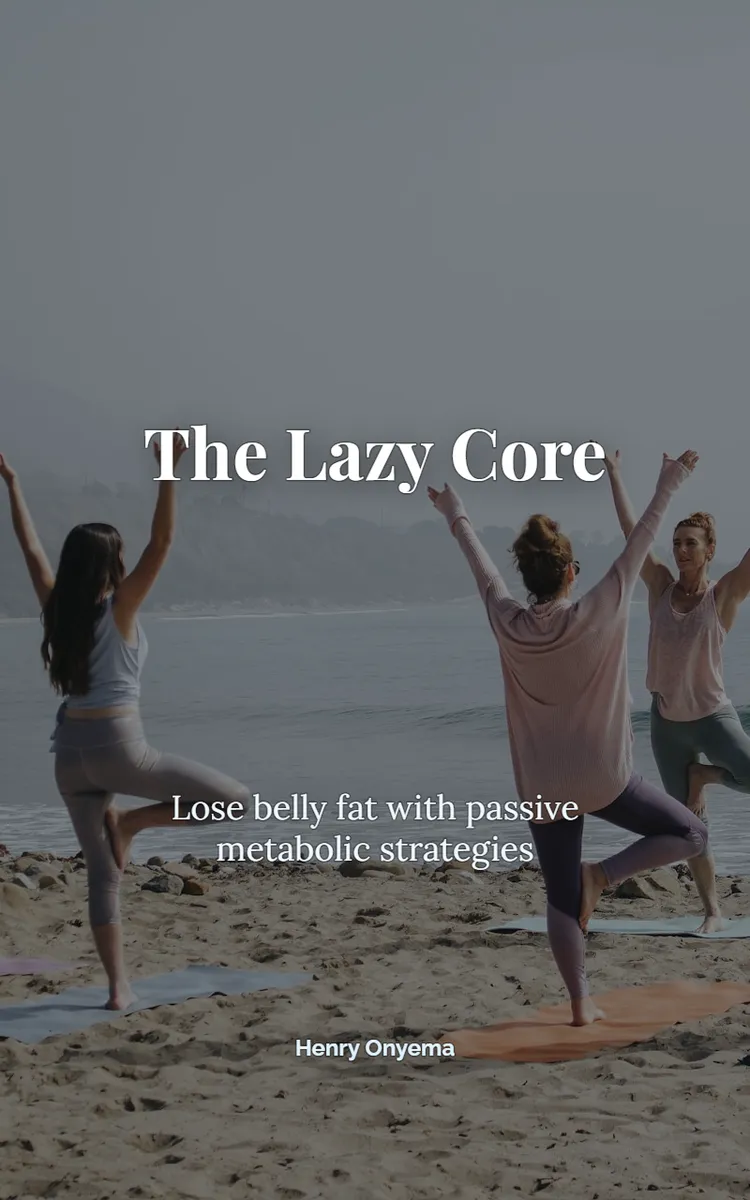
"The Lazy Core" is a health & wellness book by Henry Onyema with 5 chapters and approximately 8,596 words. Non-exercise belly fat loss via sleep, stress, nutrition, NEAT.
This book was created using Inkfluence AI, an AI-powered book generation platform that helps authors write, design, and publish complete books. It was made with the AI Health Book Generator.
Frequently Asked Questions
What is "The Lazy Core" about?
Non-exercise belly fat loss via sleep, stress, nutrition, NEAT
How many chapters are in "The Lazy Core"?
The book contains 5 chapters and approximately 8,596 words. Topics covered include The TDEE Frictionless Approach, Cortisol Lock & Sleep Signal Routine, TEF Volumetrics for Blood Sugar Calm, NEAT Micro-Habits for Desk-Job Fat Burn, and more.
Who wrote "The Lazy Core"?
This book was written by Henry Onyema and created using Inkfluence AI, an AI book generation platform that helps authors write, design, and publish books.
How can I create a similar health & wellness book?
You can create your own health & wellness book using Inkfluence AI. Describe your idea, choose your style, and the AI writes the full book for you. It's free to start.
Write your own health & wellness book with AI
Describe your idea and Inkfluence writes the whole thing. Free to start.
Start writingCreated with Inkfluence AI


