
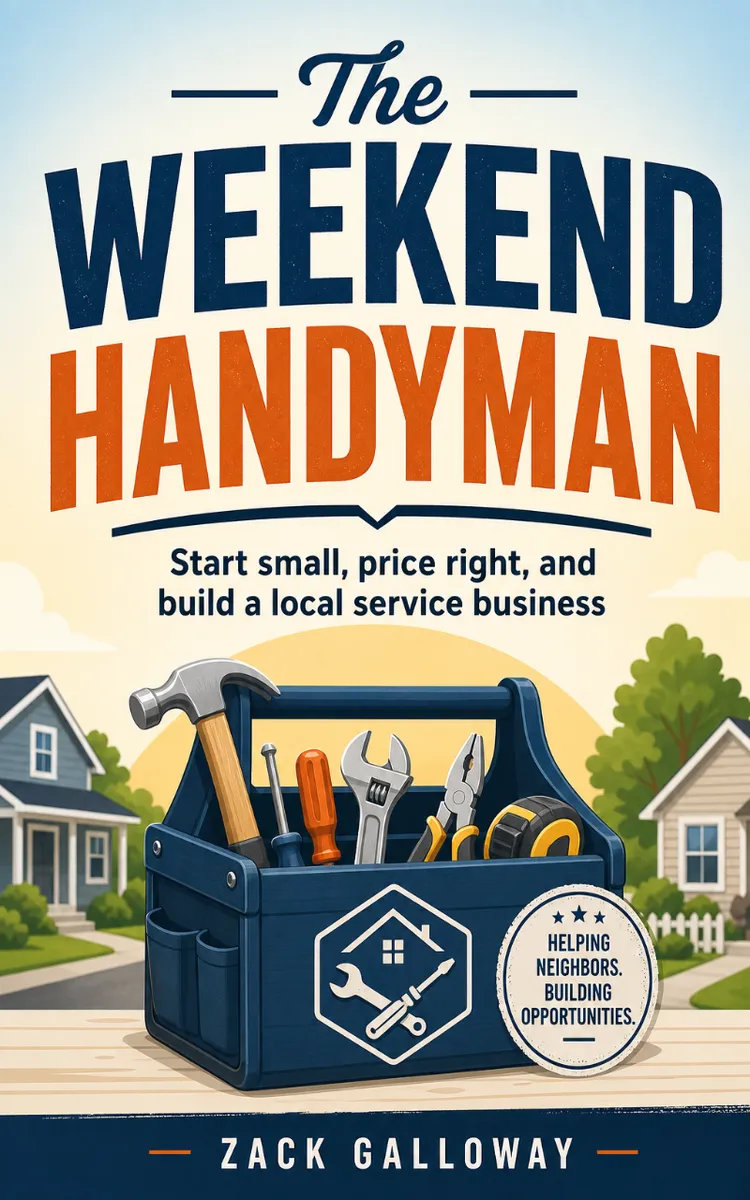
The Weekend Handyman
Created with Inkfluence AI
Beginner guide to starting and running a handyman property-maintenance business
Table of Contents
- 1. Day 1: Choose Your Service Menu
- 2. Day 2: Form Your Legal Business
- 3. Day 3: Get Insurance That Fits
- 4. Day 4: Permits and Licensing Basics
- 5. Day 5: Contractor License Considerations
- 6. Day 6: Build Your Estimating System
- 7. Day 7: Minimum Service Charge Rules
- 8. Day 8: Material Markup and Waste
- 9. Day 9: Hourly vs Project Pricing
- 10. Day 10: Travel Charges and Time Blocks
- 11. Day 11: Warranties and Callback Policies
- 12. Day 12: Customer Expectations and Intake
- 13. Day 13: Written Scopes of Work
- 14. Day 14: Deposits and Payment Terms
- 15. Day 15: Invoicing and Receipts
- 16. Day 16: Starter Tool Kit $300
- 17. Day 17: Starter Tool Kit $750
- 18. Day 18: Starter Tool Kit $1,500
- 19. Day 19: Starter Tool Kit $2,500
- 20. Day 20: Tool Maintenance and Inventory
- 21. Day 21: Ladders and Safe Access
- 22. Day 22: PPE and Dust Control
- 23. Day 23: Van Organization and Job Staging
- 24. Day 24: Job-Site Cleanliness and Photos
- 25. Day 25: Customer Communication Scripts
- 26. Day 26: Furniture Assembly and Hardware Replacement
- 27. Day 27: Shelving and Picture Hanging
- 28. Day 28: Curtain Rods and Blinds Mounting
- 29. Day 29: Drywall Patching and Small Trim Repairs
- 30. Day 30: Door Adjustments and Weatherstripping
- 31. Day 31: Minor Fence Repairs and Deck Care
- 32. Day 32: Pressure Washing and Gutter Cleaning
- 33. Day 33: Lawn Cleanup and Rental Turnovers
- 34. Day 34: Caulking and Weatherproofing Touchups
- 35. Day 35: Marketing With Facebook Ads
- 36. Day 36: Referrals and One-Year Roadmap
Preview: Day 1: Choose Your Service Menu
A short excerpt from “Day 1: Choose Your Service Menu”. The full book contains 36 chapters and 65,325 words.
Start With the Jobs You Can Finish Cleanly
Could you complete your first customer job on a Saturday morning, with the tools you already own, without touching regulated systems or guessing at a repair? That question should decide your first service menu - not the number of services listed by established handyman companies.
A narrow menu protects your customer, your reputation, and your weekend schedule. It also makes pricing easier because you can learn the time, materials, and common problems for each job. After choosing carefully, you should have a short list of services you can describe in one sentence, perform safely, inspect before leaving, and decline when the conditions exceed your skill or local rules.
Start with maintenance work that has a clear beginning and end. Furniture assembly, picture hanging, curtain rods, blinds, basic wall mounting, drywall patching, small trim repairs, door adjustments, weatherstripping, caulking, hardware replacement, cabinet adjustment, minor fence repairs, property cleanup, and rental turnovers often fit that description. Your first menu does not need to cover every request. It needs to match what you can reliably deliver. Ask yourself: which three jobs could you repeat five times and produce the same quality each time? Those jobs belong at the center of your first weekend menu.
Apply the Starter Menu Filter
The Starter Menu Filter gives you a practical way to test each possible service before you advertise it. A service passes only when you can control the work, explain its limits, and correct ordinary mistakes without creating a larger problem.
Use these four checks:
1. Known tools and materials. List the tools and supplies before you accept the job. A curtain-rod installation may need a drill, bits, a level, a stud finder, anchors, screws, and a tape measure. If you need specialized equipment or a tool you have never used, leave the service off the starter menu. Familiar tools reduce setup time and prevent damage.
2. Clear work boundary. Write what you will do and what you will not do. For a door adjustment, you might tighten hinges, adjust the strike plate, and correct minor rubbing. You should not promise to repair a shifted foundation, replace a damaged door frame, or correct structural movement. Clear boundaries stop a small maintenance visit from turning into an open-ended repair.
3. Visible quality check. Choose services that allow you to inspect the result before you leave. Check that a shelf sits level, a patch feels smooth, a cabinet door closes evenly, or weatherstripping seals without preventing the door from latching. A visible check gives you a chance to fix defects while you still have your tools out.
4. Safe and legally suitable work. Confirm local licensing, permit, and insurance requirements before advertising. Rules vary by location and by the value or type of work. Do not perform electrical wiring, new circuits, panel work, or repairs inside electrical equipment unless you hold the required license and training. Do not alter supply lines, drains, gas piping, water heaters, or other plumbing systems when local law requires a licensed plumber. Heating, ventilation, and air-conditioning work can involve electrical power, refrigerant, combustion, and specialized testing, so refer it to a qualified technician unless your credentials and local rules clearly allow the task.
The same boundary applies to gas work, structural repairs, roofing, excavation, and work involving asbestos, mold, or lead. Gas leaks and combustion equipment require immediate referral. Structural changes, load-bearing walls, foundation repairs, roof repairs, and excavation can create serious injury, property, or utility risks. Suspected asbestos, mold growth, or lead-based coatings require appropriate assessment, containment, and often certified professionals. Stop when you see unknown wiring, active leaks, damaged gas lines, suspected hazardous materials, major rot, unstable decks, or movement in a wall or foundation.
A good starter menu usually contains six to ten closely related services, not thirty unrelated tasks. Group them by the customer’s problem: “mount and install,” “patch and adjust,” and “exterior cleanup and minor maintenance.” For example, your first menu could include picture hanging, curtain rods, blinds, furniture assembly, shelving that does not carry unusually heavy loads, drywall patches smaller than a doorway, caulking, door adjustments, cabinet hardware, and property cleanup. Exclude anything that requires opening a wall to find a fault or diagnosing a system you cannot test properly.
Price the menu only after you understand the work. Suppose a small drywall patch takes forty-five minutes of labor, fifteen minutes of setup and cleanup, and $8 in materials. If you charge $75 for the visit, the customer sees a simple service while you still account for the time spent preparing and cleaning....
About this book
"The Weekend Handyman" is a how-to guide book by Zack Galloway with 36 chapters and approximately 65,325 words. Beginner guide to starting and running a handyman property-maintenance business.
This book was created using Inkfluence AI, an AI-powered book generation platform that helps authors write, design, and publish complete books. It was made with the AI Ebook Generator.
Frequently Asked Questions
What is "The Weekend Handyman" about?
Beginner guide to starting and running a handyman property-maintenance business
How many chapters are in "The Weekend Handyman"?
The book contains 36 chapters and approximately 65,325 words. Topics covered include Day 1: Choose Your Service Menu, Day 2: Form Your Legal Business, Day 3: Get Insurance That Fits, Day 4: Permits and Licensing Basics, and more.
Who wrote "The Weekend Handyman"?
This book was written by Zack Galloway and created using Inkfluence AI, an AI book generation platform that helps authors write, design, and publish books.
How can I create a similar how-to guide book?
You can create your own how-to guide book using Inkfluence AI. Describe your idea, choose your style, and the AI writes the full book for you. It's free to start.
Write your own how-to guide book with AI
Describe your idea and Inkfluence writes the whole thing. Free to start.
Start writingCreated with Inkfluence AI


