
Read the first chapter
The whole of chapter one, free. About 7 min. Turn the pages with the arrows, your keyboard, or a swipe.
Chapter 1
The Invisible Prison of Dependency
“Normal is just dependency wearing a clean shirt.”
Amina, 34, runs a call center shift where the phones never stop. She knows the scripts like a second language. Her team hits targets, the manager smiles on KPI days, and customers complain on every other day. After work, Amina scrolls-relief, entertainment, escape-until her thumb feels like it’s been trained. She tells herself she’s tired, not trapped. She’s doing “fine.” She even laughs at people who talk about “freedom,” because freedom sounds expensive and childish.
But here’s the tension nobody names out loud: if you’re not starving, not homeless, not violently unsafe-why do you feel like you’re moving inside a cage? Why do your dreams feel imported, like they belong to somebody else’s life? And why does “trying harder” always turn into the same loop-more effort, same outcome, same quiet numbness?
If you feel normal, you might be the most successfully controlled person in the room.
The Mindset Shift
Old Belief: “I’m not trapped. I’m just living the way life is-responsibility, stress, bills, and scrolling to cope.”
New Reality: “I might not be in chains-I might be in an operating system that keeps me choosing predictable discomfort.”
This is the core claim of Forbidden Truths: most people don’t experience dependency as pain. They experience it as routine. They call it “adulting.” They call it “staying realistic.” They call it “being grateful.” The invisible prison doesn’t need locks when it can install habits. Dependency psychology disguises itself as common sense.
Imported dreams do the same work. Amina doesn’t wake up thinking, I’m building someone else’s plan. She wakes up thinking, I should be stable. The dream she carries-promotion, salary growth, respectability-was handed to her through schooling, media, family expectations, and the constant drumbeat that says, “Your value is what you earn, and your earning comes from being useful to somebody else.” It’s not that the dream is evil. It’s that it’s not fully hers.
Fear conditioning seals the deal. Not dramatic fear-small, daily fear. Fear of failing out loud. Fear of looking unserious. Fear of “wasting time.” Fear that if you stop performing, you’ll fall behind and prove you’re not enough. So you stay. You optimize your survival. You don’t “escape,” because escape would require you to risk becoming unknown.
Here’s a concrete example: Amina wants to “open something someday”-a small service business, a side hustle, a skill. But every time she gets close, she tightens back into the call center lane. Not because she lacks talent. Because her brain treats uncertainty like danger. She doesn’t just fear failure; she fears the identity shift that comes with trying something that isn’t measured by her current employer. That fear doesn’t feel like a prison. It feels like maturity.
That’s the mindset shift: you stop asking, “Why can’t I break free?” and start asking, “What part of me believes I’m safer staying normal?”
Going Deeper
Dependency psychology is not only about money. It’s about perception. It trains you to interpret your world through the lens of other people’s rules-what’s “possible,” what’s “smart,” what’s “respectable,” what’s “too risky.” When those rules become your internal voice, you don’t need an external guard. You become your own guard.
Imported dreams are how the prison gets dressed for public. You’re told to want what the system already supports: stable employment, branded lifestyles, status through consumption, achievement through permission. The culture teaches you what to chase, then sells you the tools to keep chasing it. And when you’re tired, digital distraction shows up like a kindly nurse: it numbs the discomfort of being out of alignment. Scrolling doesn’t just entertain you-it quiets the questions you’d rather not answer.
Survival-mode thinking completes the circuit. When your mind is running on “maintain and avoid,” you don’t plan creatively. You plan defensively. You don’t build long-term leverage; you patch immediate gaps. You don’t ask, “What system could make my work multiply?” You ask, “How do I survive this month?” The prison doesn’t need you to be stupid. It just needs you busy enough not to notice your own patterns.
Signs this pattern is running your life 1. Your goals sound like someone else’s language. “I want promotion.” “I want a better salary.” “I want to be respected.” When you describe your dream, it often sounds like a job title. 2. You feel relief after distraction more than relief after progress. Your best moments are rarely the ones where you build. They’re the ones where you escape-then you return to the same problem wearing the same face. 3. You treat uncertainty like a moral failure. If you try something new and it doesn’t work instantly, you interpret it as proof you’re not capable, not as information. 4. You can explain the system, but you can’t change your dependence on it. You understand how things work-transport, payments, work culture, customer expectations-but your life design still relies on somebody else’s schedule and somebody else’s approval.
En résumé: Normal isn’t neutral-it’s a control method that trains your choices until you stop questioning them.
Now let’s make it practical, because “realizing” doesn’t liberate you. That’s why this book uses the Independence Diagnostic Loop. It’s the only kind of self-work that doesn’t evaporate after a good feeling.
Reflection & Self-Assessment
Answer these honestly. Not dramatically. Just honestly.
1. When do you feel most “alive”-during creation or during escape? If it’s mostly escape (scrolling, late-night entertainment, constant errands), that’s not a personality flaw. That’s your nervous system telling you it doesn’t trust the path of building yet.
2. What do you want that your current life doesn’t measure? Try naming one desire that doesn’t fit neatly into your current work metrics. For Amina, it might be “owning a service business” or “training others.” Naming it is the start of reclaiming it.
3. What fear shows up the moment you imagine changing your dependence? Is it fear of losing income, fear of disappointing family, fear of looking foolish, or fear of being stuck again? Your fear will have a face. Describe it.
4. Where do you copy “imported dreams” without realizing you’re copying? Think of one goal you pursued because it looked like success in your environment. Then ask: would you still want it if nobody applauded?
5. What part of your routine is designed to keep you normal? Be specific: the hours you work, the content you consume, the way you spend “rest.” Rest is fine-automatic rest that shuts down your agency isn’t.
If you answer and feel uncomfortable, good. Discomfort usually means you found the seam where the prison hides.
Growth Challenge
The Independence Diagnostic Loop (7 Days) For the next 7 days, you’re going to catch dependency in action-not in theory. You’ll track three moments and one decision.
What to do each day (10 minutes total): - Moment of Escape (2 minutes): Write down the exact time you reached for scrolling, food, gambling, or entertainment to stop feeling something. What were you avoiding? - Moment of Performance (2 minutes): Write down one task you completed mainly to keep approval or avoid complaints (work, messaging, “being nice,” hitting targets). What emotion were you protecting? - Moment of Choice (4 minutes): Ask: Did I move toward independence today, or did I stabilize dependency? Describe one action that counts either way. - One Independence Decision (2 minutes): Choose one small action you can do tomorrow that reduces your reliance on “somebody else’s system.” Keep it tiny enough to survive your fear.
Difficulty rating: Medium (You’re not changing your whole life in a week. You’re building a mirror sharp enough to show you where you’ve been cooperating with the cage.)
You'll know it's working when... - You can predict your escape moments before they happen. - Your “normal” routine starts to feel less automatic and more adjustable. - You make at least 5 out of 7 days of Independence Decisions that don’t require permission.
If Amina does this, she won’t suddenly quit her job. She’ll start noticing the exact triggers that pull her back into survival mode-late-night doom-scrolling after work, fear-driven “later” when she schedules her side plans, the way approval becomes a drug.
That’s how the loop breaks: not by fantasy, but by pattern recognition with follow-through.
Key Takeaway
You don’t escape dependency by wanting freedom-you escape it by recognizing how “normal” trains your decisions.
• Dependency psychology often feels like routine, not suffering. - Imported dreams and fear conditioning turn other people’s rules into your internal “common sense.” - Digital distraction isn’t only entertainment-it’s frequently a nervous system anesthetic that protects you from uncertainty. - The Independence Diagnostic Loop helps you see the prison while it’s still operating quietly in your day.
Next, we’ll go one step deeper into the machinery: how imported dreams get funded by consumption culture, and why status can feel like oxygen while it quietly drains your independence.
End of chapter one. 7 more chapters in the full book.
Swipe or use the arrows to turn the page


What's inside: 8 chapters
- 1. The Invisible Prison of Dependency
- 2. Breaking Imported Dreams Without Shame
- 3. Status Is a Subscription, Not Success
- 4. The Business of Distraction Runs You
- 5. Ownership Beats Income Every Time
- 6. Education Designed for Obedience
- 7. Creators Become More Powerful Than Politicians
- 8. AI Leverage for African Independence
About this book
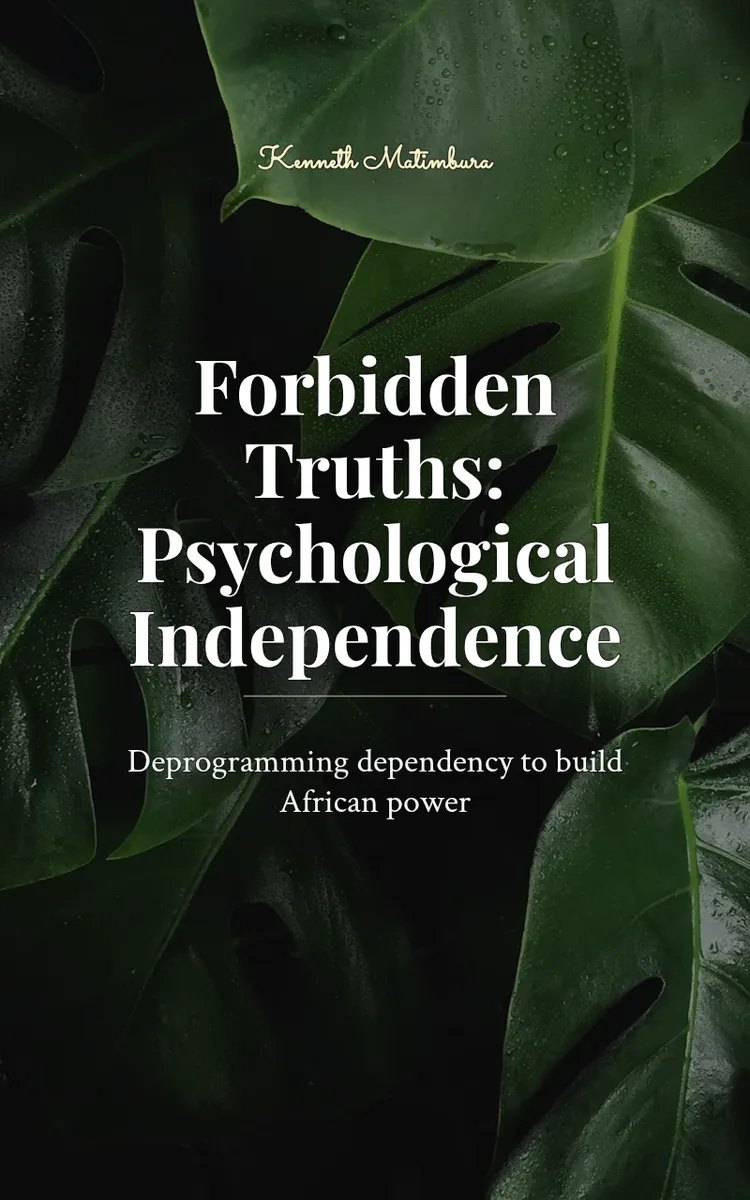
"Forbidden Truths: Psychological Independence" is a self-help book by Kenneth Matimbura with 8 chapters and approximately 11,621 words. Psychological, economic, and cultural systems enabling dependency and suppression.
This book was created using Inkfluence AI, an AI-powered book generation platform that helps authors write, design, and publish complete books. It was made with the AI Self-Help Book Writer.
Frequently Asked Questions
What is "Forbidden Truths: Psychological Independence" about?
Psychological, economic, and cultural systems enabling dependency and suppression
How many chapters are in "Forbidden Truths: Psychological Independence"?
The book contains 8 chapters and approximately 11,621 words. Topics covered include The Invisible Prison of Dependency, Breaking Imported Dreams Without Shame, Status Is a Subscription, Not Success, The Business of Distraction Runs You, and more.
Who wrote "Forbidden Truths: Psychological Independence"?
This book was written by Kenneth Matimbura and created using Inkfluence AI, an AI book generation platform that helps authors write, design, and publish books.
How can I create a similar self-help book?
You can create your own self-help book using Inkfluence AI. Describe your idea, choose your style, and the AI writes the full book for you. It's free to start.
Write your own self-help book with AI
Describe your idea and Inkfluence writes the whole thing. Free to start.
Start writingCreated with Inkfluence AI


