
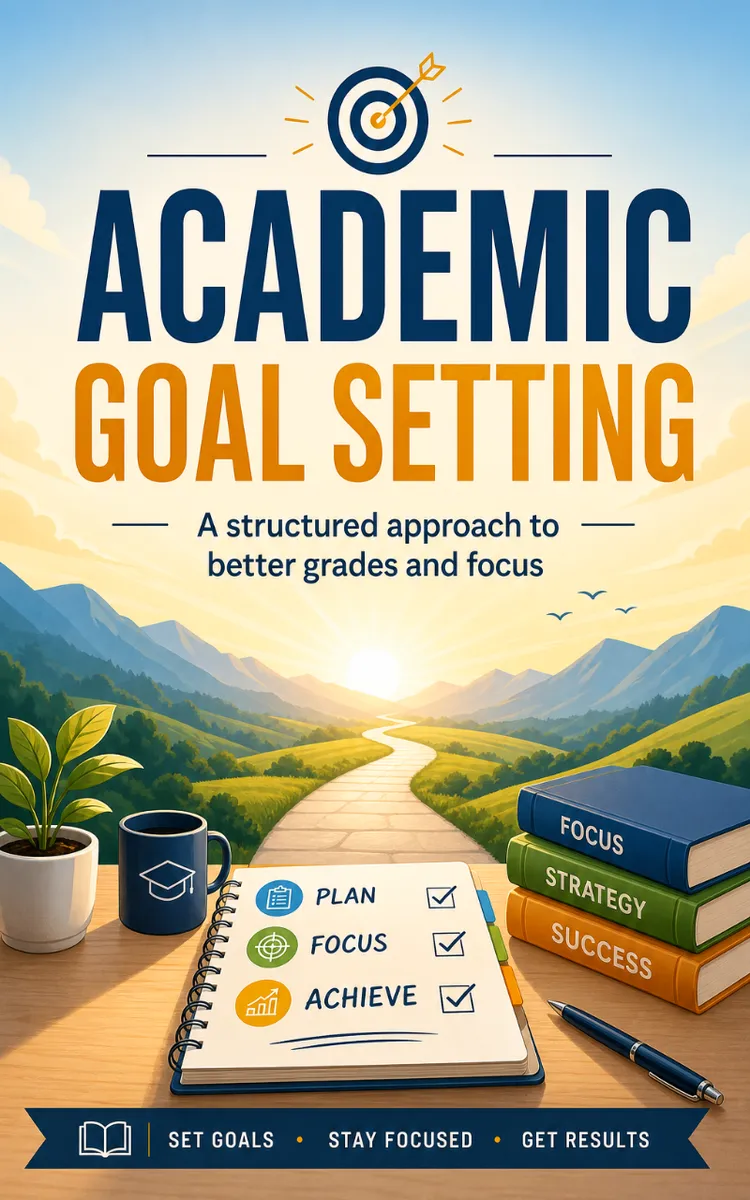
Academic Goal Setting
Created with Inkfluence AI
Goal setting methods to improve academic performance
Table of Contents
- 1. Designing Your Academic Identity
- 2. Replacing Fixed Beliefs with Growth
- 3. Using the SMART-Plus Goal Builder
- 4. Building a Study Habit Stack
- 5. Time-Blocking for Deep Work Sessions
- 6. Communicating Goals with Accountability
- 7. Escaping Perfectionism with Revision Cycles
- 8. Turning Setbacks into Purposeful Resets
Preview: Designing Your Academic Identity
A short excerpt from “Designing Your Academic Identity”. The full book contains 8 chapters and 13,300 words.
Your grades don’t just reflect what you study - they reflect who you believe you are while you’re studying.
The night before a calculus midterm, Talia sat at her desk with highlighters spread like she was about to perform surgery. She’d made “study notes” that looked impressive. She’d highlighted sentences that felt deep. But when she opened the practice problems, her confidence drained fast. Not because she didn’t know anything - because she didn’t feel like the kind of student who could solve them. So she kept rewriting notes instead of wrestling with questions. By 1 a.m., she wasn’t studying math anymore. She was studying her identity: Why am I like this? Why can’t I just be good at this?
That’s the trap. We don’t only set goals - we set stories about ourselves. And those stories quietly decide what “effort” means, what “progress” looks like, and whether setbacks feel temporary or personal. If you want goals that actually stick, you have to define your academic identity in a way that makes sense on a Tuesday night, not just on a motivational high.
The Pattern of “I’m Not That Kind of Student”
You’ll probably recognize the loop fast. It starts with a moment that should be normal - missing an assignment, getting a draft back with comments, blanking on a question you swear you studied. Instead of treating it like information, you treat it like evidence. You read the grade or feedback and translate it into a verdict about you. Then your behavior changes in a way that feels logical in the moment: you avoid the thing, you “prepare” instead of practice, or you double down on the easiest part of studying. Maybe you reread the chapter instead of doing problems. Maybe you make flashcards but never test yourself. Maybe you spend an hour organizing notes so you don’t have to face the messy feeling of being a beginner again.
With Talia, it looked like this: after a quiz score she didn’t love, she told herself she was “just not a math person.” The next day, she studied for ninety minutes by rewriting the same example in her own words. It felt productive - she could see the work on paper - but it didn’t move her toward the skills the quiz actually tested. When she finally tried a new problem, she got stuck in the first step, and that stuckness became the proof she’d been waiting for. The cycle repeated until studying felt like proof of failure instead of a chance to build something.
So here’s the question hiding inside the pattern: when studying gets hard, do you switch from learning to judging? And if you do, who are you judging yourself as?
The Question That Changes Your Whole Identity Story
What if your “student identity” isn’t something you are - it’s something you practice?
Most people treat identity like a fixed label: smart, bad at math, naturally organized, “a writer,” “not good with deadlines.” The trouble is that labels don’t give your brain a target. They give it a verdict. If you’re a “bad test taker,” then practice becomes pointless because the problem isn’t skills - it’s you. If you’re “not a math person,” then struggling feels like confirmation, not data.
But identity can work in the opposite direction. When you define yourself by what you do consistently - not by what you’re good at once - you create a compass for your goals. In Identity-First Goal Compass terms, your “who” becomes your training ground. Your goals stop feeling like a performance review and start feeling like a routine you’re building.
Talia’s before-and-after shift happened during office hours. She went in with the same fear she always carried, but this time she tried a different question in her head: not “Am I bad at this?” but “What does a student who improves look like this week?” The answer was concrete: she would do two practice problems per day, even when they felt ugly, and she would bring one mistake she made so they could diagnose it. After that, her studying stopped being a mood. It became a practice identity: I’m the kind of student who shows up, tries, and brings evidence. Her next quiz didn’t suddenly turn into an A, but her confidence changed fast because the work matched the identity. She could see herself becoming someone else - one problem at a time.
Turning Student Feelings into a Goal Direction Chain
1. When you get feedback that stings (a low quiz score, a comment in red), you feel exposed.
2. You tell yourself a story like, “I’m just not that type of student.”
3. So you protect yourself by switching to avoidance - rewriting notes, postponing practice, asking for reassurance instead of doing the hard thing.
4. Which leads to slower improvement, and then the slower improvement becomes “proof” your story was right.
Here’s the alternative chain - same moment, different identity lens:
1. When you get feedback that stings, you feel the discomfort - and you name it as data, not a verdict.
2....
About this book
"Academic Goal Setting" is a self-help book by Carissa Renee with 8 chapters and approximately 13,300 words. Goal setting methods to improve academic performance.
This book was created using Inkfluence AI, an AI-powered book generation platform that helps authors write, design, and publish complete books. It was made with the AI Self-Help Book Writer.
Frequently Asked Questions
What is "Academic Goal Setting" about?
Goal setting methods to improve academic performance
How many chapters are in "Academic Goal Setting"?
The book contains 8 chapters and approximately 13,300 words. Topics covered include Designing Your Academic Identity, Replacing Fixed Beliefs with Growth, Using the SMART-Plus Goal Builder, Building a Study Habit Stack, and more.
Who wrote "Academic Goal Setting"?
This book was written by Carissa Renee and created using Inkfluence AI, an AI book generation platform that helps authors write, design, and publish books.
How can I create a similar self-help book?
You can create your own self-help book using Inkfluence AI. Describe your idea, choose your style, and the AI writes the full book for you. It's free to start.
Write your own self-help book with AI
Describe your idea and Inkfluence writes the whole thing. Free to start.
Start writingCreated with Inkfluence AI


