
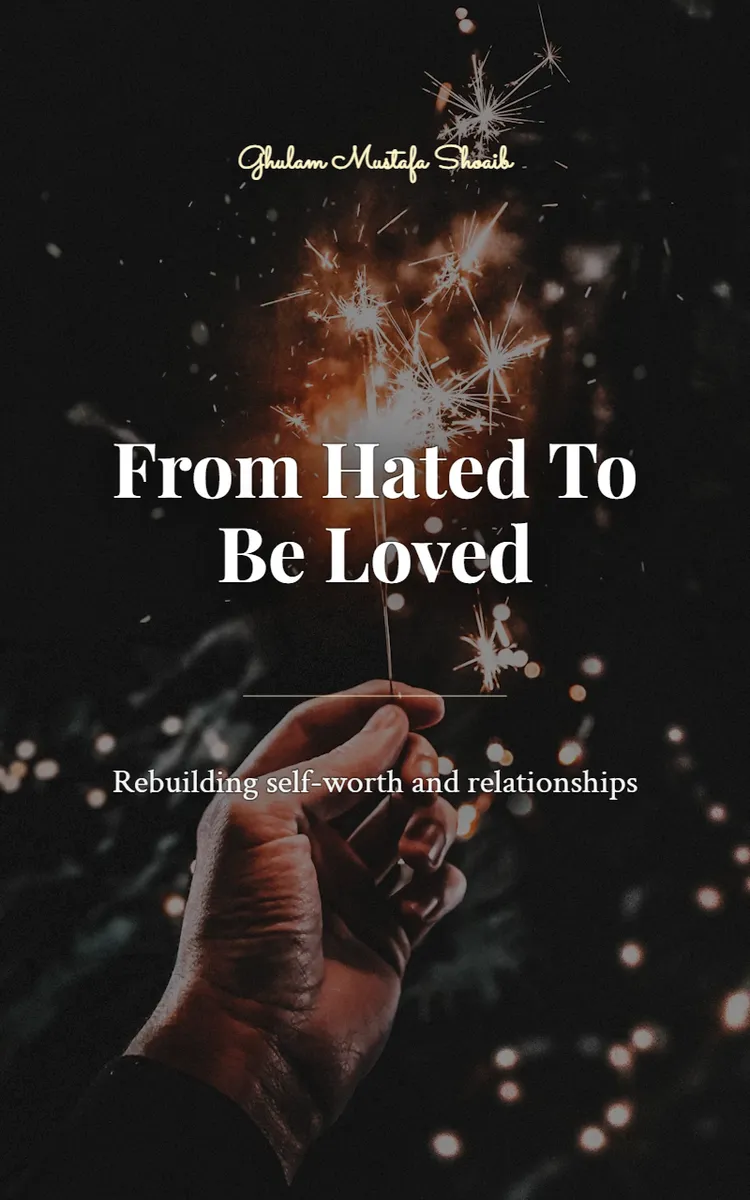
From Hated To Be Loved
Created with Inkfluence AI
Self-worth recovery and improving relationships
Table of Contents
- 1. Rebuilding Self-Worth From the Inside
- 2. Breaking the Approval Addiction Cycle
- 3. Building Boundaries Without Losing Love
- 4. Repairing Communication With the 3-Message Rule
- 5. Becoming Resilient Enough to Choose Yourself
Preview: Rebuilding Self-Worth From the Inside
A short excerpt from “Rebuilding Self-Worth From the Inside”. The full book contains 5 chapters and 7,063 words.
Picture This
Have you ever caught yourself scrolling through messages, not because you’re bored, but because you’re waiting to feel “enough” again? Like your worth is hiding in the silence-waiting for a reply, a reaction, a certain tone. You replay conversations the way you’d replay a song you can’t stop hearing, hunting for the exact moment you “messed up.” And then you start bargaining with yourself: If I just say it better, if I just prove it, if I just earn it… they’ll finally see me.
Talia, 31, a customer success manager, knows this feeling too well. She’ll walk into a team check-in with a solid smile, and ten minutes later she’s measuring her whole day by one sentence someone said. Not the big picture. Not the results she brought. Just the way her manager’s eyebrows rose when she paused. By the end of the afternoon, she’s rewriting her own identity in her head-deciding she’s careless, annoying, too much-based on one moment that wasn’t even about her as a person. She’s not “overthinking” for fun. She’s trying to regain safety.
Where does your self-worth go the moment someone else’s approval, tone, or timing changes?
The Mindset Shift
Old Belief: “If they like me, I’m valuable. If they don’t, I’m broken.”
New Reality: “Their reaction is information about the moment-not a verdict on my worth.”
That shift sounds simple, but it’s huge. Because when your self-worth depends on approval, your nervous system becomes a tiny lie detector that never turns off. You’ll feel it: the tight chest when someone’s distant, the spike of relief when they’re warm, the dread when they don’t respond. You start living like you’re on trial-always presenting evidence, always scanning for threats, always trying to prevent rejection by controlling outcomes.
Here’s the concrete part. The Inner Worth Reset isn’t about pretending people don’t matter. It’s about separating two things that get tangled: your value (stable) and their experience (variable). Talia learned this when she noticed a pattern: every time she felt “small,” it was usually after a feedback moment. Her brain translated feedback into “I’m not enough.” Her heart then tried to fix it fast-over-explaining, sending extra messages, softening her boundaries. The more she did that, the more she felt frantic, and the more likely her relationships felt shaky.
So instead of asking, “What’s wrong with me?” she started asking, “What part of my worth just got pulled into their response?” That one question changes the whole direction of your attention. Approval stops being the fuel and becomes what it actually is: a signal you can respond to without abandoning yourself.
And when you can do that, your relationships get different. Not perfect. Just steadier. You stop bargaining for love and start showing up in a way you can respect-even if the other person is having a tough day, is confused, or simply isn’t matching your energy.
Going Deeper
Self-worth gets damaged in a very specific way: you start believing that love is conditional, and you learn to “earn” it by adjusting yourself until you feel safe. Usually it begins quietly-small moments where your needs weren’t met, where your feelings were dismissed, where you learned that being “easy” or “pleasant” kept things from blowing up. Over time, your mind creates a rule: I survive by being chosen.
The Inner Worth Reset tackles the rule directly. It helps you recognize that approval is a moving target. It changes with mood, misunderstandings, stress, communication styles, and even timing. If your worth is tied to that target, you’ll feel like you’re always chasing. But worth that comes from inside isn’t “earned” by getting it right. It’s built by staying in contact with yourself-especially when the outside world isn’t giving you certainty.
Here are the signs this pattern is running your life:
1. You feel your worth rise and fall based on speed. If they reply quickly, you feel solid. If they don’t, you feel like you did something wrong-even when you didn’t.
2. You replay conversations like you’re on a courtroom show. You look for the “mistake” that explains why you might be unwanted, not the shared context that might explain everything else.
3. You overperform to prevent rejection. You explain more than you need to, agree when you want to disagree, or smooth things over so you don’t risk conflict.
4. You confuse feedback with rejection. One comment, one tone, one boundary gets translated into “I’m not lovable,” instead of “Here’s where we need clarity.”
En résumé: When approval controls your worth, you’ll try to control approval back-and that’s exhausting.
Talia noticed her pattern most clearly on days when she had to follow up with a customer. If they sounded annoyed, she’d send extra context and “just in case” messages. She thought she was being helpful. What was actually happening was deeper: she was trying to protect her identity....
About this book
"From Hated To Be Loved" is a self-help book by Ghulam Mustafa Shoaib with 5 chapters and approximately 7,063 words. Self-worth recovery and improving relationships.
This book was created using Inkfluence AI, an AI-powered book generation platform that helps authors write, design, and publish complete books. It was made with the AI Self-Help Book Writer.
Frequently Asked Questions
What is "From Hated To Be Loved" about?
Self-worth recovery and improving relationships
How many chapters are in "From Hated To Be Loved"?
The book contains 5 chapters and approximately 7,063 words. Topics covered include Rebuilding Self-Worth From the Inside, Breaking the Approval Addiction Cycle, Building Boundaries Without Losing Love, Repairing Communication With the 3-Message Rule, and more.
Who wrote "From Hated To Be Loved"?
This book was written by Ghulam Mustafa Shoaib and created using Inkfluence AI, an AI book generation platform that helps authors write, design, and publish books.
How can I create a similar self-help book?
You can create your own self-help book using Inkfluence AI. Describe your idea, choose your style, and the AI writes the full book for you. It's free to start.
Write your own self-help book with AI
Describe your idea and Inkfluence writes the whole thing. Free to start.
Start writingCreated with Inkfluence AI


