
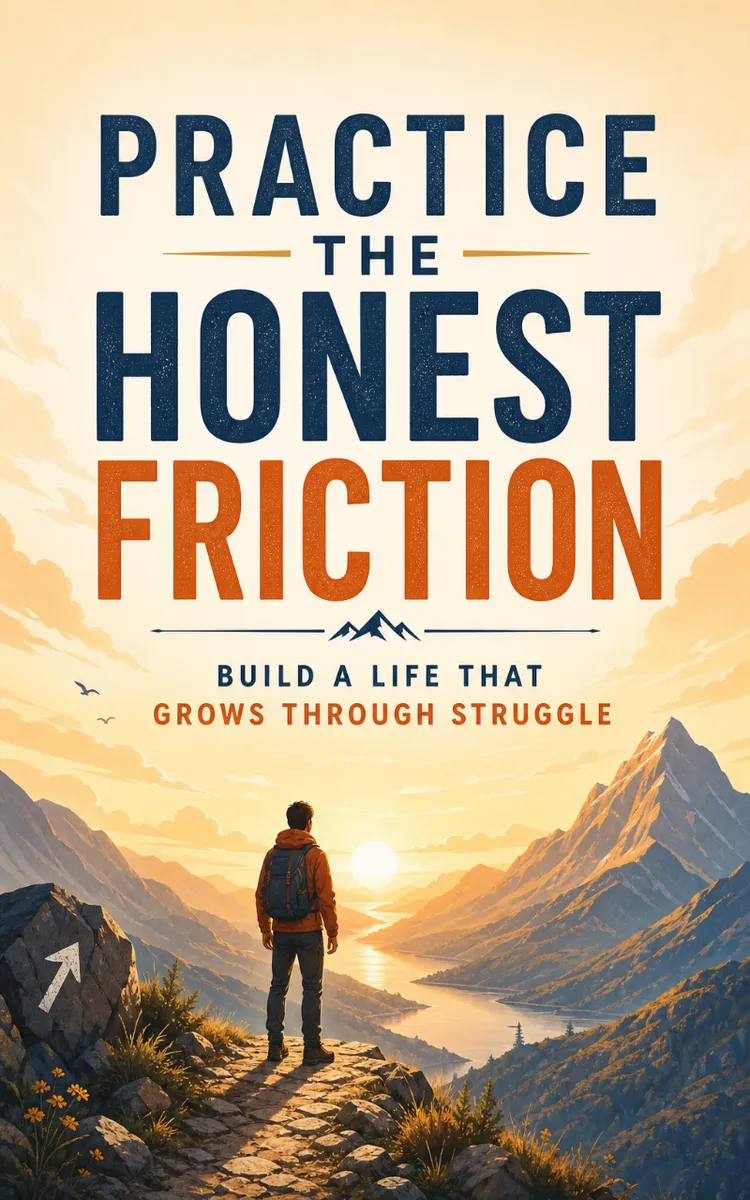
Practice the Honest Friction
Created with Inkfluence AI
🔀 Remixed from The Illusion of the Smooth Path
An empathetic self-help guide that replaces the myth of ease with practical ways to use friction as feedback, fuel, and direction.
Table of Contents
- 1. The Smooth-Life Lie
- 2. Friction as Feedback, Not Proof
- 3. Design Your Life Around Growth
- 4. Rethink Ease: Boundaries and Tradeoffs
- 5. The Skill of Staying in It
- 6. Your New Definition of Progress
Preview: The Smooth-Life Lie
A short excerpt from “The Smooth-Life Lie”. The full book contains 6 chapters and 4,522 words.
Chapter 1: The Smooth-Life Lie
There is a comforting idea many people carry without questioning it: a good life should feel easy. It sounds harmless. It can even sound caring, like you are just “doing life right” when things feel smooth, calm, and friction-free.
But here is the quiet cost of that belief: it teaches you to treat normal discomfort as a sign you are failing. And when you confuse discomfort with failure, you start making choices that protect your comfort instead of building your life.
The Lie, in Plain Words
The smooth-life lie usually looks like this:
Struggle means something is wrong.
If you were meant for it, it would feel effortless.
Growth should be painless.
You should feel good all the time to be doing well.
When this becomes your internal rule, you stop listening to the real message your experience is sending you.
How It Shapes Your Choices
At first, the smooth-life belief feels like common sense. You choose the “easier” path because it seems safer. You avoid hard conversations. You wait until motivation shows up. You leave relationships when they get real. You switch goals when effort gets inconvenient.
None of these choices are evil. The problem is what they teach you about yourself:
“If I have to work at it, I’m not good enough.”
“If it hurts, I should get away.”
“If I feel stuck, it means I picked wrong.”
Over time, your life becomes a set of exits you take whenever things stop feeling frictionless.
How It Shapes Your Relationships
Relationships are not supposed to be frictionless. They require negotiation, repair, and honesty. But the smooth-life lie makes you interpret natural tension as danger.
So you might do one of these:
Try to “stay peaceful” by bottling what you actually feel.
Assume conflict means incompatibility.
Expect your partner to guess your needs without you speaking them.
Call it “toxic” when it is simply hard and human.
Real intimacy does not require constant ease. It requires honest friction - the kind that turns into clarity, boundaries, and care.
How It Shapes Your Self-Worth
Here is the most damaging part: you start measuring your worth by how smoothly you are doing.
When life is difficult, you do not only feel challenged. You also feel judged by yourself. You may think:
“Other people can handle this. What’s wrong with me?”
“If I were healthier, it wouldn’t be this hard.”
“I must be doing something wrong.”
But discomfort is not proof of failure. It is often proof that you are learning, caring, changing, or stepping into something real.
Notice the Confusion: Discomfort vs. Failure
Let’s separate two ideas that often get blended together.
Discomfort is a signal that something matters and you are moving.
Failure is not a feeling. It is an outcome that tells you a change is needed.
Discomfort can happen even when you are doing everything right. Failure can happen even when you feel great. Feelings are not verdicts.
Takeaway and Action
Key Takeaway: A good life is not a smooth life. A good life is one where you can stay present with friction long enough to learn and choose wisely.
Action Item (5 minutes): Tonight, write down one moment this week when you felt discomfort and assumed it meant you were failing. Then answer two questions:
What exactly did I feel? (tight chest, dread, irritation, numbness, restlessness)
What might that feeling have been trying to tell me? (I need a boundary, I need practice, I need to speak up, I need a new plan)
If you can do this once, you can do it again. And each time you name the moment, you interrupt the smooth-life lie.Now we build a different reflex. One that does not run from friction, but uses it.
A New Question to Ask in Real Time
When you feel yourself reaching for “easy,” pause and ask:
“What part of my life is asking for honesty right now?”
This question shifts your attention from self-judgment to information. It turns discomfort into data you can work with.
Try it the next time you notice any of these:
You are tempted to ghost a hard conversation.
You want to quit something the moment it stops being effortless.
You feel ashamed when your progress is slower than you expected.
You resent others because they seem to “handle it” better.
What Honest Friction Looks Like
Honest friction is not chaos. It is the kind of resistance that comes when you are:
Learning a skill that requires repetition.
Setting a boundary for the first time.
Repairing trust instead of avoiding the truth.
Making a choice that costs you something, and you know it.
In these moments, the goal is not to feel better fast. The goal is to get clearer so you can choose the next right step.
Mini Practice: The 3-Step Friction Check
Use this whenever you feel the smooth-life urge to escape.
Name it: Say, “This is friction, not failure.”
...
About this book
"Practice the Honest Friction" is a self-help book by Anonymous with 6 chapters and approximately 4,522 words. An empathetic self-help guide that replaces the myth of ease with practical ways to use friction as feedback, fuel, and direction..
This book was created using Inkfluence AI, an AI-powered book generation platform that helps authors write, design, and publish complete books. It was made with the AI Self-Help Book Writer.
Frequently Asked Questions
What is "Practice the Honest Friction" about?
An empathetic self-help guide that replaces the myth of ease with practical ways to use friction as feedback, fuel, and direction.
How many chapters are in "Practice the Honest Friction"?
The book contains 6 chapters and approximately 4,522 words. Topics covered include The Smooth-Life Lie, Friction as Feedback, Not Proof, Design Your Life Around Growth, Rethink Ease: Boundaries and Tradeoffs, and more.
Who wrote "Practice the Honest Friction"?
This book was written by Anonymous and created using Inkfluence AI, an AI book generation platform that helps authors write, design, and publish books.
How can I create a similar self-help book?
You can create your own self-help book using Inkfluence AI. Describe your idea, choose your style, and the AI writes the full book for you. It's free to start.
Write your own self-help book with AI
Describe your idea and Inkfluence writes the whole thing. Free to start.
Start writingCreated with Inkfluence AI


