
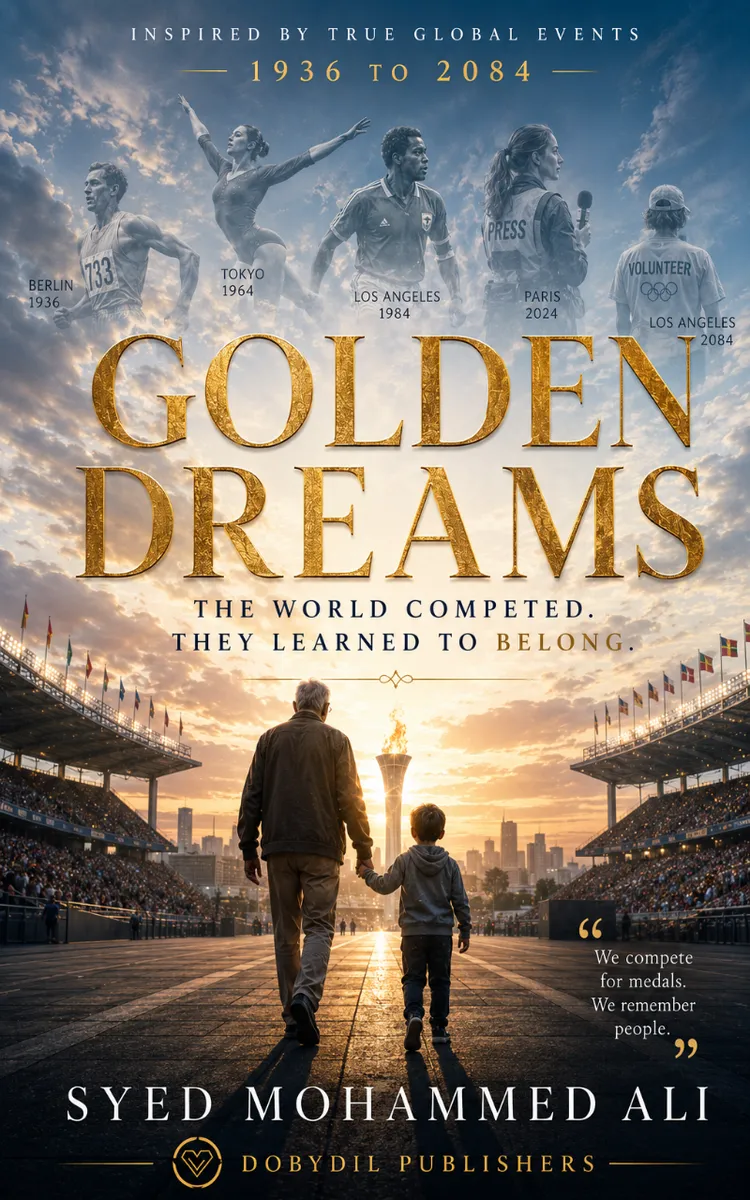
Golden Dreams
Created with Inkfluence AI
Multi-generational Olympic saga across global history and hidden connections
Table of Contents
- 1. Berlin 1936: The Stadium’s Politics
- 2. Elena’s Promise to Train
- 3. The Bombed Baton in London
- 4. 1948: Hope Finds the Track
- 5. A Handshake That Crosses Borders
- 6. Tokyo 1964: Rebirth Under Lights
- 7. Mexico 1968: Protest in the Stands
- 8. Munich 1972: The Day Everything Stops
- 9. Los Angeles 1984: A Comeback Laugh
- 10. Seoul 1988: Unity Through One Drill
- 11. Barcelona 1992: The World Changes Fast
- 12. Sydney 2000: Joy, Family, and Fear
- 13. Beijing 2008: Dreams Rewritten Overnight
- 14. London 2012: A Legacy With Teeth
- 15. Rio 2016: A Medal That Isn’t Metal
- 16. Tokyo 2021: The Virus Stops Applause
- 17. Paris 2024: The World Holds Its Breath
- 18. Los Angeles 2028: Homecoming on Wheels
- 19. The Diaries: A Voice From 1936
- 20. The Search: Hidden Connections Unfold
- 21. The Reunion: Families Recognize Each Other
- 22. The Torch: Passed With a Secret
- 23. One Humanity: Beyond Flags and Borders
- 24. Golden Dreams: The Truth Revealed
- 25. 2084 Opening Ceremony: We Remember
Preview: Berlin 1936: The Stadium’s Politics
A short excerpt from “Berlin 1936: The Stadium’s Politics”. The full book contains 25 chapters and 66,031 words.
The concrete steps of the Olympiastadion sweat under the August heat, and Jack Sullivan felt it through the soles of his shoes as he jogged the inner ring, counting each lap with the stubborn precision of a man who didn’t have the luxury of being watched for sport. Above him, loudspeakers hammered out German announcements that turned every footfall into a cue. Flags snapped from poles like impatient hands. Somewhere beyond the brick and steel, a marching band rehearsed a rhythm that never quite matched his breathing, and the mismatch made him angry in a way he couldn’t afford.
He’d been told - politely, through a translator with careful eyes - that his training times were “for efficiency.” He’d been told that his papers were “in order.” He’d been told a lot of things by men who never introduced themselves, men in stiff coats who stood too close to the track and too far from any human warmth. Jack kept his face calm, because calm was safer than hope in a place like this. He wanted only one thing: to qualify for the American trials, to earn a lane that didn’t belong to politics, to run his own race.
The first time he’d heard the word trials used aloud here, it sounded like a joke. The Games were the loudest thing in the world, and everything else had to whisper. But Jack had a number penciled on his training log, a time he’d chased since Iowa and Ohio and every borrowed track he could find between jobs, and it sat behind his ribs like a promise. If he could get through the surveillance and the staged “fitness checks,” if he could keep his legs honest, he could still make the team. He could still be more than a symbol pinned to a foreign map.
A whistle cut through the stadium noise, sharp as a thrown stone. Jack slowed, not because he wanted to, but because the men around the track moved first. One of them - tall, clean-shaven, eyes like polished buttons - lifted a hand and pointed toward the field. Another stepped closer, boots clicking in a quick, practiced cadence. Jack caught the faint smell of tobacco on the air, and beneath it the sour bite of sweat and hot rubber from the running cinders.
“American?” the second man asked in halting English, as if the language itself were a privilege.
Jack nodded once. “Runner.”
The tall one smiled without humor. “You run for your country. Yes. But today - training. Tomorrow - inspection.”
Jack felt the trap in the word tomorrow. Tomorrow meant the officials would decide what his body looked like on paper, what his face looked like in photographs, what his story would be when the newspapers came. He tightened his grip on his stopwatch. The metal was cool against his palm, a small truth he could hold.
“Where?” Jack asked.
The translator appeared, like he’d been waiting in the shadow of the stands. His accent was smooth, his tone rehearsed. “You will be measured. You will be filmed. You will stand where the officials indicate. You will not improvise.”
Jack wanted to laugh at the absurdity of it. Improvise. As if his stride was a dance move someone could choreograph. As if his legs weren’t his only honest possession. Instead, he nodded again, because nodding was a kind of camouflage.
They led him toward the stadium’s inner corridor, where the roar of the crowd became a distant ocean and the air turned cooler, threaded with damp stone. Checkpoints appeared the way weeds sprout: sudden, stubborn, impossible to argue with. Men in uniforms sat behind tables that looked like furniture from a government office - heavy wood, blotting paper, stacks of forms. A camera - black and sleek - rested on a tripod like a patient animal.
Jack’s lungs tightened. He could hear his own breath in the corridor, too loud, too visible. When he glanced at the field through a side opening, he saw the track stretched out under bright lights, empty for a moment, waiting to become a stage.
One official with a smooth face and thick glasses studied Jack’s stopwatch with a frown. “This is not necessary,” he said, as if Jack’s measurement were a threat.
“It helps me,” Jack replied.
The official tapped the paper in front of him. “You are not here to measure. You are here to represent.”
Represent. The word made Jack’s throat feel dry. He wanted to tell them that representation was what politicians did with microphones, not what runners did with muscles. He wanted to tell them that his father had taught him to race the wind, not the gaze. But the corridor had ears, and the camera had a lens.
A hand brushed Jack’s shoulder, quick and almost invisible. He jerked, ready to swing or shout, but the person only adjusted his collar like a valet and moved away before he could catch a name. Jack stared after the figure - an ordinary woman in a plain dress, hair pinned back, no insignia, no uniform. Her eyes met his for a fraction of a second and then lowered, as if she’d already decided not to be remembered.
The shift in her gaze wasn’t fear. It was urgency.
...
About this book
"Golden Dreams" is a fiction book by Syed Mohammed Ali with 25 chapters and approximately 66,031 words. Multi-generational Olympic saga across global history and hidden connections.
This book was created using Inkfluence AI, an AI-powered book generation platform that helps authors write, design, and publish complete books. It was made with the AI Novel Writer.
Frequently Asked Questions
What is "Golden Dreams" about?
Multi-generational Olympic saga across global history and hidden connections
How many chapters are in "Golden Dreams"?
The book contains 25 chapters and approximately 66,031 words. Topics covered include Berlin 1936: The Stadium’s Politics, Elena’s Promise to Train, The Bombed Baton in London, 1948: Hope Finds the Track, and more.
Who wrote "Golden Dreams"?
This book was written by Syed Mohammed Ali and created using Inkfluence AI, an AI book generation platform that helps authors write, design, and publish books.
How can I create a similar fiction book?
You can create your own fiction book using Inkfluence AI. Describe your idea, choose your style, and the AI writes the full book for you. It's free to start.
Write your own fiction book with AI
Describe your idea and Inkfluence writes the whole thing. Free to start.
Start writingCreated with Inkfluence AI


