
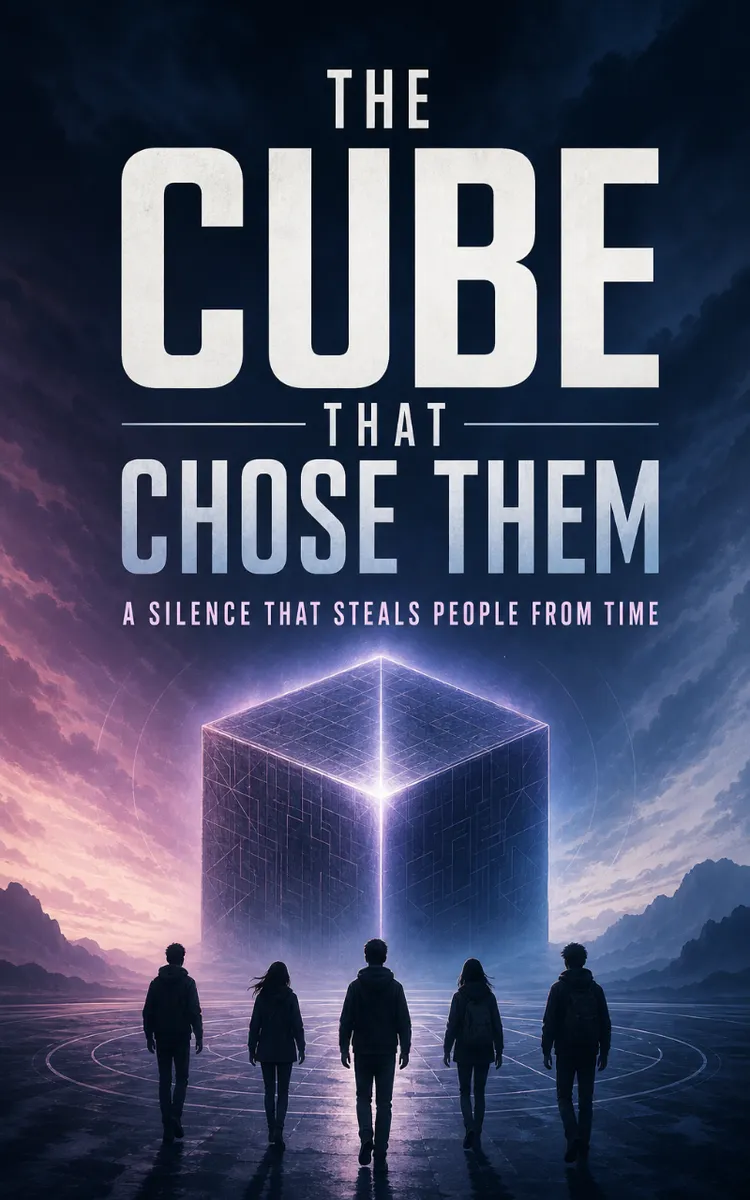
The Cube That Chose Them
Created with Inkfluence AI
A sentient cube abducts people and rewrites reality
Table of Contents
- 1. The One-Second Satellite Blindness
- 2. Nevada’s Cube Waits for Feet
- 3. The Whisper That Knows Your Name
- 4. Tokyo’s Empty Highway Vanishing
- 5. Mara’s First Whisper in Pennsylvania
- 6. The Drone Feed That Went Silent
- 7. Elias Vance Returns for Six Seconds
- 8. Black-Eyed Proof on Elias’s Skin
- 9. The Cube’s Geometry That Loops Memories
- 10. Reliving Regrets in a Roomless Void
- 11. The Rogue Physicists’ Hidden Quantum Cache
- 12. CONTAINMENT FAILURE in Cosmic Background
- 13. The Cube Phased Past Human Perception
- 14. When the Trigger Hits, People Vanish
- 15. Elias’s Sentence Becomes a Law
- 16. The Cube Takes the Wrong Volunteer
- 17. Mara Refuses the Whisper’s Bargain
- 18. A Government Seal That Can’t Hold
- 19. Paris Drones Find No Footprints
- 20. The Variable Map Midpoint Revelation
- 21. Mara Chooses to Stay Put
- 22. The Cube Erases a Whole Timeline
- 23. Mara’s Decision Becomes a Simulation
- 24. Rogue Physicists Lose Their Containment Model
- 25. The Desert Cube Reappears in Snow
- 26. Mara’s Whisper Turns Into a Threat
- 27. Only One Cube, Only One Earth
- 28. The Erasure Starts With Names
- 29. Mara Watches Her Town Forget Her
- 30. Lina’s Last Recorded Timeline
- 31. Following Mara’s Anchor Object
- 32. The Cube Ripples at Twenty Feet
- 33. Mara Makes the Small Choice
- 34. The Cube Pulses, Reality Holds
- 35. Earth Inside the Filter Tightens
- 36. After the Pulse, Names Return
- 37. The Cube Moves Away from Nevada
- 38. Mara’s Choice Rewrites Her Future
- 39. Lina Broadcasts the Whisper’s Origin
- 40. The Cube That Chose Them Pulse
- 41. The Last Pulse
Preview: The One-Second Satellite Blindness
A short excerpt from “The One-Second Satellite Blindness”. The full book contains 41 chapters and 121,977 words.
The first time the feed died, Lina Mercer blamed the usual things - packet loss, a routing hiccup, the cheap curse of a redundant system that wasn’t quite as redundant as it promised. Then it happened again, everywhere at once: every Earth-orbiting satellite on the Nevada wall of monitors blinked to black as if someone had reached in and pinched the signal between thumb and forefinger.
At 3:17 a.m., the room’s sound didn’t so much change as thin. The air-conditioning kept running, the cooling fans kept their steady whine, but the distant hum of data - charts snapping, telemetry scrolling - fell silent for exactly one second. Lina saw the timestamp tick to the edge of that void. Her cursor hung over a strip of spectral graphs that suddenly refused to exist. And then the darkness lifted with the same brutal immediacy, as if the universe had been holding its breath and decided to start again.
A new shape filled the Nevada camera overlays like an error message that had learned geometry. Not a flare. Not a lens artifact. Not a satellite body tumbling through exposure. The desert beneath the live feed - flat, heat-warped, anonymous - became the stage for something too clean to be real.
Fifty feet above the Nevada desert, hovering without cables, without drift, without any physics Lina could reconcile, a perfect cube presented itself to the world. No seams. No markings. No visible material. The thing didn’t reflect light the way an object should; it absorbed it. Where it hovered, illumination fell away as if the cube were a hole carved out of the cameras’ certainty. The edges were mathematically flawless - sharper than anything ever produced by human hands - and the more the system tried to compensate for it, the less it understood what it was seeing.
Lina’s throat tightened. She grabbed the nearest headset and spoke before she could think of a better question.
“Say again,” she told the operator channel. Her voice sounded too loud in the control room. “All satellite feeds - confirmed blackout at 3:17?”
A pause, then a technician’s voice, thin with disbelief. “Confirmed. Every single one. It’s uniform. No stagger. No propagation delay.”
Lina’s eyes flicked to the time sync panel, then to the atomic clock reference. Everything agreed. The world’s clocks were telling the same lie in perfect unison. Or the same truth. She couldn’t decide which was worse.
“Get me optical from the nearest ground stations,” Lina said. “And stop filtering the raw - no smoothing, no enhancement. I want the ugly pixels.”
Another voice joined, someone from outside the core team. “We’ve got ground-level drone feed too. Just… there’s something wrong with exposure. The cube’s like - like it’s eating the contrast.”
Lina leaned forward until the chair creaked. The cube’s silhouette sat on the screen like a wound in the image. She watched a line of sensor readouts attempt to label it - confidence values dropping, sensor models stuttering - until the system stopped offering explanations and simply displayed empty fields. The cube wasn’t out of range. It was out of category.
“Lina,” Elias Vance said.
The name struck her like a dropped tool. Elias wasn’t supposed to be in this room. Elias had been transferred out days ago after his last debrief, after his hands had stopped shaking long enough to sign the paperwork that made him someone else’s problem. But when she turned her head, he stood near the console as if he’d stepped in from a different segment of time.
He looked wrong in a way that made her stomach turn over. His eyes weren’t bleeding red or black from injury; they were bleeding black from inside. Veins of darkness threaded through the whites, and his face had the waxy pallor of someone who’d been underwater and returned to air too quickly. His mouth opened like he was trying to speak around pain.
“Elias,” Lina managed. “What - how are you - ”
He raised one trembling hand. The motion made his wrist look too heavy, as if gravity had been negotiated with and then reneged on. His gaze cut to the cube on the monitor.
“It doesn’t trap your body,” Elias said, each word scraping out of him. “It traps your life.”
Lina’s mind reached for the old language of accidents and hallucinations and shock. None of it fit the black bleeding in his eyes. None of it fit the way the monitors still showed the cube hovering like a judgment that didn’t need witnesses.
The room’s lights didn’t flicker. The servers didn’t crash. The data kept flowing - except for the one-second blackout that had already happened once, cleanly, globally. Lina stared at the timestamp and felt something colder than fear take hold: the certainty that this wasn’t a malfunction. This was an event with intent.
“We can’t - ” the technician began, then stopped when Lina lifted her hand sharply.
Elias’s shoulders jerked as if he’d been yanked by an invisible cord. His skin tightened over his cheekbones. He tried to speak again, but the sound that came out wasn’t words....
About this book
"The Cube That Chose Them" is a fiction book by Nichole Haines with 41 chapters and approximately 121,977 words. A sentient cube abducts people and rewrites reality.
This book was created using Inkfluence AI, an AI-powered book generation platform that helps authors write, design, and publish complete books. It was made with the AI Novel Writer.
Frequently Asked Questions
What is "The Cube That Chose Them" about?
A sentient cube abducts people and rewrites reality
How many chapters are in "The Cube That Chose Them"?
The book contains 41 chapters and approximately 121,977 words. Topics covered include The One-Second Satellite Blindness, Nevada’s Cube Waits for Feet, The Whisper That Knows Your Name, Tokyo’s Empty Highway Vanishing, and more.
Who wrote "The Cube That Chose Them"?
This book was written by Nichole Haines and created using Inkfluence AI, an AI book generation platform that helps authors write, design, and publish books.
How can I create a similar fiction book?
You can create your own fiction book using Inkfluence AI. Describe your idea, choose your style, and the AI writes the full book for you. It's free to start.
Write your own fiction book with AI
Describe your idea and Inkfluence writes the whole thing. Free to start.
Start writingCreated with Inkfluence AI


