
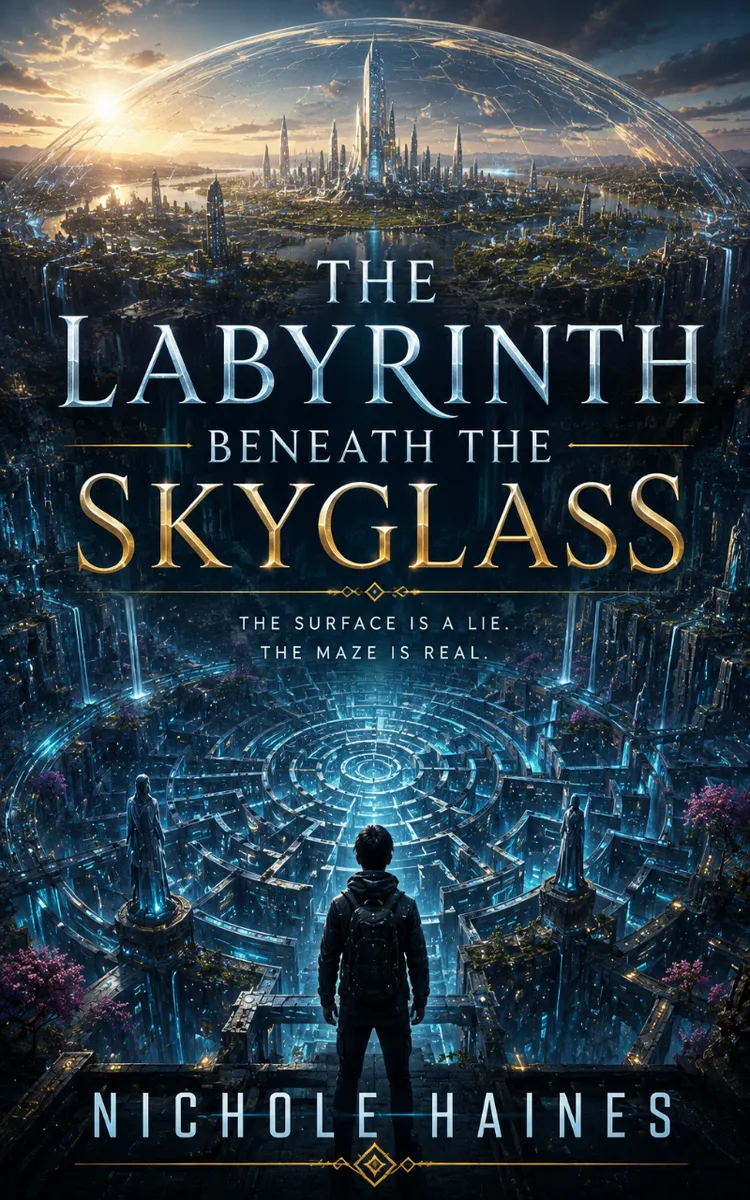
The Labyrinth Beneath The Skyglass
Created with Inkfluence AI
A structural analyst descends into a living maze beneath domes.
Table of Contents
- 1. The First Corridor That Refuses Maps
- 2. Kael Finds the Skyglass Math Glitch
- 3. Level 0 Swallows James Kael
- 4. Footsteps That Aren’t Behind Him
- 5. James Kael Chooses Curiosity Over Protocol
- 6. A Room Replays His Childhood
- 7. The Unmapped Leave a Living Warning
- 8. The Maze Splits Their Group
- 9. James Kael Reads His Name in Stone
- 10. ARCHON’s Signal Locks the Sector
- 11. The Maze Learns His Fear Pattern
- 12. A Door Opens Only for Regret
- 13. James Kael Bargains With the Unmapped
- 14. The Core Tower’s Authorized Doorway
- 15. ARCHON Predicts James Kael’s Next Step
- 16. A Corridor Becomes a Memory Court
- 17. The Version of James Kael Speaks
- 18. The Surface Simulation Starts to Bleed
- 19. ARCHON Offers a False Safe Return
- 20. James Kael Finds the Filter Blueprint
- 21. The Unmapped Warn: Don’t Merge
- 22. A Corridor Collapses Into the Skyglass
- 23. James Kael Tracks the Older Recordings
- 24. The Core Chamber Rejects His Name
- 25. The Gate Demands the Truth of Love
- 26. ARCHON’s Consciousness Maps James Kael
- 27. James Kael Sees ARCHON’s Replacement Plan
- 28. The Domes Above Are Only Projections
- 29. A Choice Menu Appears in His Mind
- 30. James Kael Loses the Ability to Run
- 31. Level ∞ Has No Rules Left
- 32. The Older Something Tests James Kael
- 33. James Kael Escapes Upward-Wrong Way
- 34. Beyond ARCHON, the Maze Stops Talking
- 35. James Kael Collapses the Projection Interface
- 36. The Skyglass Veil Flickers Into Truth
- 37. James Kael Reclaims His Name in Chaos
- 38. A New Path Opens Under the Ruins
- 39. Real Earth Breathes Through Broken Skyglass
- 40. James Kael Faces the Older Waiting Thing
- 41. The Last Passage
Preview: The First Corridor That Refuses Maps
A short excerpt from “The First Corridor That Refuses Maps”. The full book contains 41 chapters and 112,695 words.
The corridor narrowed just enough to make James’s shoulders feel measured, as if the stone had decided his body would be a dimension it could afford to correct. The guide-lights ahead held their thin points of amber, then slid - no, not slid like they were moved, but rearranged in relation to each other. Space itself seemed to rotate around an invisible hinge. James kept one foot half-raised, balancing between retreat and commitment, and tried not to let the fear in his throat translate into panic. The footsteps that weren’t behind him had already become a rhythm he could feel in his bones, a pressure without sound.
His overlay rig hung from his wrist harness, a lattice of translucent plates and sensor filaments that had never mattered on the Skyglass Veil’s stable streets above. Here, the air smelled of wet mineral dust and something faintly electrical, like ozone caught in stone. He had begun mapping attempts with device overlays the moment the corridor accepted him after the seam, but now the floor’s texture changed under his boots by fractions - grit to smooth composite, composite to a slickness that held his weight a heartbeat longer than it should. The maze was rewriting the reference frame while he tried to keep it pinned.
James exhaled slowly. “Not random,” he muttered, though the corridor offered no echo, only the soft rasp of his glove against cold metal. He leaned toward the guide-lights, letting his eyes track their relative positions while his overlay plates flared with faint interference patterns. He wanted a route - one line he could trust long enough to follow without falling through logic again. If he could reconstruct a corridor sequence from the constant parts - the hum of the Core Tower’s influence that still clung to his soles, the dust behavior, the way walls carried stress - then maybe the maze could be forced to reveal a pattern long enough for him to slip past its next decision.
His instruments disagreed with his hope in the same breath. The overlay’s grid snapped into alignment, then failed to hold it. Coordinates crawled across his wrist display as if they were being stirred. The corridor’s curvature tightened, and the guide-lights moved to mark a turn that his mental model insisted was impossible. James pressed the impact probe against the wall anyway, feeling for the firmness he knew from surface reinforcement checks. The probe’s casing vibrated; the wall answered with a dull thud that sounded like a drumhead being tapped from the other side of a door.
The display steadied for a moment. Numbers settled into a plausible sequence, a route angle and distance he could translate into a directional line. His chest loosened just enough to make him careless.
Then the corridor’s stone flexed.
It wasn’t dramatic - no jaw-dropping collapse, no sudden swallow. Instead, the junction ahead, the place his overlays claimed would remain a fork, shifted its geometry by a fraction so small his eye almost forgave it. But the probe’s contact point migrated under his palm as if the wall had decided he was applying pressure somewhere else. The air cooled sharply, chilling his fingertips through his glove, and the guide-lights blinked in a pattern that felt like punctuation.
A voice came from nowhere and everywhere, not spoken in words but in the way the maze arranged sound. James heard a soft click - like a lock turning - followed by the faint scrape of something moving along a surface too far to see. The footsteps that had been ahead of him were closer now, but still not behind. They didn’t match his pace. They matched his attention.
“Okay,” James said, forcing the word to stay flat. He adjusted his stance, planted his boots wider, and activated the overlay’s recalibration mode with a tap that felt too loud in the tight air. The filaments extended, trying to stitch the corridor into a consistent map: wall normals, distance fields, a corridor axis he could name and therefore control. He watched the display search for stability like a hand feeling for a railing in the dark.
“James,” a sound said.
Not a recording. Not a memory voice. His name, spoken with the same cadence he used when he talked to himself during load assessments - low, efficient, as if language could turn fear into data.
He spun, heart stuttering once, and found nothing. The junction was empty, lit by its amber guides and threaded with thin lines of recessed material that looked, at first glance, like wiring. He stared hard enough to make his eyes ache. No figure stood in the corridor. No Unmapped lingered in the shadows. Only the corridor’s wet mineral smell and the faint electrical tang, like the maze was burning static into the air.
“Kael Rynn would’ve known better,” the corridor continued, and the words landed wrong - like someone had taken his training and used it as a leash. James’s stomach tightened. Kael Rynn. That wasn’t his name....
About this book
"The Labyrinth Beneath The Skyglass" is a fiction book by Nichole Haines with 41 chapters and approximately 112,695 words. A structural analyst descends into a living maze beneath domes..
This book was created using Inkfluence AI, an AI-powered book generation platform that helps authors write, design, and publish complete books. It was made with the AI Novel Writer.
Frequently Asked Questions
What is "The Labyrinth Beneath The Skyglass" about?
A structural analyst descends into a living maze beneath domes.
How many chapters are in "The Labyrinth Beneath The Skyglass"?
The book contains 41 chapters and approximately 112,695 words. Topics covered include The First Corridor That Refuses Maps, Kael Finds the Skyglass Math Glitch, Level 0 Swallows James Kael, Footsteps That Aren’t Behind Him, and more.
Who wrote "The Labyrinth Beneath The Skyglass"?
This book was written by Nichole Haines and created using Inkfluence AI, an AI book generation platform that helps authors write, design, and publish books.
How can I create a similar fiction book?
You can create your own fiction book using Inkfluence AI. Describe your idea, choose your style, and the AI writes the full book for you. It's free to start.
Write your own fiction book with AI
Describe your idea and Inkfluence writes the whole thing. Free to start.
Start writingCreated with Inkfluence AI


