
Read the first chapter
The whole of chapter one, free. About 6 min. Turn the pages with the arrows, your keyboard, or a swipe.
Chapter 1
Days 1-2: Set Your Sleep Target
Have you ever noticed how sleep advice always sounds like it’s talking to someone else-someone with the same wake time every day, the same schedule, the same life? Your body doesn’t care about “someday.” It runs on patterns. So the first real question isn’t “How do I sleep better?” It’s simpler and tougher: what does “better” look like for you, with your actual days and your actual wake time?
Talia, 34, is a nurse with rotating shifts, and she learned this the hard way. On days off, she’d sleep in until noon like it was a reward, then wonder why the next shift felt like dragging herself through wet sand. She wasn’t lazy-she was just treating her sleep like a mood, not a plan. The result? Her sleep schedule kept moving targets, and her brain kept re-learning the rules every few days.
So we’re starting with the one thing that makes everything else easier: a realistic eight-hour goal that fits your life. Not a fantasy. Not “I’ll be asleep by 9 p.m. every night” unless that’s already true. We’re building your 8-Hour North Star, which is just a clear destination you can aim for-so you always know what you’re doing and why.
Day 1: Choose your eight-hour target (your 8-Hour North Star)
Your eight-hour target is not “eight hours in bed.” It’s eight hours of sleep-what your body actually gets. That distinction matters, because lying in bed awake for an hour still counts as time in bed, not time slept. If you’re like most people, you probably already have a rough idea of how long you’re getting. You don’t need perfect data. You need a target that won’t set you up to fail.
Start by picking an “ideal wake time” you can realistically protect. Not “sometime in the morning.” A time. For Talia, it was the time she could anchor on her busiest days, even with shift changes. For you, it might be the time you absolutely have to be up for work, school, caregiving, or whatever keeps your day moving. This wake time is your anchor because it keeps your body’s clock from drifting like a boat without a rope.
Now work backward. If your goal is eight hours of sleep, your target bedtime depends on your ideal wake time and how long it usually takes you to fall asleep. If you’re not sure how long it takes, don’t overthink it-use a simple estimate. Most people fall asleep somewhere around 10-30 minutes after lights out. If you’ve got a history of tossing and turning, you can start with 30-45 minutes. The point is to be honest enough to be useful.
Here’s the simple way to set your 8-Hour North Star:
1) Choose your ideal wake time (the time you’ll aim to wake up). 2) Decide what bedtime you need to make eight hours of sleep possible. 3) Add a buffer for falling asleep, because your body isn’t a switch.
If you want to keep it extra practical, aim for a bedtime that gives you the chance at eight hours, then refine over the next couple days. Sleep doesn’t reward perfection. It rewards consistency. And consistency starts with choosing a destination you can reach.
Talia did this by stopping the “sleep whenever” thing on her days off. She didn’t force every detail-she kept her wake time within a reasonable window and focused on making nights consistent enough that her body could stop panicking about what time it was supposed to be. Rotating shifts can’t be erased, but your internal clock can be coached. Your eight-hour target is the first coaching move.
Before you lock it in, ask yourself one quick question: if your schedule went exactly as usual-work, errands, the usual chaos-could you still hit your target on most days? If the answer is “no way,” adjust the plan. The goal isn’t to prove you can suffer. The goal is to build a pattern you can actually repeat.
Day 2: Define your ideal wake time and map your baseline
Yesterday you picked your ideal wake time and built a bedtime around it. Today you’re going to measure what’s currently happening, because you can’t steer what you won’t look at. Sleep tracking doesn’t have to be fancy. If you want a notebook-and-pen approach, that’s totally fine. If you prefer your phone notes, that works too. The only requirement is that you write down your wake time and your best guess for how much sleep you got.
For the baseline, focus on the simplest numbers you can gather without turning sleep into a part-time job:
• your usual wake time (on workdays and days off) - the time you got into bed with the lights out intention - the time you actually fell asleep (best estimate) - the time you woke up for real - any obvious “sleep sabotage” (late caffeine, staying up scrolling, naps that stretched too long)
You’re not trying to catch every detail. You’re trying to spot the pattern that’s already running your life. Most people find one of two things: either they’re going to bed late and hoping sleep will magically happen, or they’re going to bed “fine” but their wake time is all over the place, which makes it hard to fall asleep at a consistent time.
Talia noticed her baseline fast. Even when she tried to go to bed at a decent hour, her wake times on days off were later than on shift days. That shift in timing made her next night feel like it was happening “early,” even when it wasn’t early. Her body was basically saying, “We’re not done with yesterday’s schedule yet.” The fix wasn’t just bedtime. It was wake time stability-enough stability to let her brain stop resetting the clock every few days.
So today’s work is twofold: measure your baseline and decide how strict you can be with your wake time. “Strict” doesn’t mean rigid. It means you pick a realistic window.
For example, if your ideal wake time is 7:00 a.m., you might allow up to 60-90 minutes of drift on days off. If you can only manage 30 minutes, great. If you can only manage two hours, that’s still useful information. The baseline tells you what you can change without blowing up your week.
If you’re rotating shifts like Talia, your baseline might look jagged. That’s okay. The goal isn’t to make every day identical. The goal is to keep your eight-hour target connected to an anchor wake time as often as possible. Even if you can’t hold it perfectly, you can reduce the drift. That reduction is what starts to build momentum.
Here’s a practical way to map your baseline tonight and tomorrow. Keep it simple:
• Write down the time you plan to be “done for the night” (lights out intention), even if you don’t actually fall asleep immediately. - Write down the time you wake up for real. - In the morning, estimate how long you slept-roughly, not perfectly. - Note any naps and when they happened.
If you’re thinking, “But what if I don’t know how long I slept?”-that’s why you estimate. Your goal is direction, not a lab report. Over the next few days, your estimates will get better, and your plan will become sharper.
Now lock in your Day 2 decision: what wake time window will you aim for? This is the part that makes the whole challenge real. When you know your target wake time (and your acceptable range), you stop negotiating with yourself every morning. You also stop accidentally training your body to expect a new schedule every day.
For Talia, the small but powerful move was treating her ideal wake time like an anchor instead of a suggestion. Even when her shift changed, she kept her wake time closer than she used to. She didn’t try to “win” sleep by brute force. She worked with her body’s clock instead of against it.
By the end of Day 2, you should have two things clear: your 8-Hour North Star (your eight-hour target built around your ideal wake time) and a baseline picture of what you’re currently doing. That’s enough to start making changes that actually stick.
And tomorrow? We’ll get into how to aim for your target at night-without turning bedtime into a stressful guessing game.
End of chapter one. 4 more chapters in the full book.
Swipe or use the arrows to turn the page
What's inside: 5 chapters
- 1. Days 1-2: Set Your Sleep Target
- 2. Days 3-4: Build a Wind-Down Routine
- 3. Days 5-6: Master Light and Timing
- 4. Day 7: Fix Common Sleep Disruptors
- 5. Days 8-10: Lock In Eight Hours
About this book
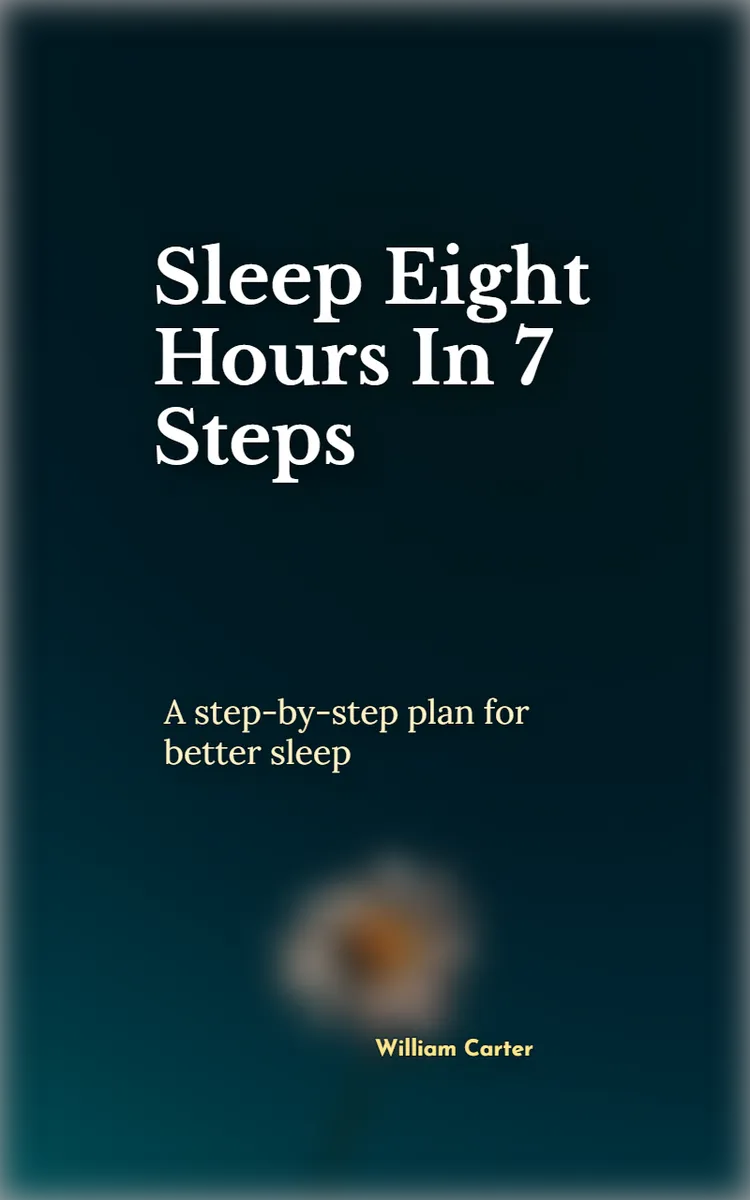
"Sleep Eight Hours In 7 Steps" is a day challenge book by William Carter with 5 chapters and approximately 7,794 words. A seven-step program to achieve eight hours of sleep.
This book was created using Inkfluence AI, an AI-powered book generation platform that helps authors write, design, and publish complete books.
Frequently Asked Questions
What is "Sleep Eight Hours In 7 Steps" about?
A seven-step program to achieve eight hours of sleep
How many chapters are in "Sleep Eight Hours In 7 Steps"?
The book contains 5 chapters and approximately 7,794 words. Topics covered include Days 1-2: Set Your Sleep Target, Days 3-4: Build a Wind-Down Routine, Days 5-6: Master Light and Timing, Day 7: Fix Common Sleep Disruptors, and more.
Who wrote "Sleep Eight Hours In 7 Steps"?
This book was written by William Carter and created using Inkfluence AI, an AI book generation platform that helps authors write, design, and publish books.
Write your own day challenge book with AI
Describe your idea and Inkfluence writes the whole thing. Free to start.
Start writingCreated with Inkfluence AI


