
Read the first chapter
The whole of chapter one, free. About 8 min. Turn the pages with the arrows, your keyboard, or a swipe.
Chapter 1
The Mediterranean Plate Test
The Opening
On a weekday afternoon in a busy hospital, Nadia, 34, a dietitian, watches a tray pass through the ward like a quiet checkpoint. One patient receives a plate designed to be “heart-healthy,” another gets something closer to what they’re used to eating at home. The surprising part isn’t what the hospital forbids-it’s how often the meals quietly end up resembling food patterns from places that, on paper, don’t always look “modern” in the same way.
That moment-when you notice that “healthy” can look like a recognizable style of eating rather than a list of rules-sits at the center of the Mediterranean Plate Test. Instead of starting with vitamins or nutrients, this framework starts with a simple question: when people eat in a certain region, what actually fills the space on the plate, day after day?
To compare countries and find the healthiest patterns, we need a way to look past headlines about single foods. We also need a way to see how culture, cooking methods, and everyday meals add up over time. The Mediterranean Plate Test is built for exactly that kind of looking, using the most basic evidence we have-what people reliably serve themselves.
If the healthiest diet isn’t a mystery of “secret ingredients,” could it be something as ordinary as the way a plate is arranged?
The Deep Dive
The Mediterranean Plate Test: a way of reading a meal
The Mediterranean Plate Test is a lens, not a diet book. It treats a typical day of eating like a document written in food: grains and vegetables occupy the bulk of the page, proteins show up in particular roles, and fats are present but usually in the form of olive oil rather than butter or heavy cream. The test doesn’t ask whether a meal is “perfect.” It asks whether the overall pattern keeps returning to a familiar structure.
That structure is easier to spot than you might think once you stop thinking in terms of nutrients and start thinking in terms of “what takes up room.” In many Mediterranean-style eating patterns, vegetables and legumes are frequent companions, fruit appears as a regular sweetness, and whole grains are more common than refined flour. Fish tends to show up more often than red meat, and when red meat appears, it’s usually not the centerpiece of every plate. Even desserts, when they appear, tend to be smaller, less frequent, and often tied to fruit or simple preparations rather than a daily ritual of sugary snacks.
There’s a reason this plate-based view feels different from the usual nutrition conversation. Nutrients are measurable, but plates are lived. A nutrient can be supplemented or isolated. A plate tells you what households buy, what cooks know how to prepare, and what people can realistically repeat. In other words, the plate doesn’t just describe chemistry-it describes habits.
A historical coastline of eating habits
When people say “Mediterranean diet,” they often picture a single, timeless recipe. In reality, it’s a family of regional patterns shaped by geography. Coastal areas offered fish and seafood opportunities; inland places leaned harder on legumes, grains, and vegetables that could be grown and stored. The Mediterranean climate also supports fruit and many vegetables, which helps explain why fruit isn’t just a special occasion in many of these cuisines.
There’s also the historical matter of what was expensive versus what was everyday. Olive oil-made from olives-became a core fat in many Mediterranean areas. That doesn’t mean butter or animal fats didn’t exist, but it does mean cooking styles evolved around the ingredients that were accessible and useful. Over time, those choices became normal: the default fat, the default seasoning, the default way to make vegetables taste good without relying on heavy sauces or deep frying.
This matters for the plate test because it explains why the pattern is sticky. If a diet is built around ingredients that are available, affordable, and culturally familiar, it’s easier for people to keep the overall structure intact-even when life gets busy. The plate test is essentially looking for that stickiness in the arrangement of food.
What science actually does with plates
To connect a plate pattern to health outcomes, researchers don’t just rely on guesswork. They use methods designed for long-term eating behavior, because what matters most often isn’t a single meal-it’s the repeated rhythm of meals.
One of the most influential ways science has tackled this question is through randomized controlled trials and large observational studies, where researchers compare patterns of eating over time and track outcomes like cardiovascular disease. Trials can test whether a Mediterranean-style pattern improves markers or reduces events. Observational work can compare people who naturally eat more in line with that pattern versus those who don’t.
But even when studies point toward benefits, a plate test offers a different kind of clarity. It gives you a way to interpret what “Mediterranean-style” means in plain language. Instead of treating it as a vague label, the Mediterranean Plate Test asks you to look for recurring components: the heft of plant foods, the role of legumes, the presence of olive oil, and the frequency of fish relative to red meat.
A single-sentence fact helps anchor the idea: olive oil is a fat, but it behaves differently in typical diets because it replaces other fats-especially when it’s used as the main cooking and dressing fat rather than one option among many. That replacement effect is hard to see if you’re only thinking about nutrients in isolation. It’s much easier to see when you’re scanning plates and noticing what’s doing the work.
Comparing countries without getting lost in the weeds
The real challenge in comparing countries’ diets is that “healthy” can be defined in many ways, and people often get trapped by extremes. Some places eat lots of a single food-say, more fish-while other parts of the pattern may be less supportive. Another country might have low sugar intake but rely heavily on refined grains. If you focus only on one number, you can miss the bigger picture.
The plate test helps because it treats diet quality as a pattern of balance. It’s not about one perfect meal; it’s about whether the plate keeps returning to a structure that supports health. If you compare countries by what fills their plates-how much of the plate is plant-based, what kind of fats are used, how protein shows up, and how often sweets or refined grains appear-you end up with a more honest comparison. You’re less likely to confuse “one good ingredient” with “an overall healthy pattern.”
That’s also why the Mediterranean Plate Test stays grounded in everyday reality. People eat what fits into their kitchens. They keep eating what they can afford and prepare. When a plate pattern shows up repeatedly across meals, it’s not just nutrition-it’s logistics.
What You Did Not Expect
The surprise is that the Mediterranean Plate Test can feel almost too simple: it’s mostly about which foods take up the most space on the plate, not about banning or obsessing over one ingredient. That runs counter to the way many nutrition stories are told, where the spotlight goes to one villain or one miracle food.
This matters because it changes how you interpret “healthiest.” If the strongest signal is the repeated arrangement of meals-plants most of the time, olive oil as the main fat, legumes and fish showing up with regularity-then a country’s diet quality can’t be judged by a single headline. It’s the pattern that does the work, not a single swap.
In practice, that reframing also explains why people can sometimes eat “healthy foods” in a way that still doesn’t resemble a Mediterranean pattern. A plate can be full of good ingredients and yet still be structured in a way that doesn’t match the rhythm associated with better outcomes. The Mediterranean Plate Test makes that visible.
The Human Story
Nadia’s hospital job is the kind of work where you see diets at their most practical. Patients aren’t reading nutrition labels for fun; they’re trying to eat in a place where meals are timed, portioned, and often designed for medical goals. Nadia deals with the tension between what’s recommended and what’s realistic. Some patients can accept changes easily; others push back-not because they’re “noncompliant,” but because their preferences, family traditions, and budget realities make certain foods feel like the only options that truly belong on a plate.
When Nadia talks with patients and staff, she notices something that doesn’t show up in a lab report. The meals that feel most satisfying-those that people finish, ask for again, or eat without bargaining-often resemble the same structural idea: vegetables and legumes present, whole grains more common than refined starches, olive oil used as the default fat, and protein not always arriving as the biggest chunk. Even when the food isn’t called “Mediterranean,” the arrangement often echoes that logic.
One day, a patient asks why their meal doesn’t match what they’re used to at home. The conversation doesn’t turn into a lecture about cholesterol or calories. Nadia focuses on what the plate is doing: what’s taking up space, what’s being used for flavor, and how often certain categories appear across the week. The point isn’t to replicate one country perfectly. It’s to understand which parts of the pattern seem to make meals sustainable and satisfying.
That human detail connects back to the Mediterranean Plate Test because the test is designed for lived comparison. It doesn’t treat eating like an abstract set of numbers. It treats eating like a routine you can recognize-one plate at a time.
What This Tells Us
When you start comparing countries by how their plates are filled, food stops being a list of isolated ingredients and becomes a map of culture. Societies teach people what “a meal” is supposed to look like, and health outcomes often track those repeated lessons-not because people are following a nutrition plan, but because their daily habits are doing the heavy lifting.
The Mediterranean Plate Test is a reminder that the most important patterns in health can be surprisingly visible. They show up in the everyday decisions that don’t feel like decisions at all: how vegetables are served, what fat is used without thinking, and whether fish or legumes are treated as normal options rather than special treats.
And that leads to a question worth carrying into the next chapter: if plates reflect culture so clearly, what happens when two countries share the same ingredients but arrange them differently-and how much of “healthiest” is really about the structure, not the shopping list?
End of chapter one. 7 more chapters in the full book.
Swipe or use the arrows to turn the page


What's inside: 8 chapters
- 1. The Mediterranean Plate Test
- 2. Why Fiber Wins Every Time
- 3. The Salt, Sugar, and Smoke Budget
- 4. The Omega-3 Shortcut Map
- 5. Fermentation’s Quiet Health Advantage
- 6. The Ultra-Processed Food Trap
- 7. Food Culture as a Health System
- 8. The Healthiest Pattern, Not the Healthiest Country
About this book
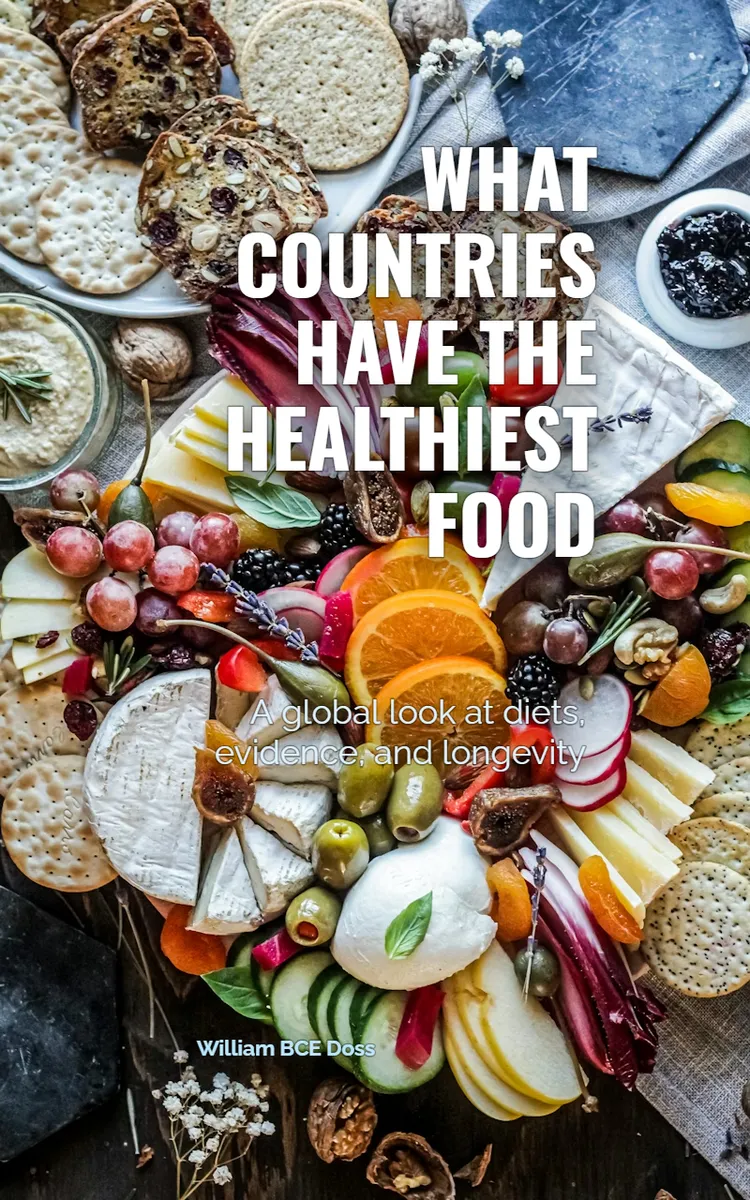
"What Countries Have The Healthiest Food" is a curiosity book by William BCE Doss with 8 chapters and approximately 12,982 words. Comparing countries' diets to identify healthiest eating patterns.
This book was created using Inkfluence AI, an AI-powered book generation platform that helps authors write, design, and publish complete books.
Frequently Asked Questions
What is "What Countries Have The Healthiest Food" about?
Comparing countries' diets to identify healthiest eating patterns
How many chapters are in "What Countries Have The Healthiest Food"?
The book contains 8 chapters and approximately 12,982 words. Topics covered include The Mediterranean Plate Test, Why Fiber Wins Every Time, The Salt, Sugar, and Smoke Budget, The Omega-3 Shortcut Map, and more.
Who wrote "What Countries Have The Healthiest Food"?
This book was written by William BCE Doss and created using Inkfluence AI, an AI book generation platform that helps authors write, design, and publish books.
Write your own curiosity book with AI
Describe your idea and Inkfluence writes the whole thing. Free to start.
Start writingCreated with Inkfluence AI


